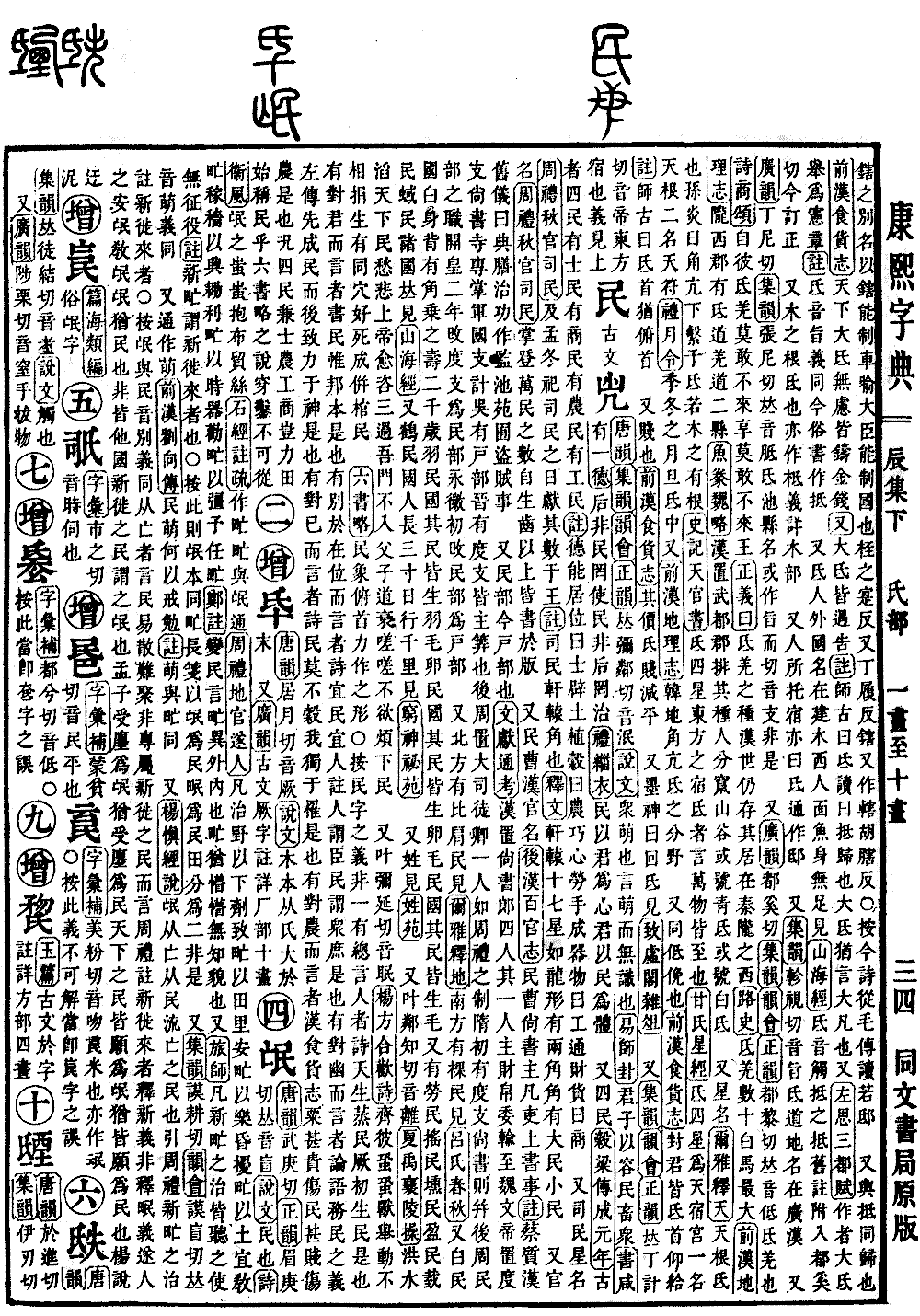
Chen Collection, Lower Volume
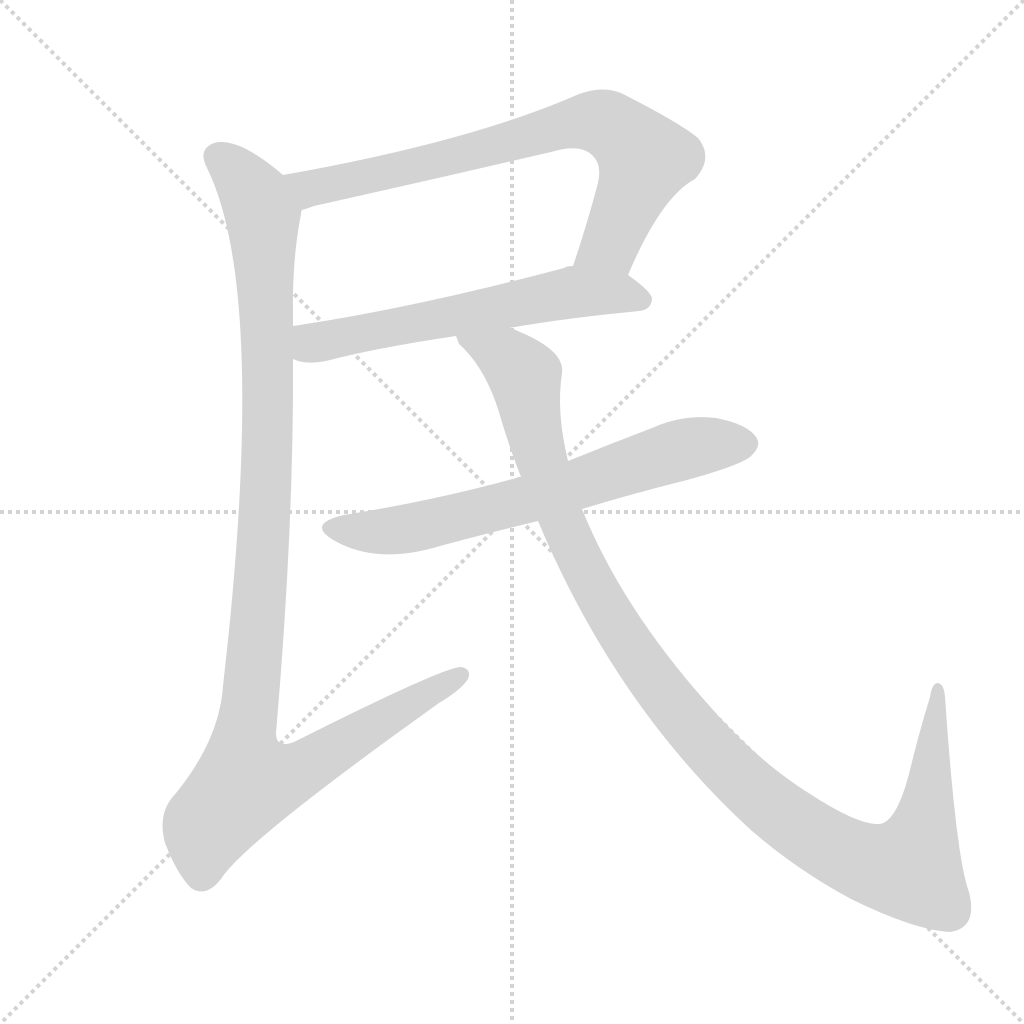
Radical: Clan (shì)
Page 598, Entry 01
Archaic script form.
Pronounced min.
Shuowen Jiezi (Explaining Graphs and Analyzing Characters): The masses. It implies being ignorant and without discernment.
Book of Changes (Yijing), Shi Hexagram: The superior man uses this to tolerate the people and nurture the masses.
Book of Documents (Shangshu), Xian You Yi De: If the sovereign has no people, there is no one to employ; if the people have no sovereign, there is no one to rule them.
Book of Rites (Liji), Zi Yi: The people take the sovereign as their heart, and the sovereign takes the people as their body.
Also, the four classes of people.
Guliang Zhuan (Guliang's Commentary on the Spring and Autumn Annals), First Year of Cheng: In ancient times there were four classes of people: scholar-people, merchant-people, farmer-people, and artisan-people.
Commentary: Those with virtue and ability who occupy positions are called scholars; those who clear land and plant grain are called farmers; those with skillful minds and hardworking hands who create implements are called artisans; those who circulate wealth and goods are called merchants.
Also, Si Min (Overseer of the People), a star name.
Rites of Zhou (Zhouli), Autumn Offices, Si Min: On the day of the sacrifice to the Si Min in the first month of winter, present their numbers to the king.
Commentary: Si Min is the horn of the Xuanyuan constellation.
Shiwen (Explanation of the Text): Xuanyuan consists of seventeen stars shaped like a dragon, having two horns; the horns contain the Big People and the Small People.
Also, an official title.
Rites of Zhou (Zhouli), Autumn Offices, Si Min: Responsible for recording the number of all the people, from those with teeth onward, all are recorded on wooden boards.
Also, Min Cao (People Section), a Han dynasty official title.
Book of the Later Han (Hou Hanshu), Treatise on Officials: The Minister of the People Section manages all matters regarding officials' petitions.
Commentary: Cai Zhi's Han Jiu Yi (Ancient Han Ceremonies) says: It manages provisions, public works, and the affairs of the imperial parks, gardens, and thieves.
Also, the Ministry of People, now the Ministry of Revenue (Hubu).
Wenxian Tongkao (Comprehensive Examination of Literature and Records): The Han dynasty appointed four Secretariat secretaries, one of whom was in charge of the treasury and the transportation of goods. By the time of Emperor Wen of Wei, the Ministry of Duty and Expenditure was established to exclusively manage military and national expenditures. Wu had a Ministry of Households, and the Jin had the Ministry of Duty and Expenditure; both were responsible for accounting. In the Northern Zhou, one Grand Minister of the Masses was appointed according to the system of the Rites of Zhou. In the early Sui dynasty, there was a Minister of Duty and Expenditure, which combined the duties of the Northern Zhou Ministry of People. In the second year of the Kaihuang reign, the Ministry of Duty and Expenditure was renamed the Ministry of People. At the beginning of the Yonghui reign, the Ministry of People was changed to the Ministry of Households.
Also, in the north there are the Bi Jian Min (Shoulder-to-Shoulder People), see Erya, Interpretation of Lands.
In the south there are the Luo Min (Naked People), see Lüshi Chunqiu (Mr. Lü's Spring and Autumn Annals).
Also, the Kingdom of Bai Min (White People), who are white-bodied, have horns on their backs, and live for two thousand years when riding them.
The Kingdom of Yu Min (Feathered People), whose people are born with feathers.
The Kingdom of Luan Min (Egg People), whose people are born from eggs.
The Kingdom of Mao Min (Hairy People), whose people are born with hair.
There are also the kingdoms of Lao Min (Toiling People), Yao Min (Shaking People), Xun Min (Ocarina People), Ying Min (Full People), Di Min (Short People), and Yu Min (Insect People), see Classic of Mountains and Seas (Shanhaijing).
Also, the Kingdom of He Min (Crane People), whose people are three inches tall and travel one thousand miles a day, see Qiong Shen Bi Yuan (Mysterious Garden of Exhausted Spirits).
Also, a surname, see Xing Yuan (Garden of Surnames).
Also, rhymes with li, pronounced li.
Xia Yu Xiang Ling Cao: The flood waters reach the heavens, the lower people are sorrowful and sad. God sighs repeatedly, three times passing my door without entering. The path of father and son decays, alas, I do not wish to burden the lower people.
Also, rhymes with mian, pronounced mian.
Yang Fang, He Huan Shi (Song of Harmonious Joy): Matching that Qiongqiong beast, their movements never part. In life they share the same hole, in death they become joined in the same coffin.
Liu Shu Lue (Survey of the Six Writings): The character for people resembles the shape of a bowed head working hard.
Note: The meaning of the character for people is not limited to one definition. There are instances where it refers to people in general, as in the Book of Odes (Shijing): "Heaven gave birth to the teeming people," and "The people born in the beginning." There are instances where it is contrasted with the sovereign, as in the Book of Documents: "The people are the foundation of the state." There are instances where it is distinguished from those in office, as in the Book of Odes: "Fit for the people, fit for the men." Commentary: "Men" refers to officials, "people" refers to the masses. There are instances where it is contrasted with the hidden or spiritual, as in the Analects: "Devote yourself to the people's duties," and the Zuo Zhuan: "First complete the people's tasks and then devote yourself to the spirits." There are instances where it is contrasted with oneself, as in the Book of Odes: "The people have nothing but goodness, yet I alone suffer." There are instances where it is contrasted with farmers, as in the Book of Han, Treatise on Food and Money: "When grain is very expensive, it harms the people; when it is very cheap, it harms the farmers." Furthermore, the four classes of people encompass scholars, farmers, artisans, and merchants; how can it be said that only those who labor in the fields are called people? The theory in the Liu Shu Lue is strained and cannot be followed.