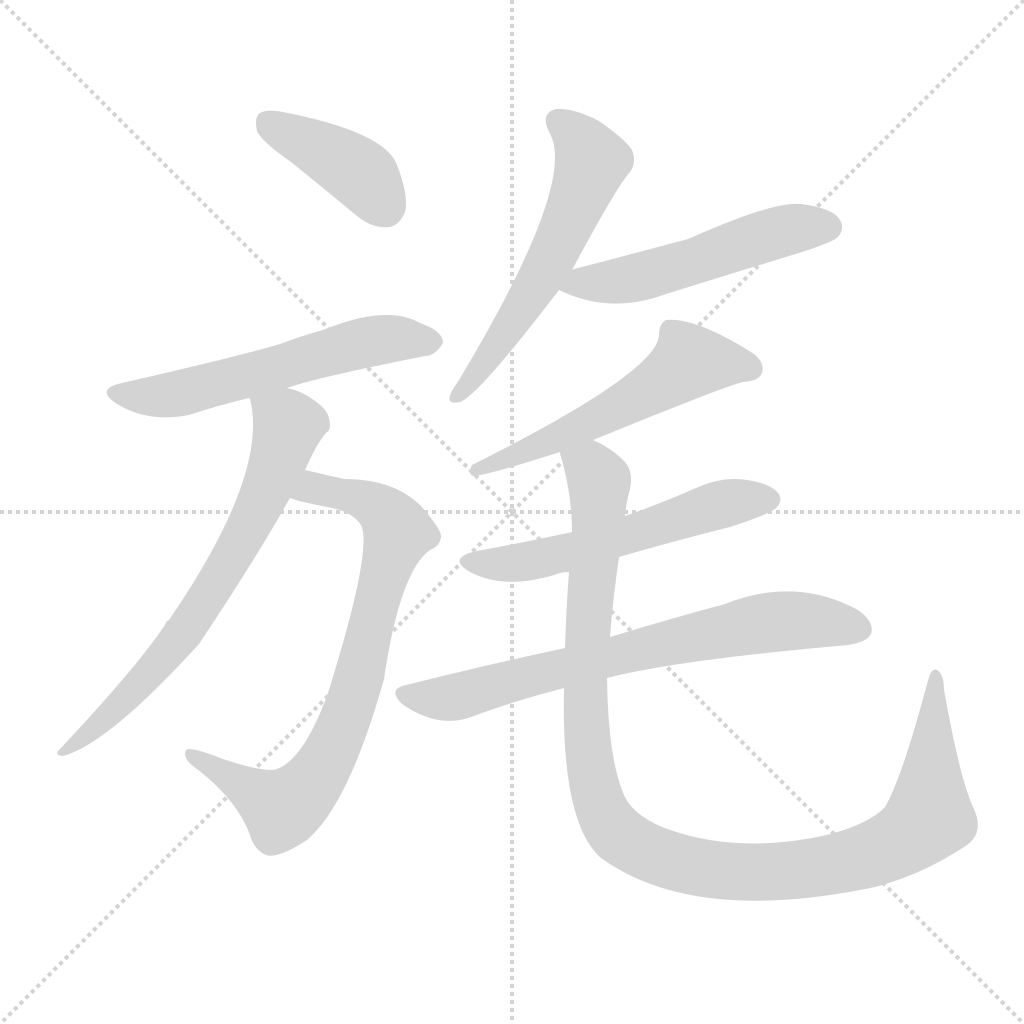
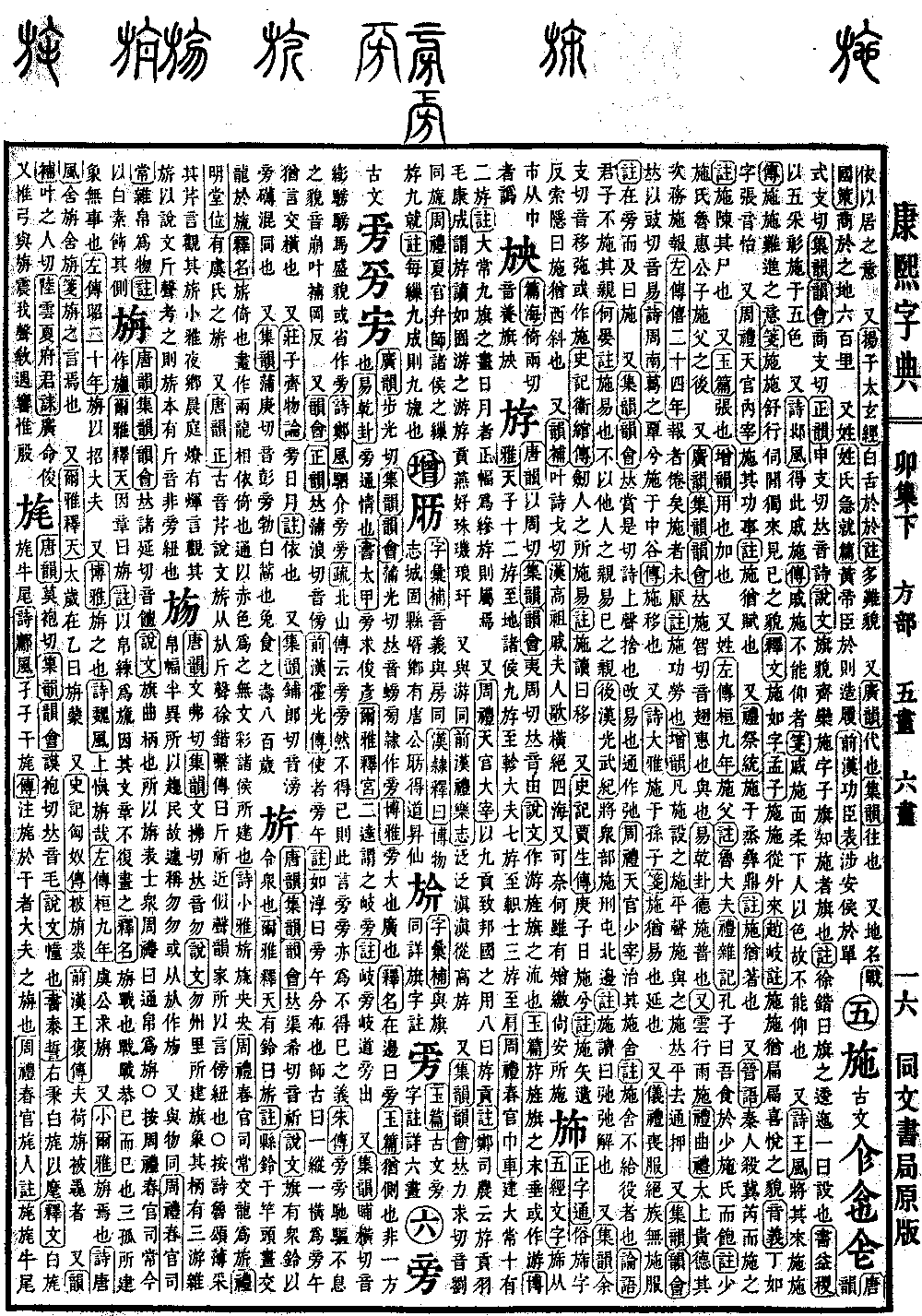
Mao Collection, Lower Volume
Radical: Square (fāng)
Kangxi Strokes: 10
Page 482, Entry 18
Pronounced mao. In the Shuowen Jiezi (Explanation of Simple and Compound Characters), it means a banner or streamer. In the Book of Documents (Shujing), specifically the Great Oath (Taishi), it is written: Holding the white banner on the right to signal. The commentary states that the white banner refers to the tail of a yak. In the Book of Odes (Shijing), in the Odes of Yong, it is written: The stalks of the banner are sparse. The commentary notes that banners attached to stalks were the pennants of a grand master. In the Rites of Zhou (Zhouli), under the Ministry of Spring, the commentary on the banner-bearer states that the banner is made of yak tail, held by dancers to signal movements. Also, in the Odes of Bei, the commentary on the Odes of Mao Qiu states: A hill that is high in the front and low in the back is called a Mao hill. Also, the name of a star. In the Records of the Grand Historian (Shiji), the Treatise on the Celestial Offices states: The Mao star is called the banner head. The commentary states that the seven stars of the Mao constellation constitute the banner head. Also, the name of a cavalry unit. In the History of the Later Han (Hou Hanshu), in the Annals of Emperor Guangwu, it is noted: Bestowed the banner head upon the Prince of Donghai. The commentary explains: During the time of Duke Wen of Qin, a catalpa tree transformed into an ox; when cavalrymen attacked it, they were unsuccessful, and some fell to the ground with their hair disheveled, which frightened the ox into the water; thus, the Qin dynasty established the banner head cavalry.
Pronounced mao (falling tone). Long fur of the roe deer. Also used interchangeably with the character meaning elderly or doting (mao). In the Rites of Zhou, under the Ministry of Autumn, regarding the second amnesty, it is referred to as old and doting. In the Works of Mencius (Mengzi), it refers to the elderly and the young.
Pronounced wu. Also written as a variant form (mao). The name of a mountain.
Rhyming note: Matches the rhyme category (meng/bu). In the Rhapsody on the Luo River Goddess (Luoshen Fu) by Fu Yi: Beautiful jade from the Kunlun Mountains, bright pearls from the surging seas, gold, silver, and precious stones, kingfisher feathers, and the tails of the yak.