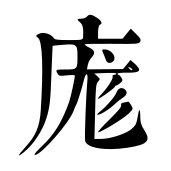
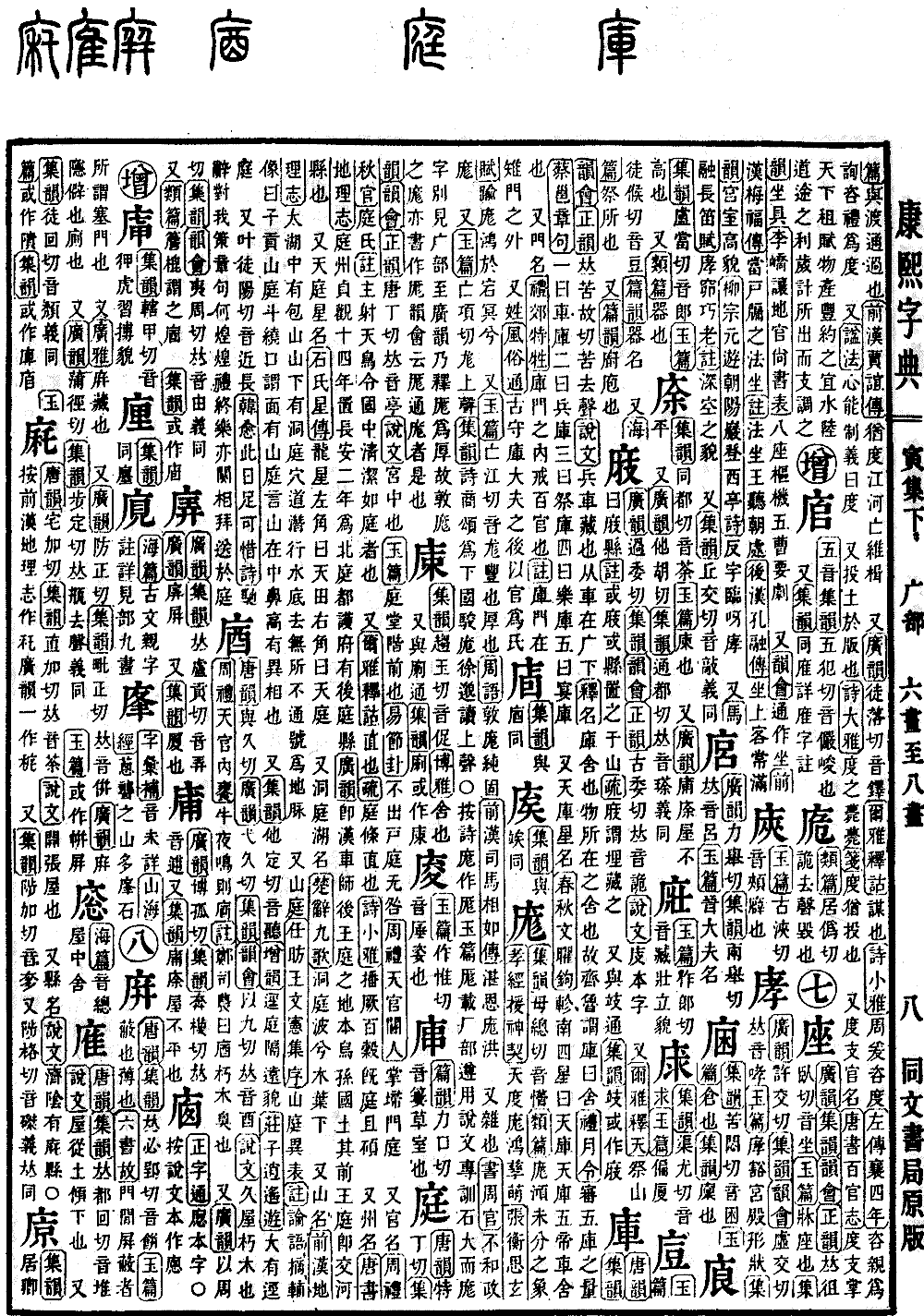
Yin Collection, Lower Volume
Radical: Wide (guǎng)
Kangxi stroke count: 10
Page 346, Entry 17
According to the Sound Compilation (Jiyun), pronounced meng (rising tone).
According to the Classification Compilation (Leipian), the term manghong refers to the chaotic state of the universe before the separation of heaven and earth. As stated in the Classic of Filial Piety (Xiaojing) auxiliary text: The measures of heaven are vast and sprouting. As referenced in the thinking rhapsody by Zhang Heng: Surpassing the vast and chaotic in the deep void.
According to the Jade Compilation (Yupian), pronounced mang. It means abundant and thick. As stated in the Discourses of Zhou (Zhouyu): Sincere, abundant, and solid. As mentioned in the Biography of Sima Xiangru in the History of the Former Han (Qianhan shu): Profound grace, abundant and vast.
It also means disordered or chaotic. As stated in the Book of Documents (Shujing), specifically the section on the Officials of Zhou (Zhouguan): When harmony is absent, government becomes disordered.
According to the Jade Compilation (Yupian), pronounced as the rising tone of mang. According to the Sound Compilation (Jiyun), in the section of the Classic of Poetry (Shijing) known as the Eulogies of Shang (Shangsong), the phrase referring to the great and vast state of the lower kingdoms is read by Xu Miao in the rising tone.
Note: In the Classic of Poetry (Shijing), the character is written as mang. The Jade Compilation (Yupian) categorizes this variant under the radical for Cliff (chǎng). According to the Explaining Graphs and Analyzing Characters (Shuowen jiezi), that variant refers specifically to large stones, whereas the entry for this character appears under the radical for Wide (guǎng). It was not until the Rhymes of the Wide (Guangyun) that the character was defined as thick and heavy; thus, the usage in the phrase meaning sincere and abundant is also written with the variant. The Rhyme Collection (Yunhui) correctly states that the two characters are interchangeable.