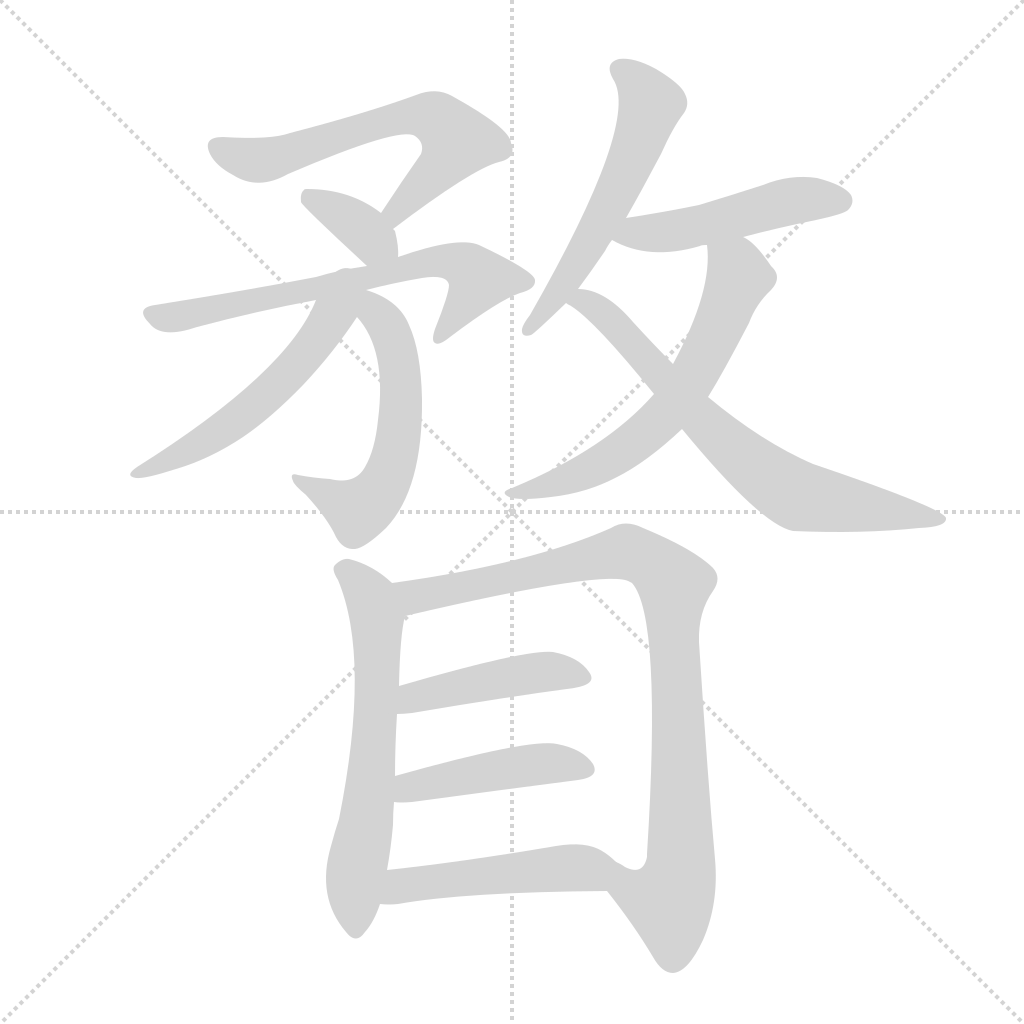
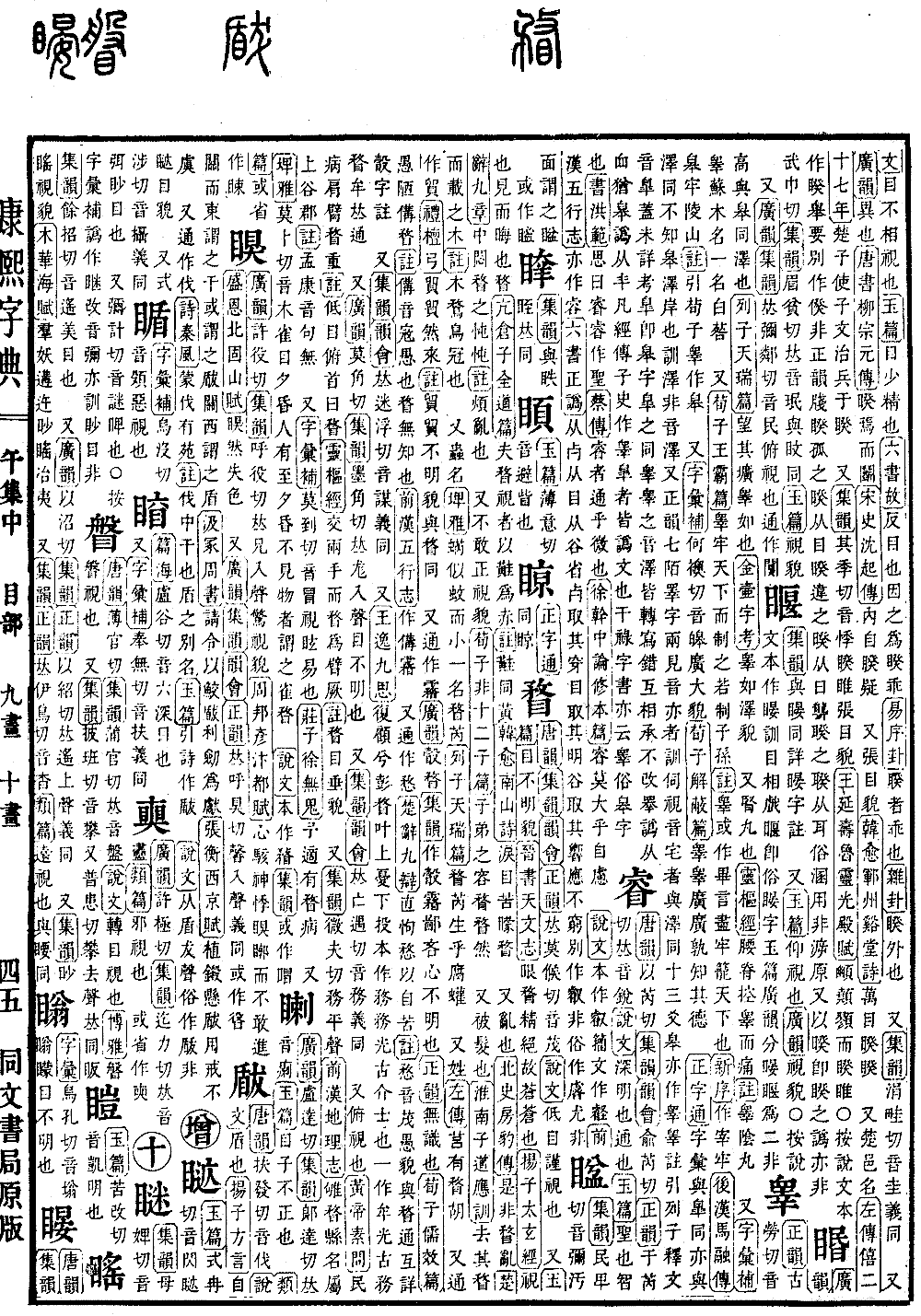
Wu Collection, Middle Volume
Radical: Eye (mù)
Kangxi Strokes: 14
Page 813, Entry 09
Pronounced mao.
According to the Explaining Graphs (Shuowen): to lower the eyes and look cautiously. Also, according to the Jade Chapters (Yupian): the appearance of the eyes being unclear.
In the History of Jin (Jinshu), Astronomy Treatise: The eyes are dim and the spirit is depleted, hence they appear pale.
In the Great Mystery (Taixuanjing) by Yangzi: When looking, one sees, but in the darkness, one is dim.
In the Kang Cangzi, Chapter on Reaching the Dao: Those with dim vision mistake yellow for red. Note: The character meaning yellow is identical to the one used here.
In Han Yu's Poem on the Southern Mountain: Tears dim the eyes with bitter obscurity.
Also, to be confused. In the History of Northern Dynasties (Beishi), Biography of Fang Bao: Right and wrong are confused and chaotic.
In the Songs of Chu (Chuci), Nine Declarations: The heart is stuffy and confused, feeling distressed. Note: Meaning troubled and chaotic.
Also, the appearance of not daring to look straight. In the Xunzi, Chapter on Negating the Twelve Philosophers: The demeanor of the young is dazed and confused.
Also, disheveled hair. In the Huainanzi, Training on How the Dao Responds: Remove the disheveled hair and place it on a wooden frame. Note: This refers to a bird-shaped wooden headpiece.
Also, the name of an insect. In the Enhanced Encyclopedia (Piya): The midge resembles a mosquito but is smaller. Another name is mao rui.
In the Liezi, Chapter on Heavenly Manifestations: The mao rui insect is born from rotting organic matter.
Also, a surname. In the Zuo Tradition (Zuo Zhuan): The state of Ju had a man named Mao Hu.
Also, used interchangeably with the character meaning trade. In the Book of Rites (Liji), Tan Gong: Arriving in a dazed, confused manner. Note: This means an appearance of lack of clarity, identical to the usage of this character.
Also, used interchangeably with the character for fog. In the Broad Rhymes (Guangyun): This character is the same as the fog character. In the Collection of Rhymes (Jiyun), it is written as the fog character, signifying a vulgar, stingy heart that is unclear.
In the Correct Rhymes (Zhengyun): Lack of knowledge.
In the Xunzi, Chapter on the Efficacy of Literati: Stupid, vulgar, and ignorant. Note: The first character is pronounced kou, meaning stupid. The second character means lack of knowledge.
In the History of the Former Han (Qianhanshu), Treatise on the Five Elements: Written as the characters for stupid and foggy.
Also, used interchangeably with the character meaning dazed. In the Songs of Chu (Chuci), Nine Arguments: Honestly foolish and dazed, causing oneself suffering. Note: Pronounced mao, meaning a foolish appearance. Interchangeable with the main character. Further details are provided in the entries for those characters.
Also, in the Collection of Rhymes (Jiyun) and the Rhyme Gathering (Yunhui), pronounced mou. The meaning is the same.
Also, in the Nine Longings (Jiushi) by Wang Yi: Looking back at Peng Mao, leaves are sad above and falling below. Originally written with the character for business. Wu Guang was a recluse of old. Sometimes written as the character for mow. In ancient times, the characters for business, this character, and mow were interchangeable.
Also, in the Broad Rhymes (Guangyun), pronounced mao (entering tone). In the Collection of Rhymes (Jiyun), pronounced mo (entering tone). Meaning: eyes that are unclear.
Also, in the Collection of Rhymes (Jiyun) and the Rhyme Gathering (Yunhui), pronounced wu. The meaning is the same.
Also, to look downward. In the Yellow Emperor's Inner Canon (Huangdi Neijing), Simple Questions (Suwen): The people suffer from shoulders and arms that are heavy and numb. Note: Lowering the eyes and bowing the head is called mao.
In the Miraculous Pivot (Lingshu Jing): Crossing the two hands results in numbness of the arms, a condition of energy reversal. Note: Mao refers to the appearance of drooping eyes.
Also, in the Collection of Rhymes (Jiyun), pronounced wu (level tone). In the History of the Former Han (Qianhanshu), Treatise on Geography: Goumao, a county name under the jurisdiction of Shanggu Commandery. Note: Meng Kang pronounces it gou wu.
Also, in the Supplement to the Compendium of Characters (Zihui Bu), pronounced mao. Meaning: vision that is blurred and prone to errors.
In the Zhuangzi, Xu Wugui: I happen to have a condition of blurred vision.
Also, in the Enhanced Encyclopedia (Piya), pronounced mu. A sparrow's eyes are dim at dusk; people who cannot see objects when it gets dark are said to have sparrow blindness.
According to the Explaining Graphs (Shuowen), this was originally written as the main character. In the Collection of Rhymes (Jiyun), it is sometimes written with the radical for strike. The original engraving of this character uses the radical for strike, not the radical for fold.