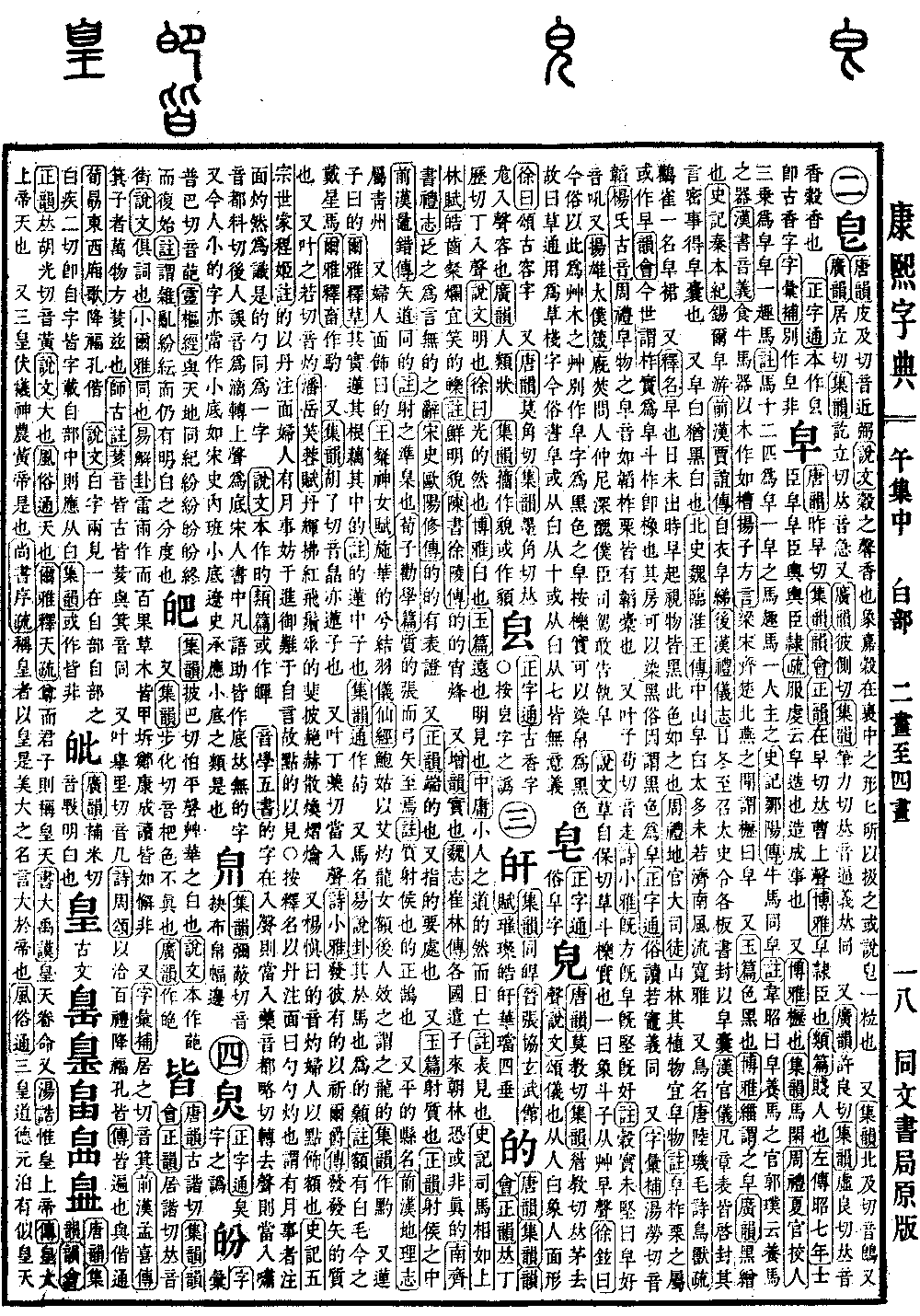
Wu Collection, Middle Volume
Radical: White (bái)
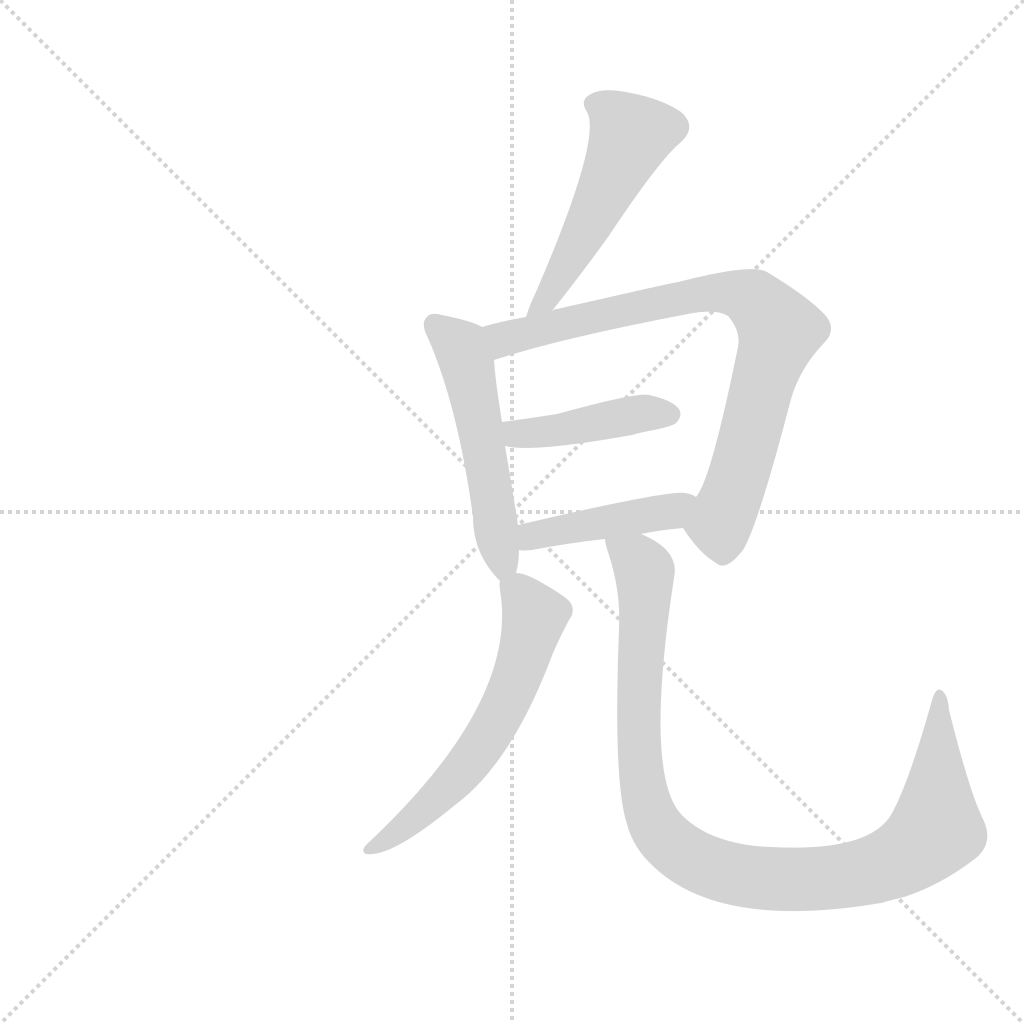
皃
Kangxi stroke count: 7
Page 786, Entry 04
Pronounced mao (falling tone). According to Explaining Graphs and Analyzing Characters (Shuowen Jiezi), it refers to one's countenance or demeanor. The character is composed of the radical for person and the character for white, representing the shape of a human face. According to Xu Kai, this character is the ancient form of the character for countenance.
Also, pronounced mo (entering tone). The meaning is countenance or appearance. According to the Extensive Rhymes (Guangyun), it refers to the look of a person. The Collected Rhymes (Jiyun) notes that the seal script variant is written as the character for appearance, and another variant form exists.
Regarding the ancient form of the character for appearance: According to the Extensive Rhymes (Guangyun), it is pronounced mao (falling tone). According to Explaining Graphs and Analyzing Characters (Shuowen Jiezi), the character refers to countenance or demeanor. The character is composed of the radical for person, with the character for white representing the face; the seal script is derived from the character for leopard, which was simplified to become the modern character for appearance.
Book of Documents (Shangshu), Chapter on the Great Plan (Hongfan): Mentions five types of conduct, the first of which is appearance. Kong Yingda states that appearance refers to demeanor and is a general term for the state of the entire body.
Also, in the Book of Rites (Liji), Chapter on the Suburban Sacrifice (Jiaotesheng): It mentions the ceremonial cap known as weimao, which was a sacrificial rite during the Zhou Dynasty. The commentary notes that some believe weimao refers to a specific type of headgear. The Book of the Later Han (Hou Hanshu), Treatise on Carriages and Clothing (Yufu Zhi): Records that the weimao was made from black silk.
Also, in the Records of the Grand Historian (Shiji), Biography of Knight-Errant (Youxia Zhuan), there is a proverb: Can the appearance and distinguished reputation of a person be fixed and unchanging? The commentary notes that a distinguished reputation is an external ornament, and praise has no limits.
Also, a surname. According to the Correct Meaning of Characters (Zhengzitong), the Strategies of the Warring States (Zhanguo Ce) records a person from the State of Qi named Maobian.
Also, according to the Collected Rhymes of the Five Sounds (Wuyin Jiyun), pronounced mao (entering tone), same as the character for dull or dim-sighted. According to the Correct Rhymes (Zhengyun), to draw or paint a person to make their likeness similar is called mao. The Old Book of Tang (Tangshu), Biography of Imperial Consorts (Houfei Zhuan): Orders were given to a court painter to create a portrait of a consort in a separate palace.
Also, same as the character for distant (miao). It means far away. In Han Yu’s Poem on the Lunar Eclipse: Moving slowly across the eastern sky. The Critical Examination (Kaoyi) notes that for the term for moving slowly, some editions use the character for appearance. According to the Collected Rhymes (Jiyun), it is also written in a variant form.