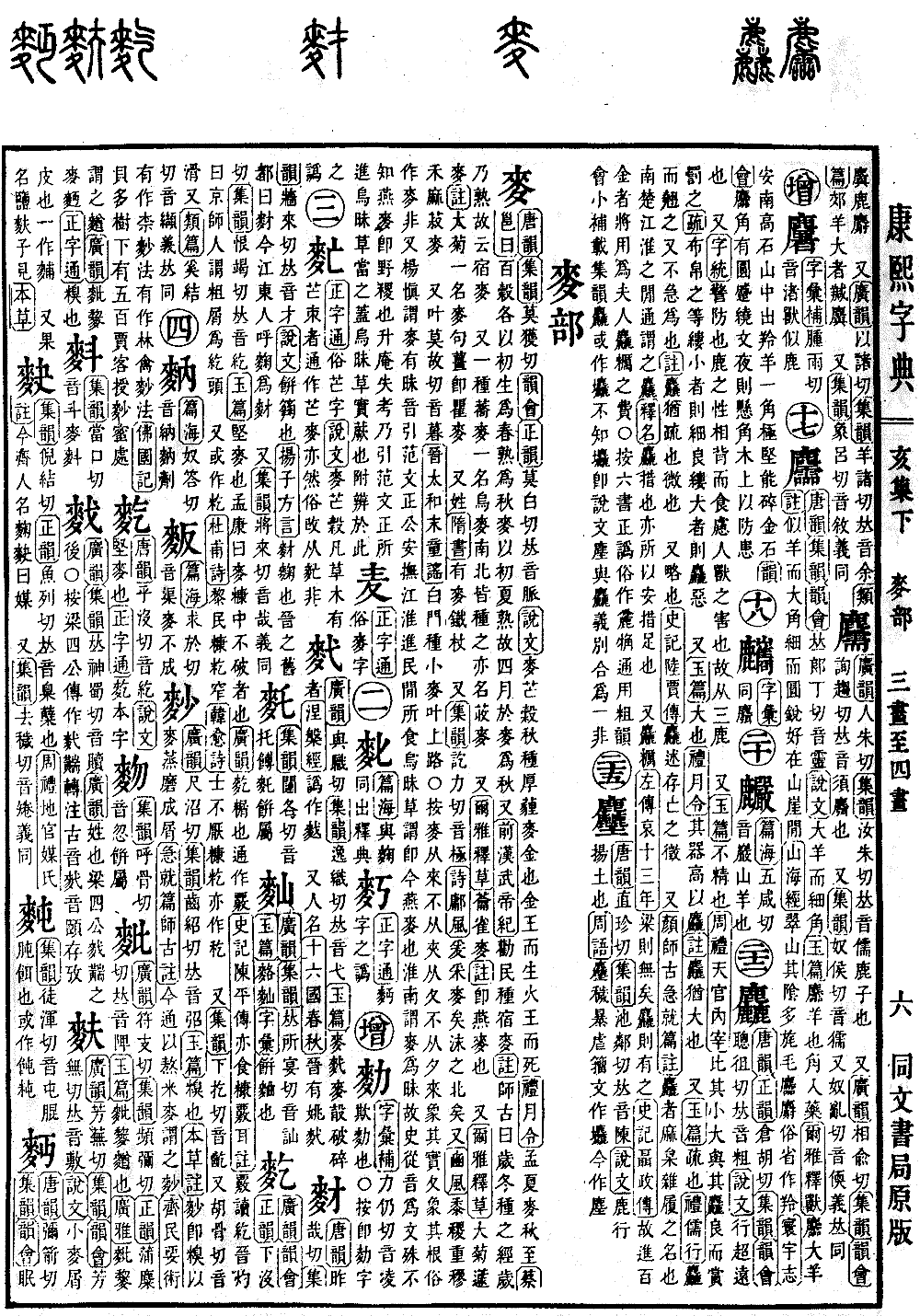
Hai Collection, Lower Volume
Radical: Wheat (mài)
Kangxi Strokes: 11
Page 1512, Entry 08
Pronounced mai.
According to the Shuo Wen Jiezi (Explaining Graphs and Analyzing Characters), wheat is a cereal with awns, sown in autumn and buried deep in the soil. Wheat belongs to the metal element; it grows when metal energy is flourishing and dies when fire energy is flourishing.
Book of Rites (Liji), Monthly Ordinances (Yueling): Wheat matures at the beginning of summer.
Cai Yong stated: All grains consider their germination to be spring and their maturation to be autumn. Wheat matures in early summer, so for wheat, the fourth month is autumn.
Also, History of the Former Han (Qian Hanshu), Annals of Emperor Wu: Encouraged the people to plant overwintering wheat (sumai). Commentary by Yan Shigu: Planted in winter and maturing after a year, hence it is called overwintering wheat.
There is also buckwheat, also called black wheat. It is cultivated in regions north and south, also called qiao wheat.
Erya, Explaining Plants (Shicao): Yue quema (a type of wild wheat). Commentary: This refers to oats.
Erya, Explaining Plants (Shicao): Daju qumai. Commentary: Daju, also known as maijujiang, is qumai (Dianthus chinensis).
Also a surname. Sui Shu (History of the Sui Dynasty) mentions Mai Tiezhang.
Pronounced ji.
Book of Odes (Shijing), Yong Feng: Gathering wheat there, north of the Mei.
Also, Bin Feng: Panicled millet and broomcorn millet, double-cropped and six-month-cropped; grain, hemp, legumes, and wheat.
Also rhymes with the sound mu. Jin Dynasty Taihe era children's ditty: Planting wheat at White Gate, leaves on the road.
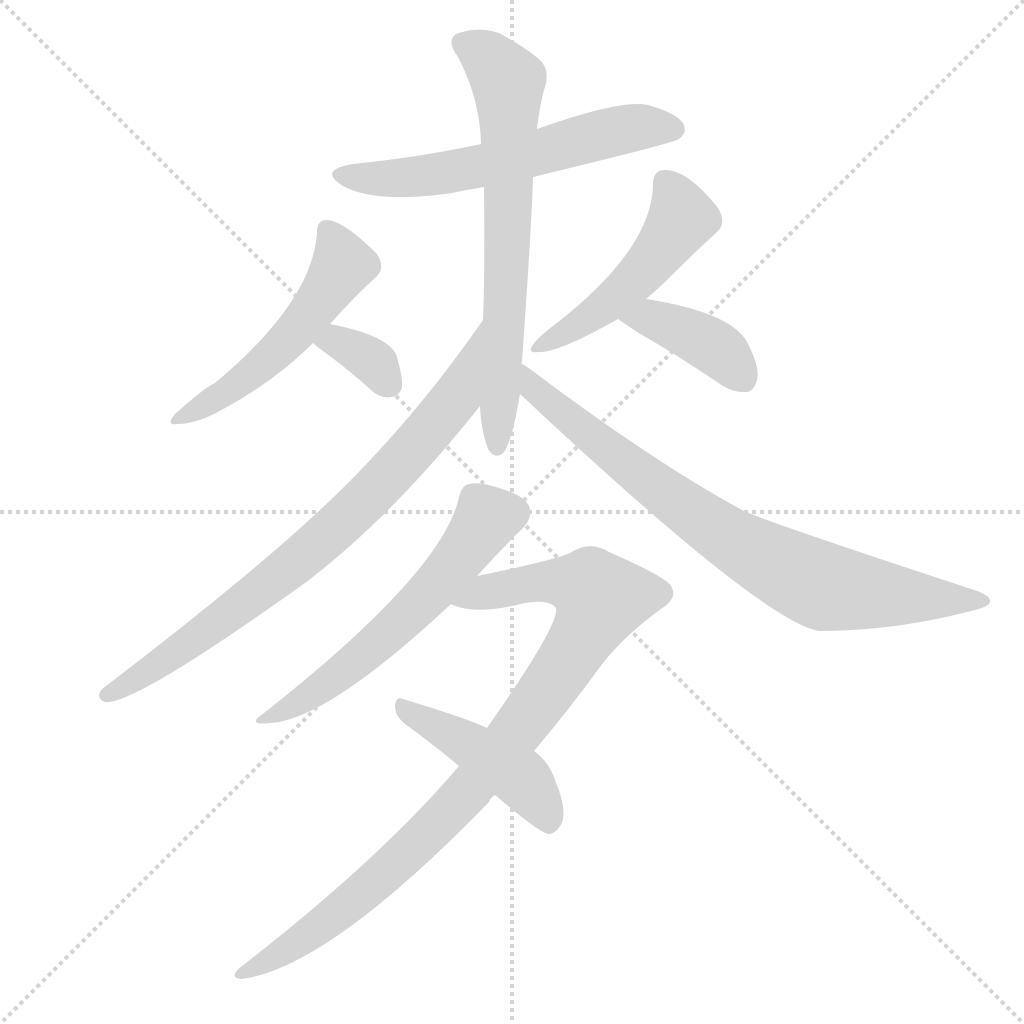
Note: The character for wheat is written with the component lai at the top and not jia, with the component sui at the bottom and not xi. Lai symbolizes its fruit, and sui symbolizes its roots. The common variant form is incorrect.
Yang Shen stated that wheat has a reading of mei. He cited Fan Zhongyan, who, while pacifying the Jiang-Huai region, presented the black mei herb eaten by the common people, claiming it was modern-day oats. In Huainan, wheat is called mei, so historical texts recorded it based on the pronunciation, not knowing that oats are wild millet. Yang Sheng'an's research was mistaken in linking it to the black mei herb presented by Fan Zhongyan; in reality, the black mei herb is bracken. This is clarified here for reference. The character for wheat is written with jia above sui.