Shen Collection, Upper Volume
Radical: Grass (cǎo)
Kangxi Strokes: 11
Page 1022, Entry 28
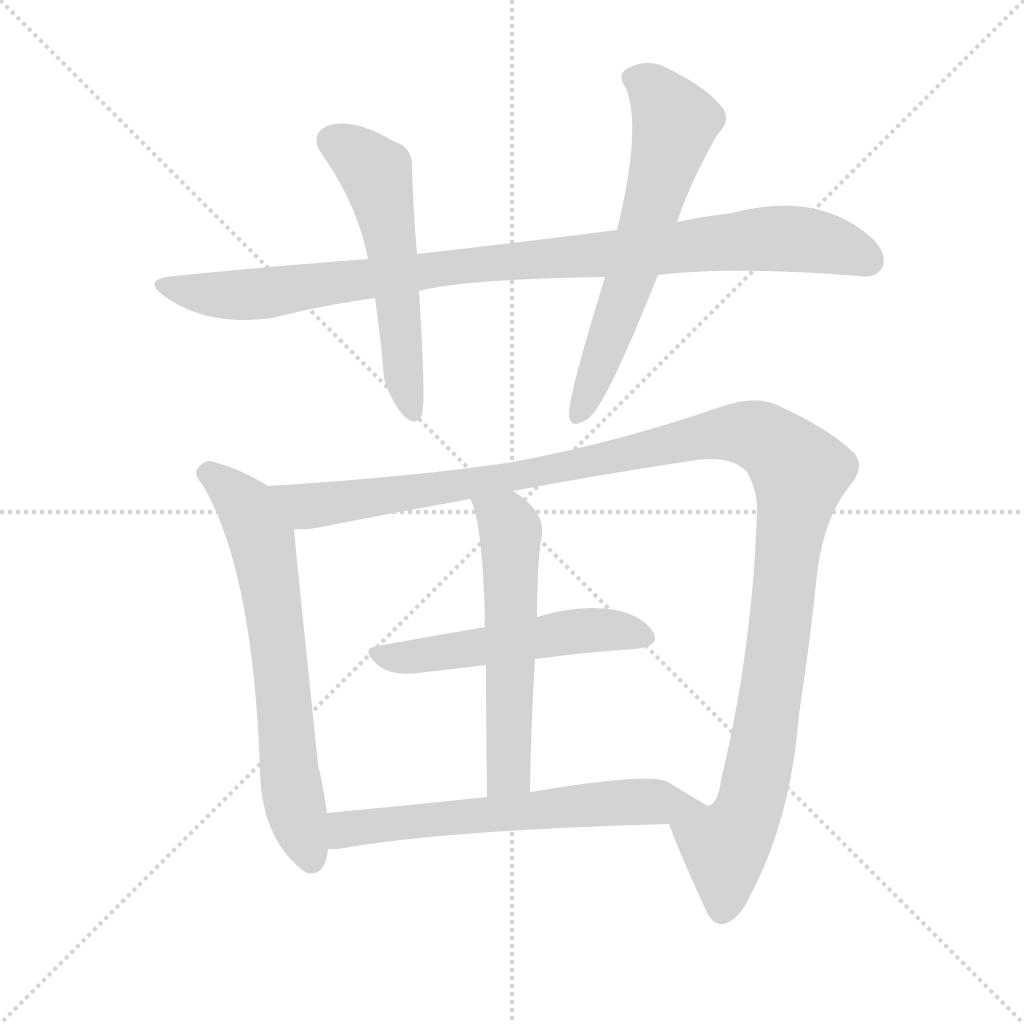
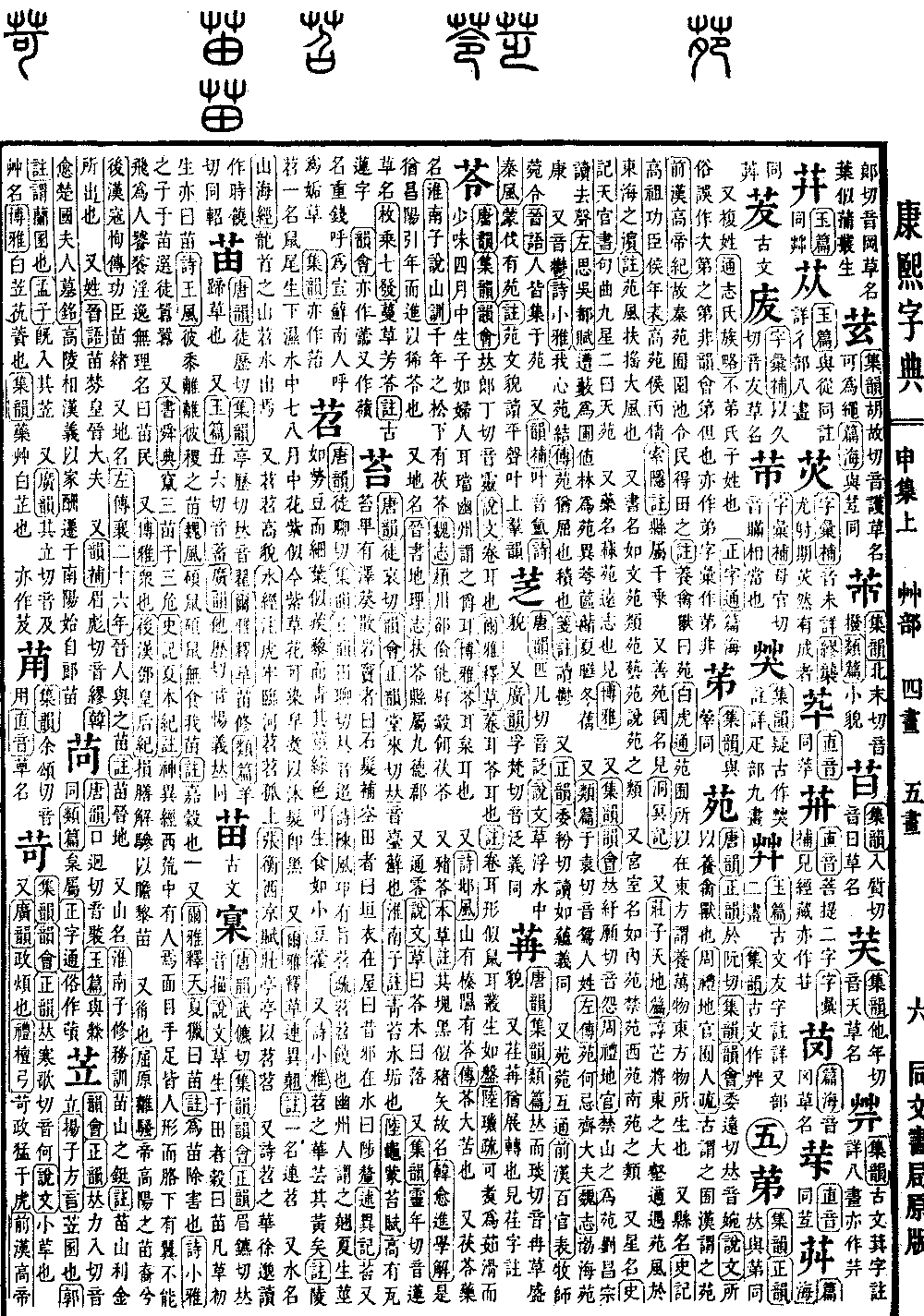
In ancient texts, it is recorded: According to Tang Rhymes (Tangyun), the pronunciation is miao; according to Collection of Rhymes (Jiyun), Rhyme Compilation (Yunhui), and Orthodox Rhymes (Zhengyun), the pronunciation is miao. It is pronounced miao. Explaining Characters and Writing (Shuowen Jiezi) defines it as: Plants that grow in fields; grain is also called sprout. In general, any plant just beginning to grow can be called a sprout. The Book of Odes (Shijing), Odes of Wang states: The broomcorn millet there is arranged in rows, the millet there produces sprouts. Odes of Wei states: Oh big rat, oh big rat, do not eat my sprouts in the field. The note explains this refers to fine grains.
Additionally, Er Ya: Interpretation of Heaven (Er Ya Shitian) mentions: Hunting in the summer is called miao. The note explains this is to remove pests for the sake of the sprouts. The Book of Odes (Shijing), Lesser Odes of the Kingdom records: That person goes to hunt in summer, only to cause a clamor.
Also, the Book of Documents (Shangshu), Canon of Shun records: Banished the Three Miao to Sanwei. Records of the Grand Historian (Shiji), Annals of Xia notes cites the Classic of Spirits and Strange Things (Shenyi Jing) stating: In the remote western lands, there is a type of people whose faces, hands, and feet resemble humans, but they have wings under their armpits; they cannot fly, are greedy and gluttonous, and are dissolute and wicked; they are called the Miao people.
Furthermore, Guang Ya defines it as numerous. The Book of the Later Han (Hou Hanshu), Annals of Empress Deng states: Reduce meals and remove carriages and horses to provide relief to the common people.
It also refers to descendants or offspring. Qu Yuan in Encountering Sorrow (Lisao) says: I am a descendant of the ancient Emperor Gaoyang. The Book of the Later Han (Hou Hanshu), Biography of Xun mentions: Descendants of meritorious officials.
It is also a place name. Zuo Tradition (Zuo Zhuan), 26th Year of Duke Xiang records: The people of Jin gave him the territory of Miao. The note states that Miao is a place in the state of Jin.
It is also the name of a mountain. Huainanzi (Huainanzi), Training in Cultivating Endeavors (Xiuwu Xun) mentions: The copper produced from Mount Miao. The note states that Mount Miao is a place that produces high-quality metal.
It is also a surname. Discourses of the States (Guoyu), Discourses of Jin records: Miao Fenhuang was an official in the state of Jin.
Additionally, Rhyme Supplement (Yunbu) indicates the pronunciation is miu. Han Yu in Epitaph for the Lady of Chu (Chu Guo Furen Muming) writes: The ancestors were enfeoffed as marquises during the Han dynasty, repaying the family with loyalty. Moving to Nanyang, it began with the Miao family of Lang territory.