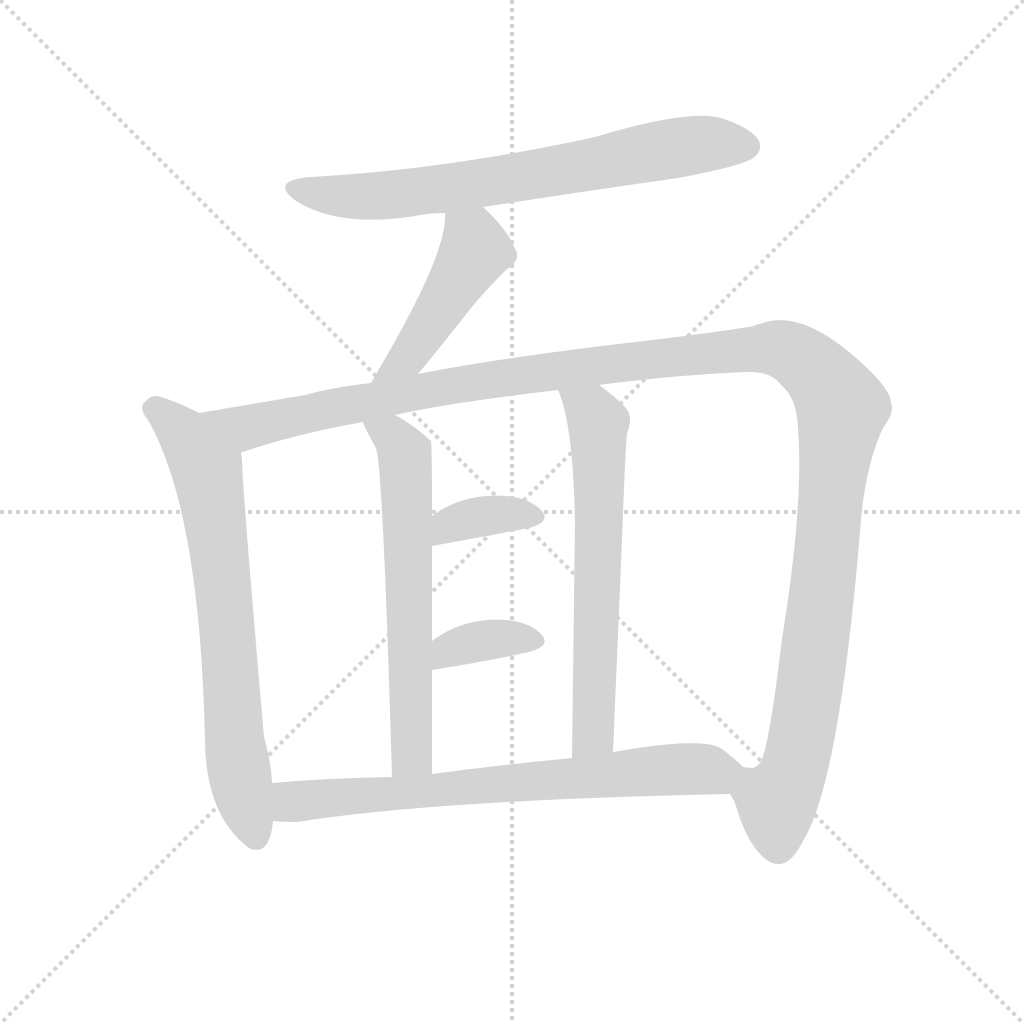
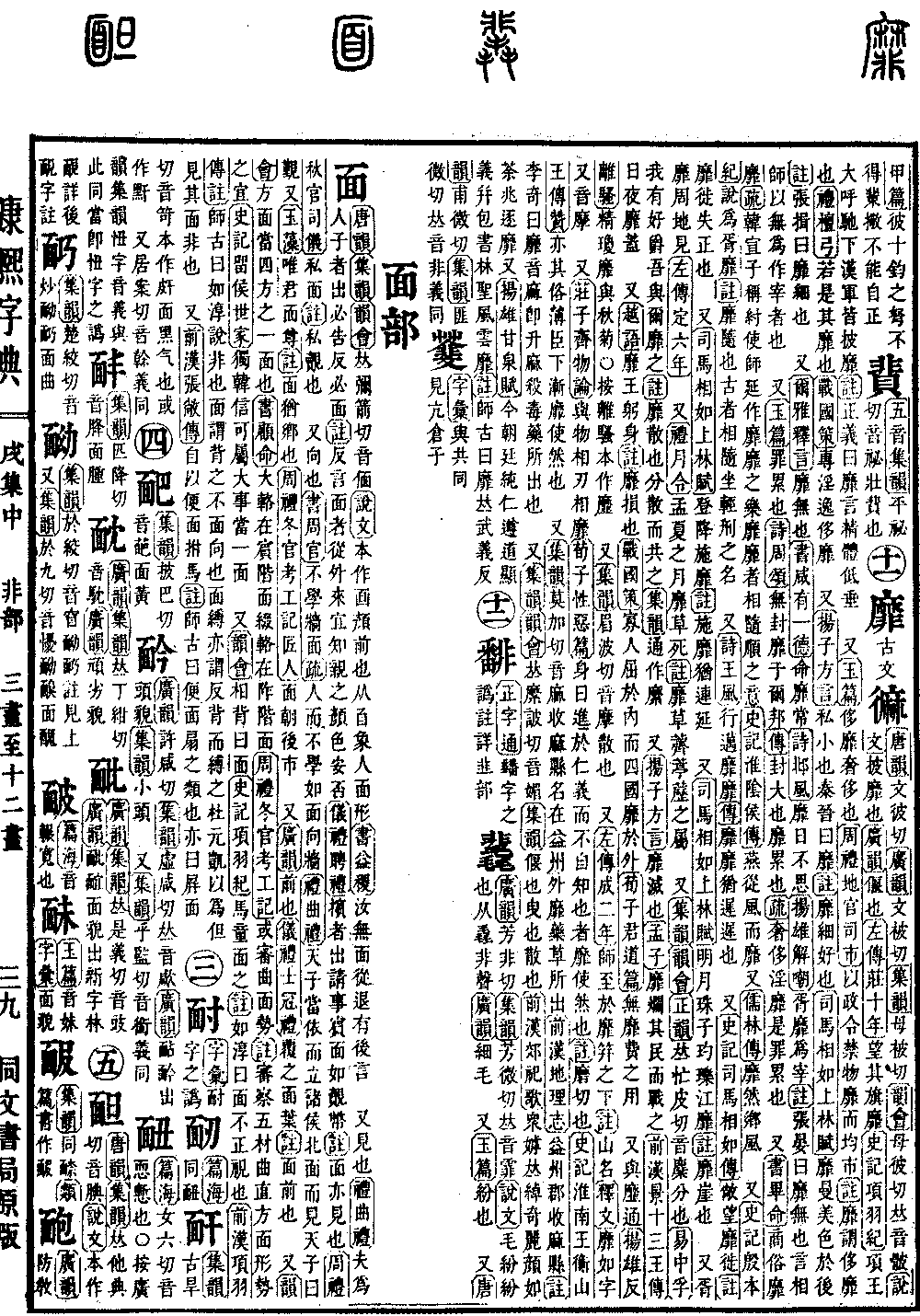
Xu Collection, Middle Volume
Radical: Face (miàn)
Kangxi Strokes: 9
Page 1383, Entry 07
Tang Yun, Jiyun, Yunhui: Pronounced mian.
Shuo Wen Jiezi (Shuo wen): Originally written as the character for face, meaning the front of the visage. Derived from the character for self, representing the shape of a human face.
Book of Documents (Shujing): Do not be compliant to someone's face while harboring criticism behind their back. Also means to see.
Book of Rites (Liji): When acting as a child, one must report before leaving and must have a face-to-face meeting upon returning. Commentary: Returning and asking for a face-to-face meeting is because upon returning from outside, one should observe whether the parents' complexions are well.
Book of Etiquette and Ceremonial (Yili): When an envoy comes out to request instructions, the guest meets face-to-face just as one would when presenting a gift. Commentary: Mian also means to see.
Rites of Zhou (Zhouli): A private meeting. Commentary: Means to meet in private.
Also means to face toward.
Book of Documents (Shujing): Not learning is like facing a wall. Sub-commentary: If a person does not learn, it is like standing before a wall.
Book of Rites (Liji): The Son of Heaven stands with his back to a screen, and the feudal lords face north to pay respects to the Son of Heaven, which is called an audience.
Also, in Jade Regulations (Yuzao): Only the ruler faces the wine vessel. Commentary: Mian means to orient oneself toward something.
Rites of Zhou (Zhouli): In front is the court, behind is the market.
Also, in Guang Yun (Guang yun): The front.
Book of Etiquette and Ceremonial (Yili): The decoration covering the front of the ceremonial cap. Commentary: Mian means the front.
Also, in Yunhui (Yunhui): A direction or side, referring to one side of the four cardinal directions.
Book of Documents (Shujing): The grand carriage is on the side of the guest steps, and the auxiliary carriage is on the side of the eastern steps.
Rites of Zhou (Zhouli): Or to examine the straightness of materials and the circumstances of all sides. Commentary: To examine the straightness of the five materials and the suitability of all aspects.
Records of the Grand Historian (Shiji): Only Han Xin can be entrusted with major tasks and take charge of one side alone.
Also, in Yunhui (Yunhui): To turn one's back is called mian.
Records of the Grand Historian (Shiji): Ma Tong turned his back to him. Commentary: Ru Chun says: Mian means not to look directly at someone.
History of the Former Han (Qianhan): Yan Shigu says: Ru Chun's explanation is incorrect. Mian means to turn one's back to him, not facing him. To bind someone face-to-face is also to bind their hands behind their back; Du Yu’s interpretation that it merely refers to seeing the face is incorrect.
History of the Former Han (Qianhan): He used a bianmian to strike the horse. Commentary: Yan Shigu says: Bianmian is a type of fan, also called a screen-face.
Textual Research:
Shuo Wen Jiezi (Shuo wen): Originally written as the character for face, meaning the front of the visage. Derived from the character for self; the original text has been corrected accordingly.