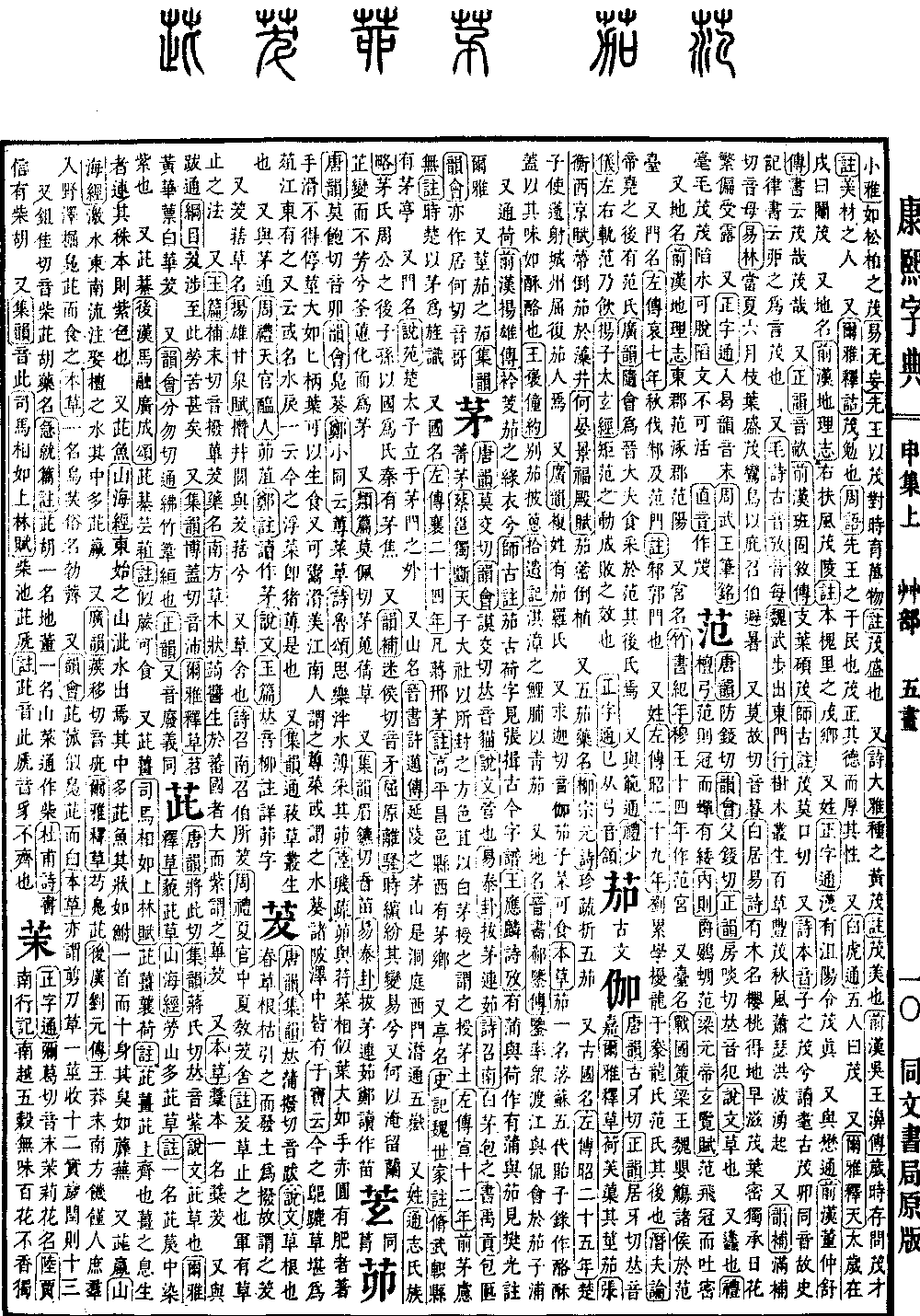
Shen Collection, Upper Volume
Radical: Grass (cǎo)
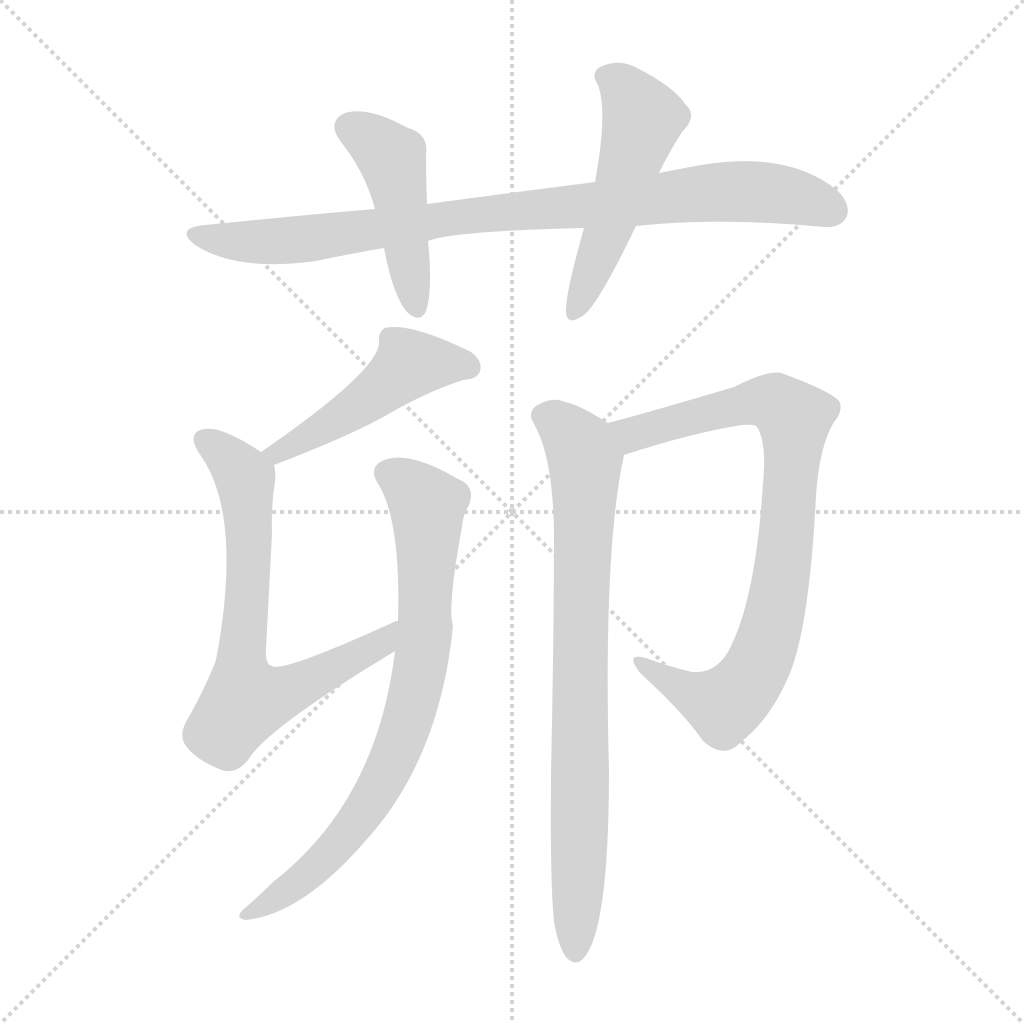
茆
Kangxi strokes: 11
Page 1026, Entry 06
Pronounced mao (rising tone).
In the Book of Rhymes (Yunhui), it is defined as water shield.
Zheng Xiaotong stated that it is a type of water shield herb.
Book of Odes (Shijing), Odes of Lu: Enjoying the semi-circular pond, gathering the water shield.
Lu Ji commentary: The water shield is similar to the floating heart herb. Its leaves are as large as a palm, reddish-circular, and have a thick, succulent texture; they feel so slippery that they cannot be held firmly. The stems are as thick as the handle of a soup spoon. The leaves can be eaten raw or cooked, being tender and delicious. People in the Jiangnan region call it water shield, or also water mallow, and it grows in ponds and marshes everywhere.
Gan Bao stated: It is what is now called the water-cress herb, which can be made into pickles; this herb is found in the Jiangdong region. It is also said that it is sometimes called water-li. Another view states that the modern floating vegetable is pig-water shield.
Also, in the Collection of Rhymes (Jiyun), it means the same as flourishing, referring to grass growing in clusters.
It is also interchangeable with the character for cogon grass (mao).
Rites of Zhou (Zhouli), Officers of Heaven, Officer of Pickles: Pickled water shield.
Zheng commentary: Read as cogon grass (mao).
In the Analytical Dictionary of Characters (Shuowen) and the Jade Chapters (Yupian), it is pronounced liu. For details, refer to the note on the character.
Textual verification: The original text reads Yu Bao, which has been corrected to Gan Bao according to the source text.