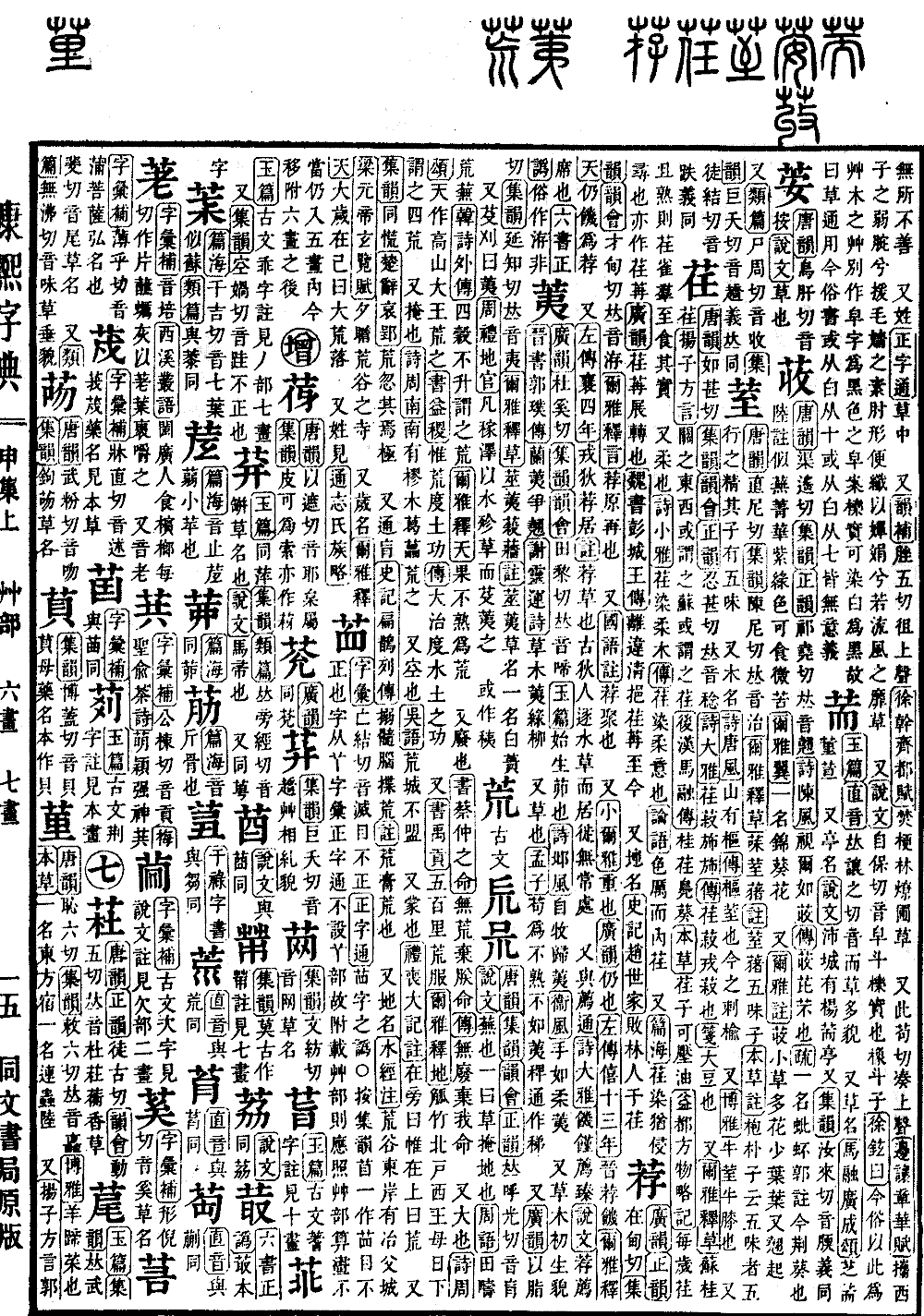
Shen Collection, Upper Volume
Radical: Grass (cǎo)
Kangxi Strokes: 12
Page 1031, Entry 08
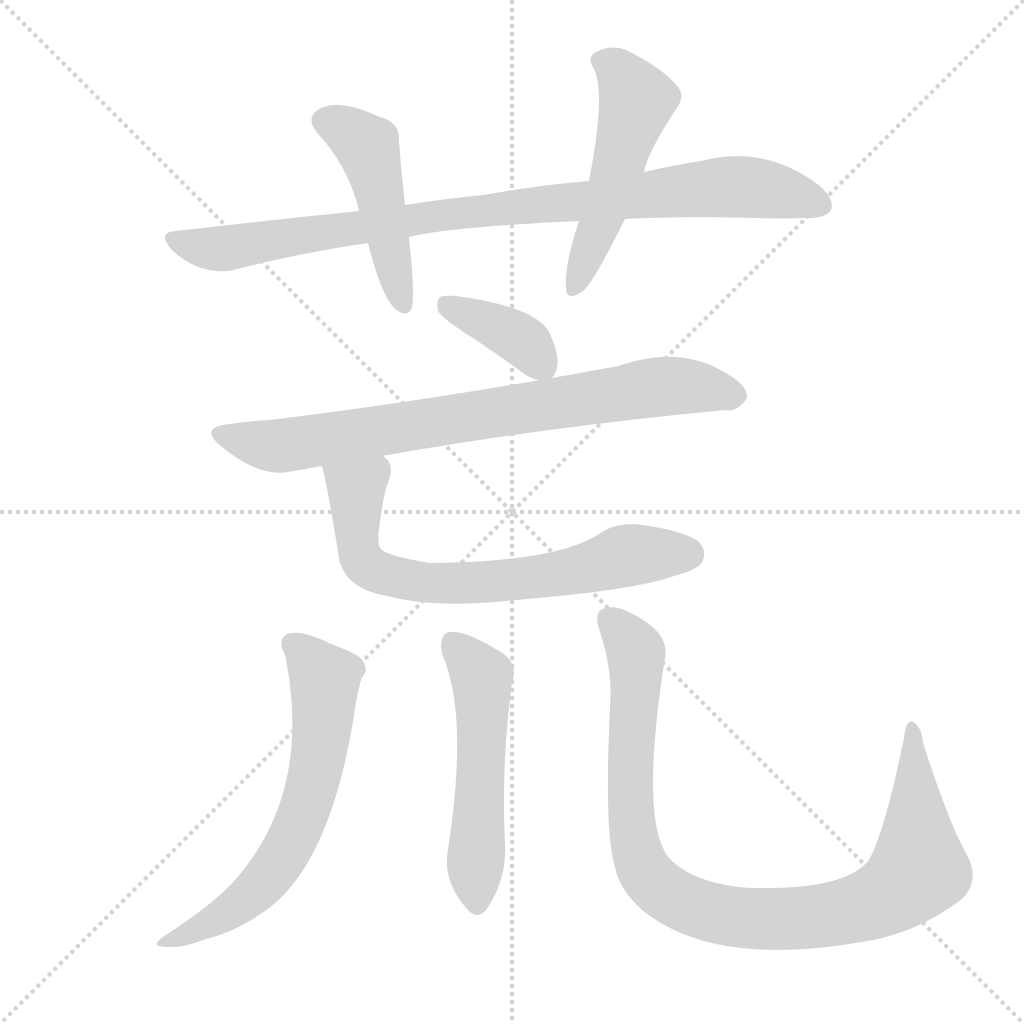
Archaic script form. Pronounced huāng.
As defined in the Analytical Dictionary of Characters (Shuowen Jiezi), it refers to overgrown or uncultivated land. Another explanation states it is when wild grasses cover the surface of the ground.
In the Discourses of the States (Guoyu), it states that farmland is desolate and uncultivated.
In the Han Family Illustrations of the Classic of Poetry (Han Shi Waizhuan), it states that when the four types of grain fail to yield a harvest, it is called a famine (huāng).
In the Literary Expositor (Erya), it states that when fruit does not reach maturity, it is called a famine (huāng).
Also, to discard or neglect. In the Book of Documents (Shangshu), Chapter on the Mandate of Cai Zhong, it says do not neglect my orders. The commentary states do not abandon or disregard my commands.
Also, vast or expansive. In the Book of Odes (Shijing), Odes of Zhou, it says the high heaven created high mountains, and King Tai expanded and governed them. In the Book of Documents (Shangshu), Chapter on the Benefit of Accomplishment, it says to greatly manage the water and soil projects. The commentary states to extensively regulate the hydraulic works.
Also, in the Book of Documents (Shangshu), Chapter on the Tributes of Yu, five hundred miles is referred to as the desolate frontier territories (huāngfú).
In the Literary Expositor (Erya), it states that the regions of Guzhu, Beihu, Xiwangmu, and Rixia are collectively known as the remote and desolate lands of the four directions.
Also, to cover or screen. In the Book of Odes (Shijing), Odes of Zhou and the South, it says in the south there are curved trees, and the kudzu vines cover them.
Also, empty or void. In the Discourses of the States (Guoyu), it refers to making a verbal alliance without performing the formal oaths.
Also, to screen or canopy. In the Book of Rites (Liji), Records of Mortuary Rites, the commentary states that curtains on the side are called wei, and a covering above is called huang.
Also, in the Collection of Rhymes (Jiyun), it is synonymous with the character for flustered or panicked (huāng). In the Verses of Chu (Chuci), Lament for Ying, it describes a state of bewilderment and uncertainty about where the end lies.
Also, interchangeable with the character for the area between the heart and diaphragm (huāng). In the Records of the Grand Historian (Shiji), Biography of Bian Que, it says to treat the bone marrow and brain, and to reach the vital area between the heart and diaphragm (gāohuāng). The commentary states that huāng here refers to the vital area (gāohuāng).
Also, a place name. In the Commentary on the Classic of Waterways (Shuijing Zhu), there is the Ye Fu City on the east bank of the Desolate Valley (Huanggu). In the Rhapsody on Viewing (Lan Fu) by Emperor Yuan of Liang, it mentions gazing at the temples of the Desolate Valley (Huanggu) at dusk.
Also, a name for a year in the Jupiter cycle. In the Literary Expositor (Erya), it states that when the Great Year (Tai Sui) is in the year of the heavenly stem ji, it is called Dahuangluo.
Also, a surname. See the Comprehensive Treatises (Tongzhi), Treatise on Clans.
Correction: In the Discourses of the States (Guoyu), the original text used the character for city, which has been corrected to the character for success or completion in accordance with the source.