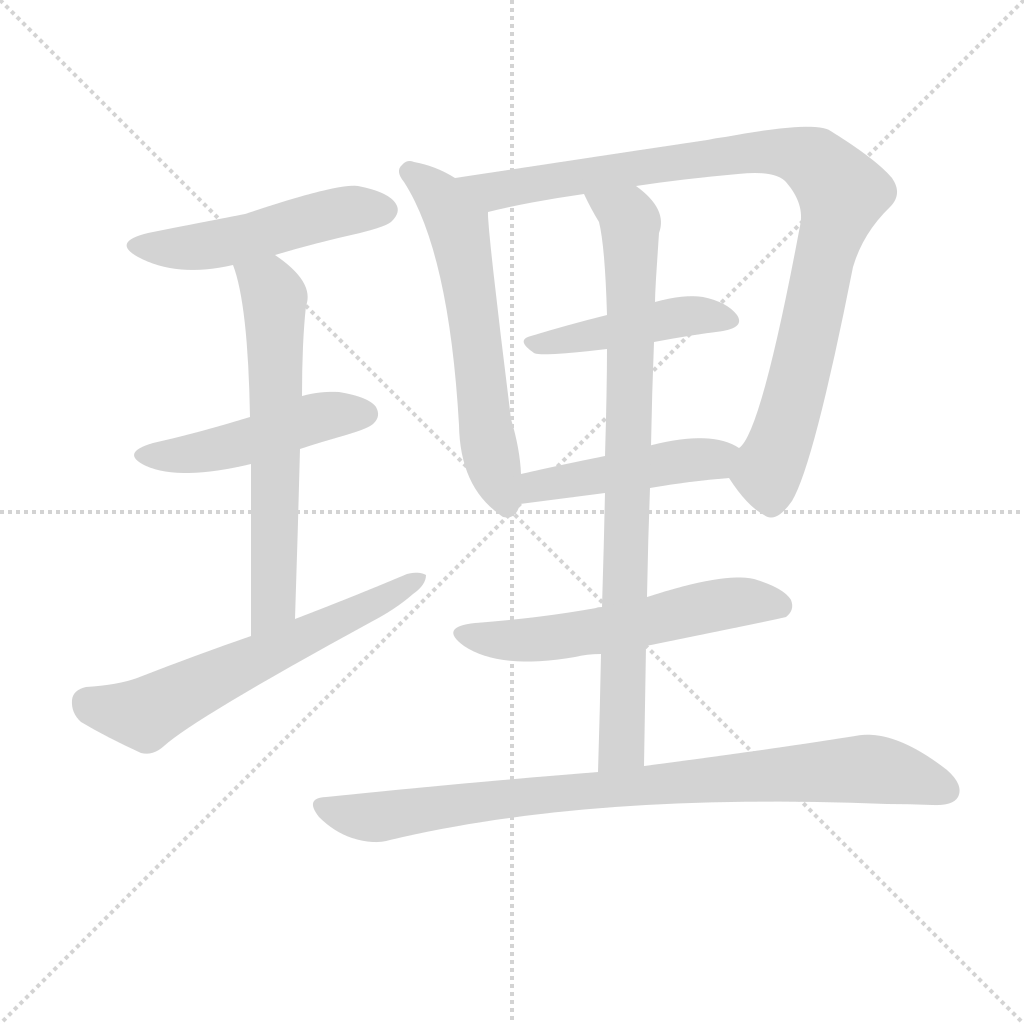
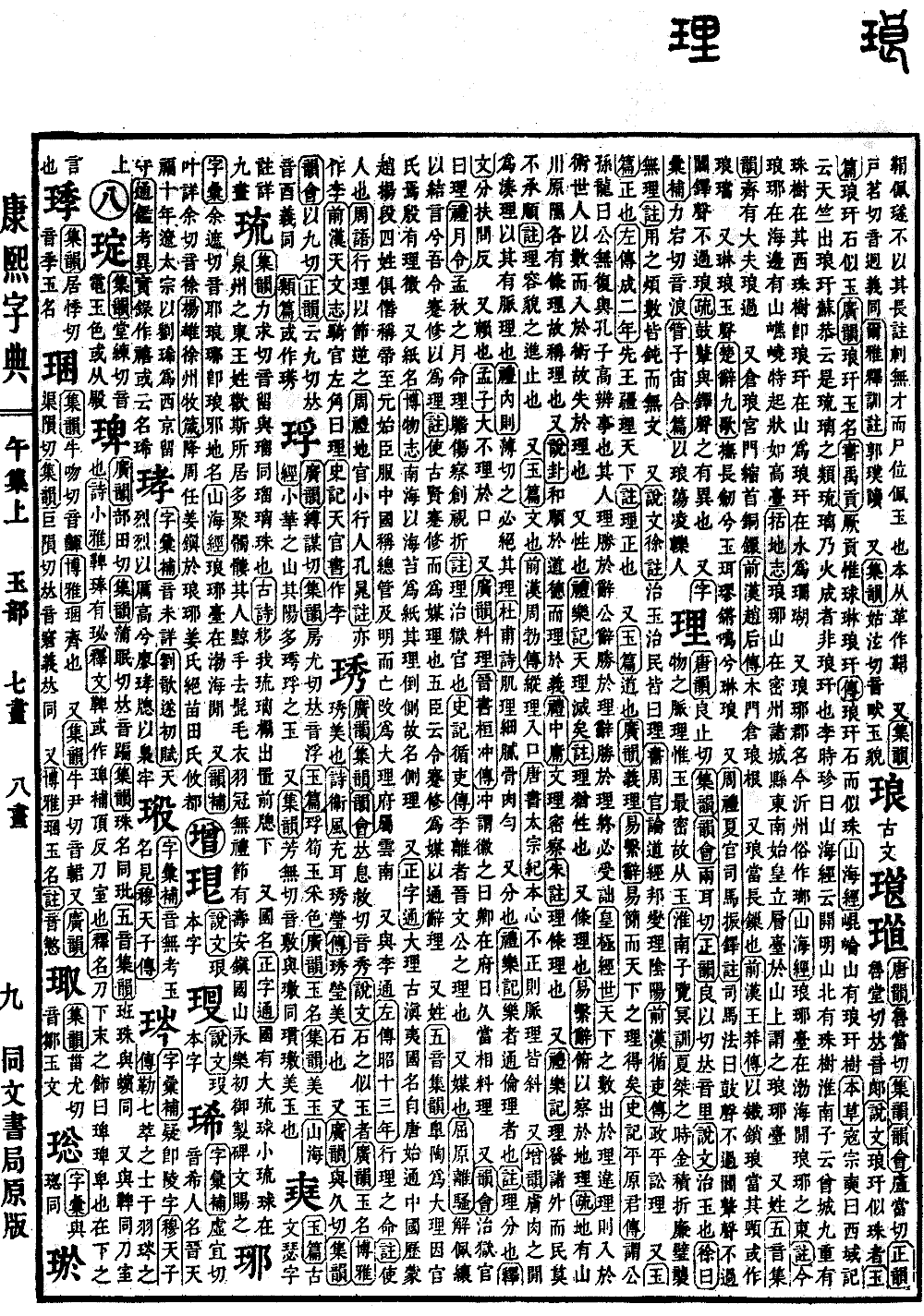
Wu Collection, Upper Volume
Radical: Jade (yù)
Kangxi Strokes: 12
Page 733, Entry 04
Tang Rhymes (Tangyun) states the pronunciation is li. Collected Rhymes (Jiyun) and Rhyme Compendium (Yunhui) state the pronunciation is li. Orthodox Rhymes (Zhengyun) states the pronunciation is li, sounding the same as the character li.
Explaining Characters and Phrases (Shuowen Jiezi) defines it as the working of jade.
Xu Kai says: The texture and veins of things are most fine and dense in jade, which is why the character form follows jade.
Huainanzi, Chapter on Viewing the Dark (Lanming Xun): In the era of Jie of Xia, metals accumulated until their sharp edges were worn smooth, and jade discs lost their texture due to frequent use.
Commentary: When used too frequently, they become blunt and lose their ornamental patterns.
Also, in the commentary to Explaining Characters and Phrases (Shuowen Xuzhu), processing jade and managing the common people are both called li.
Book of Documents (Shangshu), Chapter on Official Posts of Zhou (Zhouguan): Exploring the path of governance, managing the country, and harmonizing yin and yang.
History of the Former Han (Qian Hanshu), Biography of Upright Officials (Xunli Zhuan): Government affairs were harmonious, and lawsuits were handled justly.
Also, Jade Compendium (Yupian) defines it as to correct or to make upright.
Zuo Tradition (Zuozhuan), Second Year of Duke Cheng: The former kings divided boundaries and governed the world.
Commentary: Li means to make things upright.
Also, Jade Compendium (Yupian) defines it as reason or law.
Broad Rhymes (Guangyun): Principles (yili).
Book of Changes (Yijing), Appended Remarks (Xici): Having understood the simplicity of the Book of Changes, the principles of the world are all grasped.
Records of the Grand Historian (Shiji), Biography of Lord Pingyuan (Pingyuanjun Liezhuan): Zou Yan said to Gongsun Long: Do not argue with Kong Chuan again. That man has logic that surpasses his rhetoric, while you have rhetoric that surpasses your logic; if rhetoric surpasses logic, you will inevitably end up refuted and speechless.
Imperial Standard for Ordering the World (Huangji Jingshi): The laws of the world originate from principles; violating principles leads to power-seeking. People in the world fall into power-seeking because they pursue techniques, and thus lose sight of principles.
Also refers to nature.
Book of Rites (Liji), Record of Music (Yueji): The innate nature is extinguished.
Commentary: Li is like nature.
Also refers to patterns or order.
Book of Changes (Yijing), Appended Remarks (Xici): Look down and observe the patterns and forms of the earth.
Commentary: The earth has mountains, rivers, plains, and marshes, each having its own order and structure, which is why it is called li.
Also, Commentary on the Hexagrams (Shuogua Zhuan): Be in harmony with morality and use righteousness to organize things.
Book of Rites (Liji), Doctrine of the Mean (Zhongyong): Literary patterns are dense and clear.
Zhu Xi Commentary: Li means patterns.
Also, Book of Rites (Liji), Record of Music (Yueji): The order manifested by music is shown outwardly, and the common people accept and follow it without exception.
Commentary: Li refers to the measure and decorum in one's appearance and demeanor.
Also, Jade Compendium (Yupian) refers to textures or lines.
History of the Former Han (Qian Hanshu), Biography of Zhou Bo: There were vertical lines extending to the mouth.
Old Book of Tang (Tangshu), Annals of Emperor Taizong: If the original intent is not upright, then the blood vessels and textures will be distorted.
Also, Enlarged Rhymes (Zengyun): The gaps between skin and muscle are called cou-li, because they have pulse channels.
Book of Rites (Liji), Internal Rules (Neize): When cutting meat, one must cut across its grain.
Du Fu Poetry: The skin and grain are delicate, and the bones and flesh are proportionate.
Also refers to distinguishing or differentiating.
Book of Rites (Liji), Record of Music (Yueji): Music is what connects human relationships.
Commentary: Li means to differentiate.
Explanation of Characters (Shiewen): Fen, pronounced as fen.
Also refers to relying upon or depending on.
Mencius: Highly unsupported by public opinion.
Also, Broad Rhymes (Guangyun) defines it as to manage or to process.
History of Jin (Jinshu), Biography of Huan Chong: Huan Chong said to Wang Huizhi: Having been in the office for a long time, you should learn to handle affairs.
Also, Rhyme Compendium (Yunhui) states that officials who manage prisons are called li.
Book of Rites (Liji), Monthly Ordinances (Yueling): In the first month of autumn, command the judicial officials to inspect injuries, examine wounds, and observe bone fractures.
Commentary: Li is the official who manages prisons.
Records of the Grand Historian (Shiji), Biography of Upright Officials (Xunli Liezhuan): Li Li was a judicial official under Duke Wen of Jin.
Also refers to a matchmaker.
Qu Yuan, Encountering Sorrow (Lisao): Untie the girdle and tie the token; I shall have Jian Xiu act as a matchmaker.
Commentary: Engage the ancient sage Jian Xiu to act as a matchmaker. The Five Scholars' Commentary says: Let Jian Xiu act as matchmaker to convey words and communicate sentiments.
Also a surname.
Five Tones Rhyme Compendium (Wuyin Jiyun): Gao Yao served as Da Li (an official title), so the office name became the surname. The Shang dynasty had an individual named Li Zheng.
Also a name for a type of paper.
Record of All Things (Bowuzhi): The South Sea uses seaweed to make paper; its texture is slanted, hence it is called side-texture paper (celi zhi).
Also, Essentials of Characters (Zhengzitong): Dali was the name of a country established by an ethnic minority in the ancient Dian region. Starting from the Tang dynasty, it engaged with China, passing through four surnames: Meng, Zhao, Yang, and Duan, all of whom usurped the title of emperor. It was not until the Yuan dynasty that it submitted to China as a governorship, and in the Ming dynasty, it was destroyed and renamed Dali Prefecture, belonging to Yunnan.
Also a variant of the character Li.
Zuo Tradition (Zuozhuan), Thirteenth Year of Duke Zhao: Conveying the orders of diplomatic envoys.
Commentary: Refers to an envoy.
Discourses of the States (Guoyu), Discourses of Zhou (Zhouyu): Send an envoy holding a tally to welcome them.
Jia Kui's commentary identifies this as a Lesser Traveler (a minor official). Kong Chao's commentary also writes it as Li.
History of the Former Han (Qian Hanshu), Treatise on Astronomy (Tianwen Zhi): The star to the left horn of the Cavalry Official star is called Li.
Records of the Grand Historian (Shiji), Treatise on the Celestial Offices (Tianguan Shu): Writes it as Li.
Textual Research: Discourses of Zhou (Zhouyu): Traveling officials (xingli) meet them with tallies. Book of Rites (Zhouli), Earth Officials, Lesser Traveler, Kong Chao's commentary also writes it as Li. Note: The commentary on the Lesser Traveler in the Book of Rites does not actually contain the text of Kong Chao writing it as Li; Kong Chao is the commentator of the Discourses of the States, and the three characters Lesser Traveler also belong to Jia Kui's commentary on the Discourses of the States. Now, following the commentary of the Discourses of Zhou as cited in the sub-commentary to the Zuo Tradition, Thirtieth Year of Duke Xi, it is corrected to: Jia Kui's commentary identifies it as a Lesser Traveler. Kong Chao's commentary also writes it as Li.