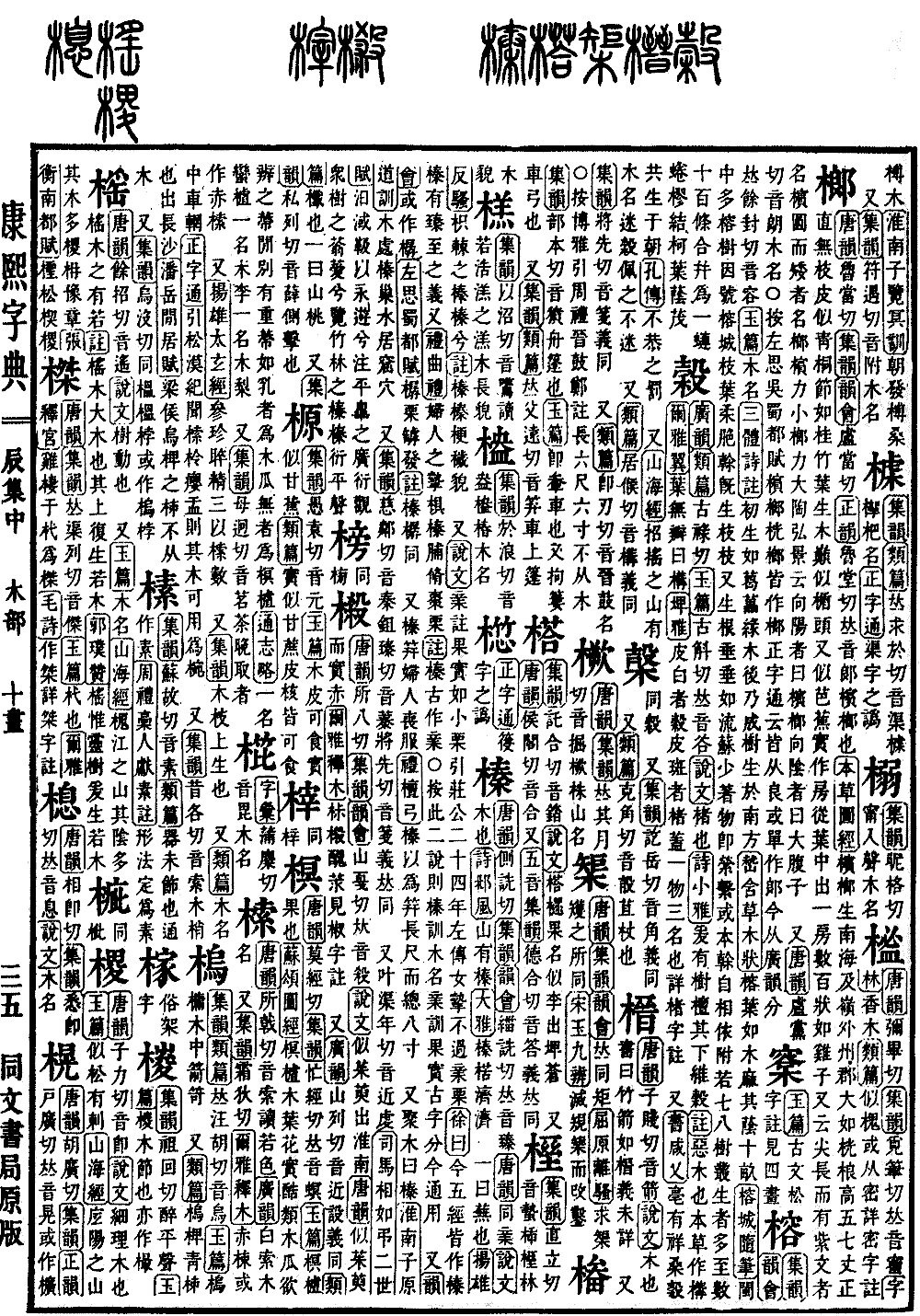
Chen Collection, Middle Volume
Radical: Tree (mù)
Page 543, Entry 04
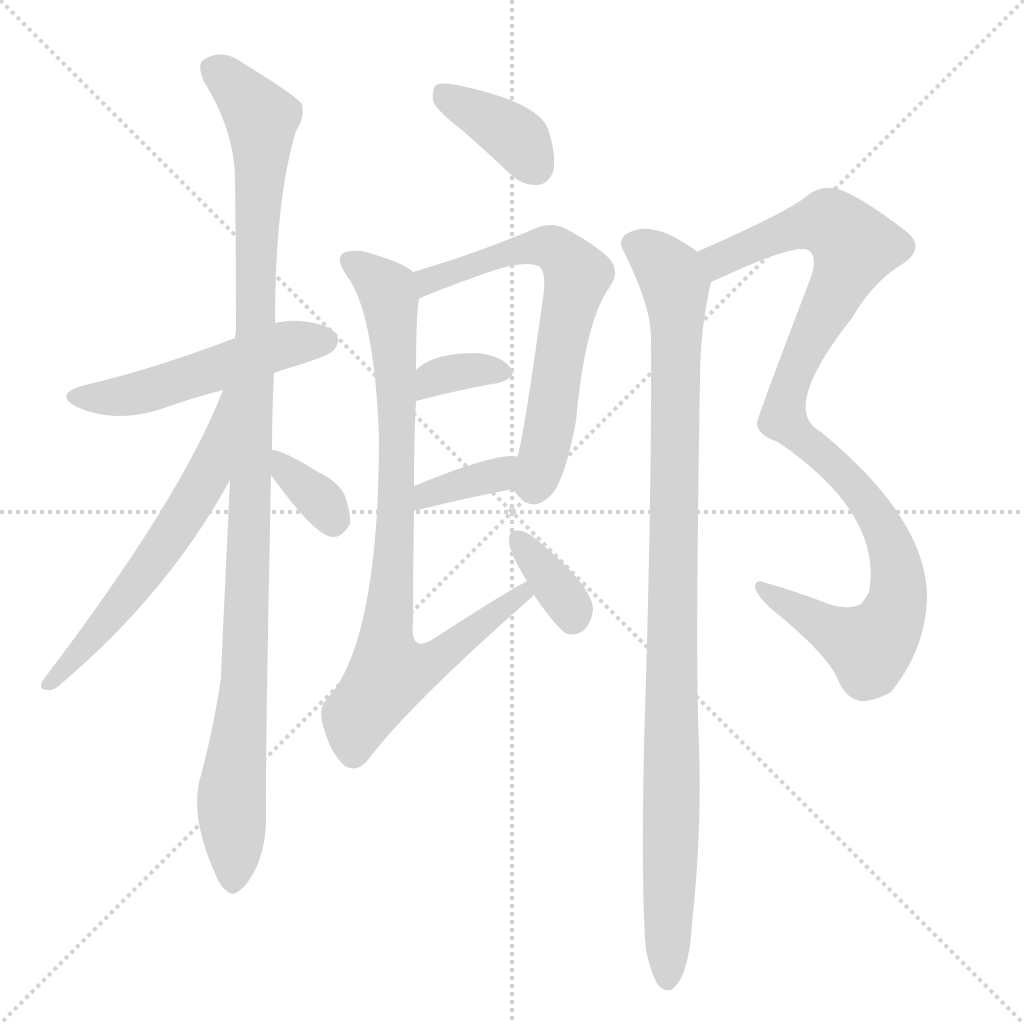
Pronounced lang. The areca nut. Compendium of Materia Medica (Bencao tujing) states: The areca tree grows in the Nanhai and Lingnan regions. It resembles the sugar palm, reaching heights of fifty to seventy feet. The trunk is straight with no branches, the bark resembles that of the Chinese parasol tree, and the nodes resemble those of the osmanthus bamboo. The leaves grow at the very top, shaped like shield heads or banana leaves. The fruits grow in clusters emerging from the center of the leaves; a single cluster contains hundreds of fruits, each the size of a hen's egg. Another source states: Fruits that are pointed and long with purple veins are called areca, while those that are round and short are also called areca. Some say the former possesses less strength while the latter possesses greater strength. Tao Hongjing states: Those growing on the sunny side are called areca, while those growing on the shaded side are called dafuzi.
Also pronounced lang. The name of a tree. According to the Rhapsody on the Capitals of Wu and Shu (Wu Shu du fu) by Zuo Si, both the areca and the sugar palm are written using this character. Correct Lexicon (Zhengzitong) states that both forms use the component meaning good. Alternatively, it is written as another character pronounced lang. Modern usage follows the Wide Rhymes (Guangyun) to distinguish between them.