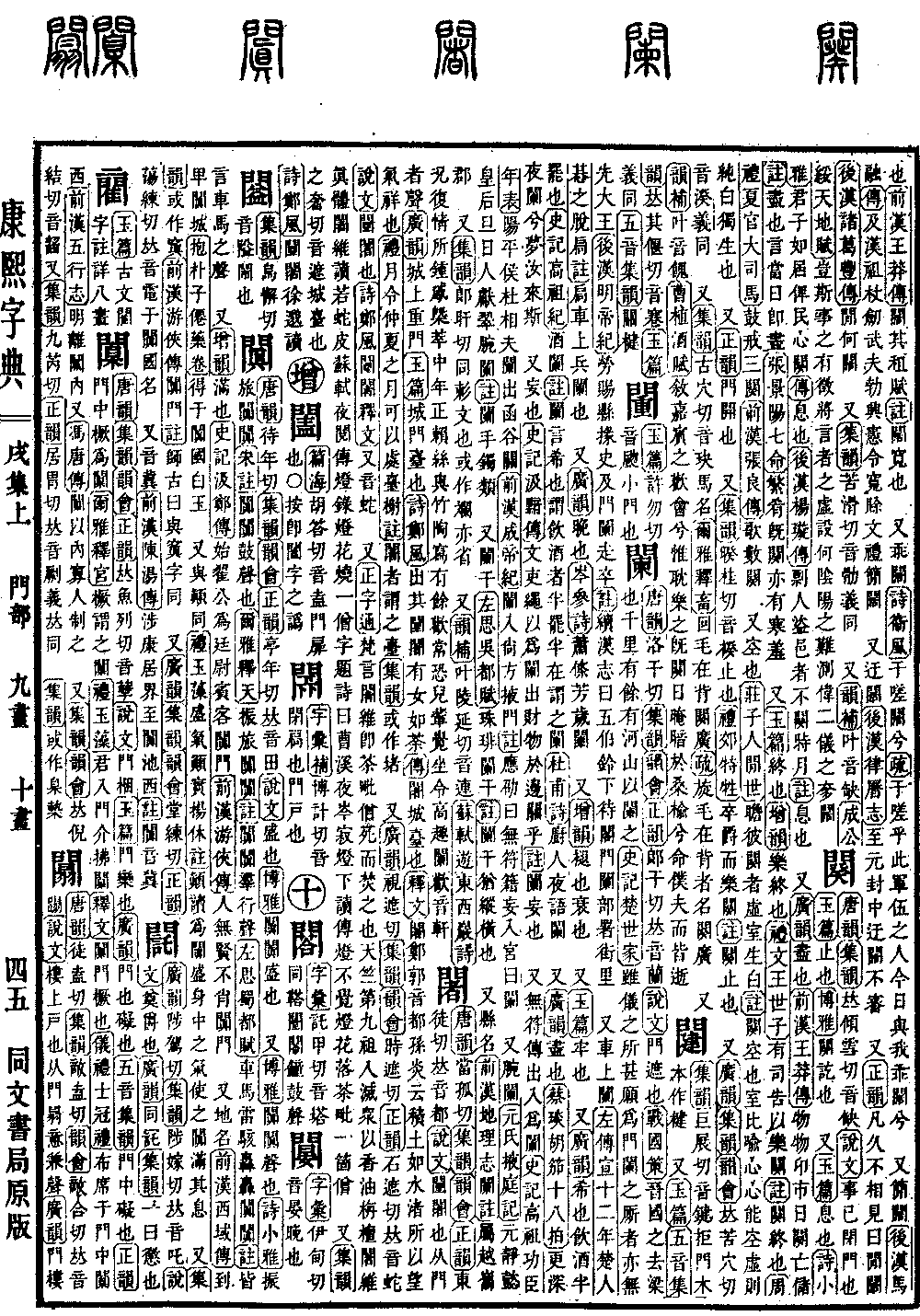
Xu Collection, Upper Volume
Radical: Gate (mén)
Kangxi strokes: 17
Page 1339, Entry 04
Pronounced lan.
As defined in the Analytical Dictionary of Chinese Characters (Shuowen Jiezi): A gate barrier.
Records of the Warring States (Zhanguo Ce): The distance from the State of Jin to Liang is over a thousand miles, with rivers and mountains to bar it.
Records of the Grand Historian (Shiji): Although it is something Zhang Yi would most desire to be a gate attendant for, there is no one who precedes the great king.
Book of the Later Han (Hou Hanshu), Annals of Emperor Ming: Rewarded the district clerks and the gate attendant couriers. Commentary: The Continuation of the Book of Han states: The five elders held bells, awaited at the cabinet gate, and managed the deployment of guards in the streets.
Also, the barrier on a carriage.
Zuo Tradition (Zuozhuan), Twelfth Year of Duke Xuan: Commentary on the passage concerning the Chu people instructing how to remove the carriage bar: A carriage bar is a weapon rail on a carriage.
Also, pronounced lan: Late.
Poem by Cen Shen: The fragrant years are desolate and late.
Also, from the Extended Dictionary (Zengyun): To fade, to decline.
Also, from the Jade Chapter (Yu Pian): A cage or pen.
Also, from the Broad Rhymes (Guangyun): Sparse. To stop drinking halfway through.
Records of the Grand Historian (Shiji), Annals of Gaozu: The wine was drawing to a close. Commentary: Lan means sparse. It refers to those drinking; when half have left and half remain, it is called lan.
Poem by Du Fu: The kitchen attendant speaks as the night grows late.
Also, from the Broad Rhymes (Guangyun): To end or exhaust.
Cai Yan, Eighteen Songs of a Nomad Flute: In the depth of night, when time is exhausted, I dream that you come here.
Also, recklessly or presumptuously.
Records of the Grand Historian (Shiji), Biography of Ji An: The administrative clerks bound him, thinking he had recklessly taken wealth and goods out through the border pass. Commentary: Lan means reckless.
Also, to enter or exit without a tally or pass is called lan.
Records of the Grand Historian (Shiji), Table of Meritorious Officials under Gaozu: Du Xiangfu of the Marquis of Yangping recklessly passed through Hangu Pass.
Book of the Former Han (Hanshu), Annals of Emperor Cheng: Recklessly entered the inner gate of the imperial workshop. Commentary: Ying Shao says: Entering the palace without a tally or register is called lan.
Also, a wrist-lan.
Yuan Family Imperial Garden Records (Yuanshi Yeting Ji): On the morning of Empress Dowager Jingyi of the Yuan, people presented jade wrist-lan. Commentary: Lan is a type of bracelet.
Also, lan-gan.
Zuo Si, Rhapsody on the Capital of Wu (Wu Du Fu): Pearls and shells scattered in disorder. Commentary: Lan-gan means crisscrossing or longitudinal and latitudinal.
Also, the name of a county.
Book of the Former Han (Hanshu), Treatise on Geography: Belonged to Yuexi Commandery.
Also, pronounced lan (same as above). Refers to patterned or variegated. Sometimes written as the variant form lan. Also in a simplified form.
Also, rhyming supplement: Pronounced lian.
Su Shi, Poem on Touring the East and West Crags: Furthermore, where my feelings are centered, emotions collect in middle age. Relying on strings and bamboo, there is more than enough joy to express. I always fear the children will notice, and sit causing my lofty interests to fade. (The character huan is pronounced xuan).