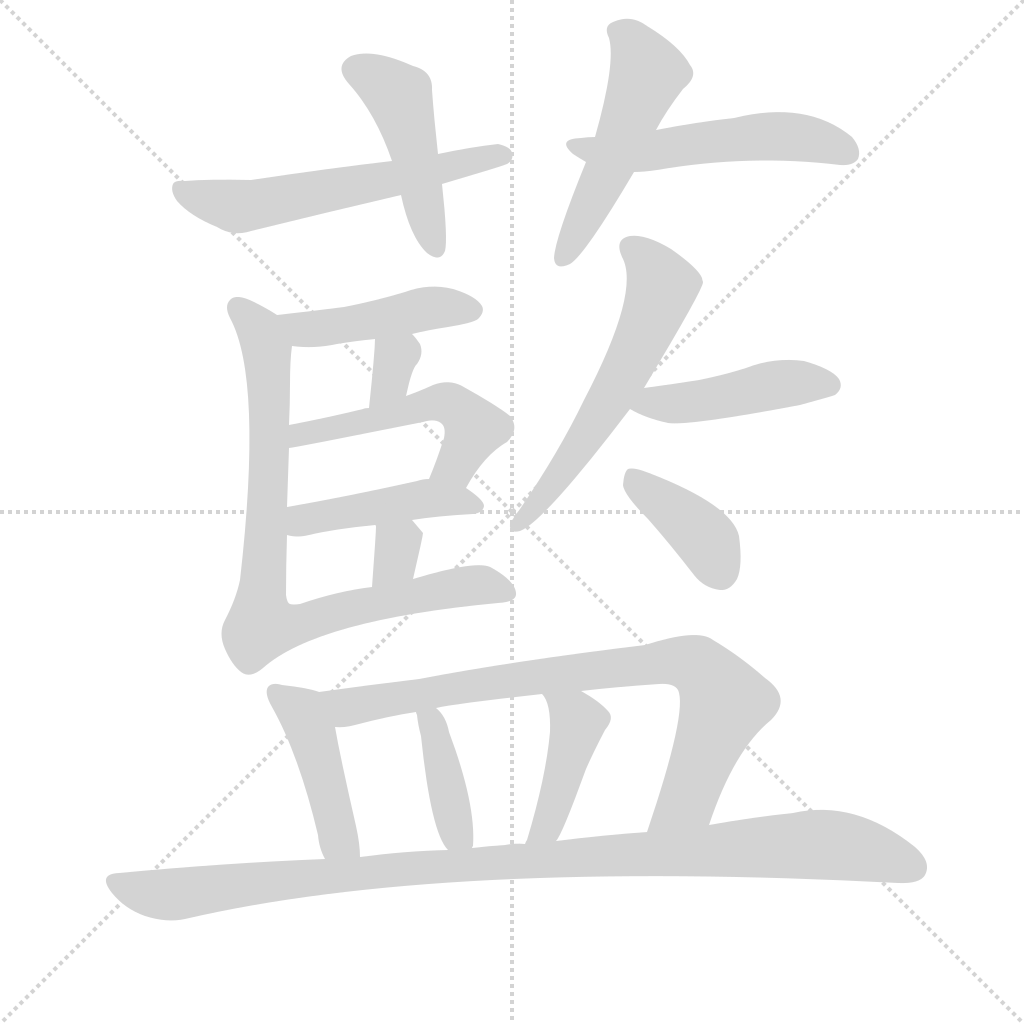
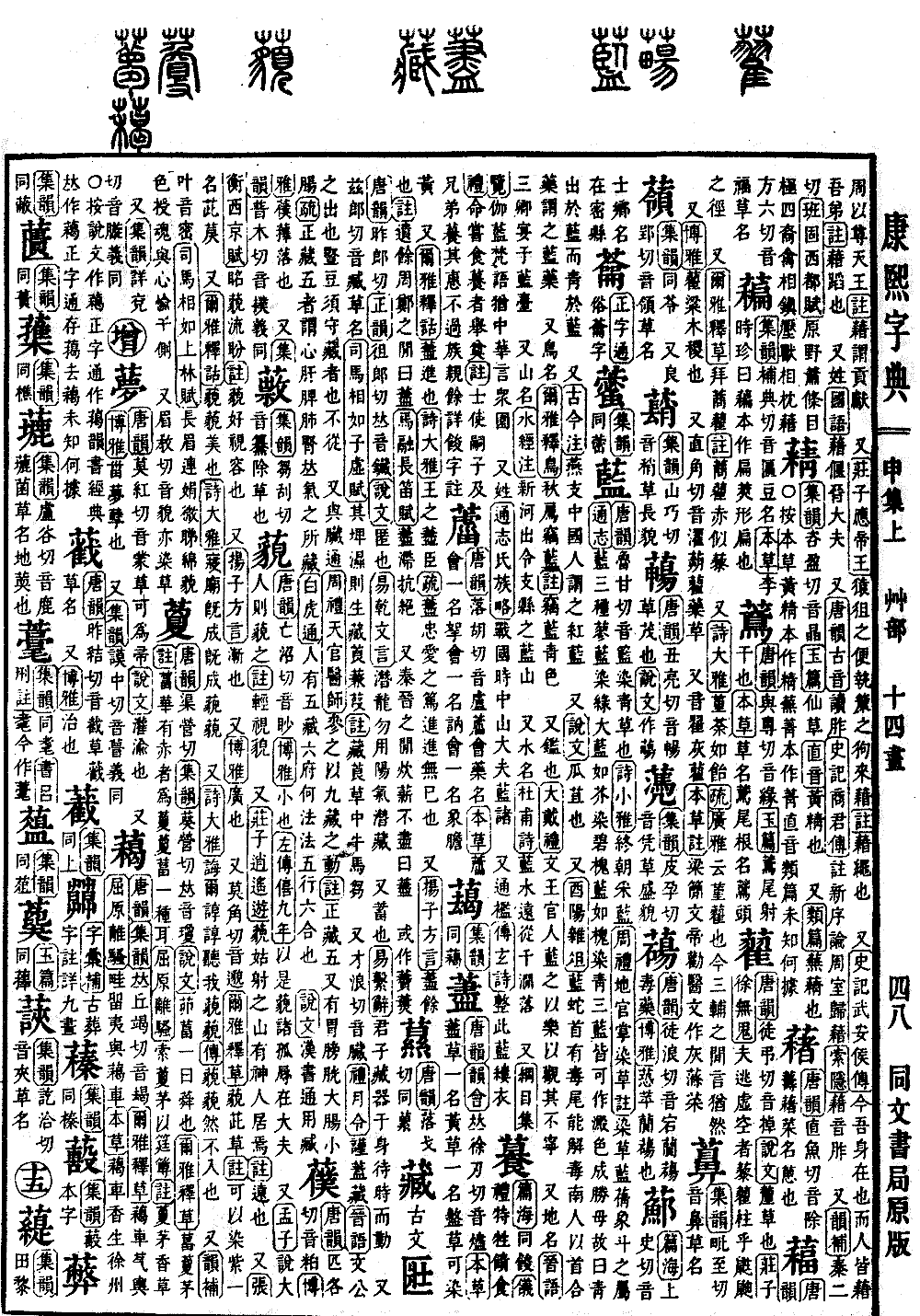
Shen Collection, Upper Volume
Radical: Grass (cǎo)
Kangxi Strokes: 20
Page 1064, Entry 16
Pronounced lan. To dye with green grass. Book of Odes (Shijing), Lesser Odes: To gather indigo for the whole morning. Rites of Zhou (Zhouli), Ministry of Earth: Overseer of Dyeing Herbs, commentary: The herbs used for dyeing include indigo and madder, which belong to the buckwheat family. Comprehensive Records (Tongzhi): There are three types of indigo: water-pepper indigo dyes green, large indigo resembles mustard and dyes blue-green, and pagoda-tree indigo resembles the pagoda tree and dyes blue. All three types can be made into sediment; the color produced surpasses the original source, hence the saying, green is extracted from indigo but is bluer than indigo.
Also, Ancient and Modern Notes (Gujinzhu): Rouge is called red-indigo by the Chinese. Also, Explaining Graphs (Shuowen): The stalk of a melon. Also, Miscellaneous Morsels from Youyang (Youyang Zazu): The indigo snake; its head is venomous, but its tail can neutralize the poison. Southerners use its head in medicine, calling it indigo medicine.
Also, a type of bird. Literary Expositor (Erya), Explaining Birds: The autumn swallow is called stealing-indigo. Commentary: Stealing-indigo is a blue-green color.
Also, to overflow. Record of Rites by Elder Dai (Dadai Liji): When King Wen selected his officials, he flooded them with music to observe whether they remained composed.
Also, a place name. Discourses of the States (Jin Yu): The three ministers feasted at the Indigo Terrace.
Also, a mountain name. Commentary on the Water Classic (Shuijing Zhu): The New River flows from Indigo Mountain in Lingzhi County.
Also, a water name. Du Fu poetry: The Indigo River flows from a thousand mountain falls.
Also, Comprehensive Compendium of the Outline (Gangmu Jilan): Sangharama (qielan), a Sanskrit term, is similar to what the Chinese call a monastery.
Also, a surname. Comprehensive Records (Tongzhi), Treatises on Clans: During the Warring States period, there was an official of Zhongshan named Lan Zhu.
Also, interchangeable with ragged. Fu poetry: Arranging these ragged garments.
Textual research: The character for mirror was changed to the character for overflow in accordance with the commentary to the Record of Rites by Elder Dai.