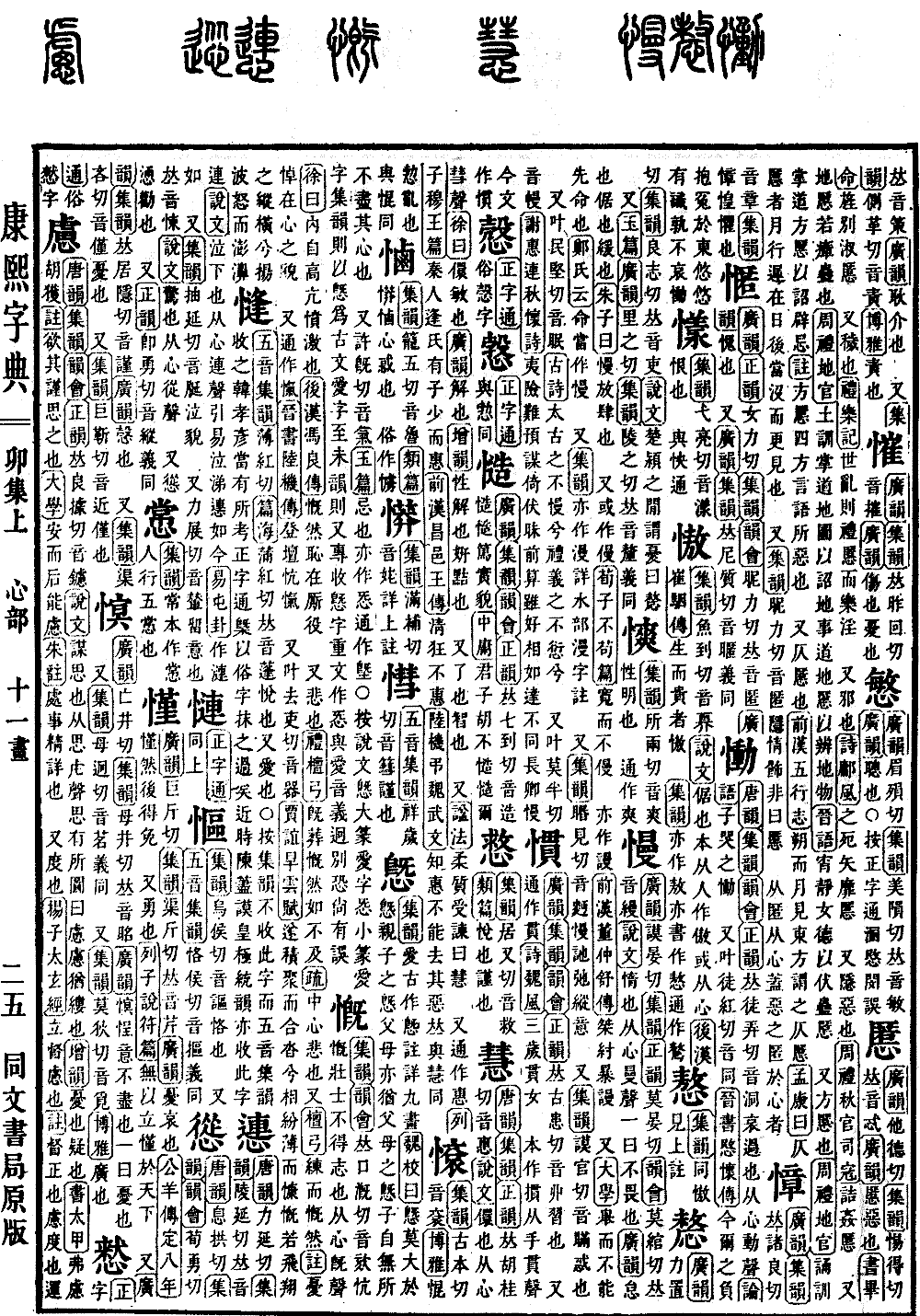
Mao Collection, Upper Volume
Radical: Heart (xīn)
Kangxi Strokes: 15
Page 399, Entry 34
Tang Dynasty Rhymes (Tangyun), Collection of Rhymes (Jiyun), Dictionary of Rhymes (Yunhui), and Corrected Rhymes (Zhengyun) all provide the fanqie spelling liang ju, pronounced lü.
According to the Explaining Graphs and Analyzing Characters (Shuowen), it means to plan and reflect. Derived from the character for thought, with hu as the phonetic element. When one has a plan for something, it is called lü; lü is like a thread.
According to the Augmented Rhymes (Zengyun), it means to worry or to doubt.
Book of Documents (Shujing), Chapter on Taijia: If one does not plan, how can one obtain success? Commentary: This means one desires him to consider matters with caution.
Great Learning (Daxue): Only after one is tranquil can one deliberate. Zhu Xi’s Commentary: This speaks of handling matters precisely and thoroughly.
Also, to estimate or assess.
Yangzi’s Supreme Mystery (Taijing): To establish a standard for assessment. Commentary: Du means to correct; lü means to estimate. It means to use the correct standard to estimate.
Also, to aggregate is called wanglü.
History of the Former Han (Qian Hanshu), Commentary on Books: This is a generalized expression, meaning that one knows the approximate amount without needing to calculate or deliberate.
Also, banners held at the front of an army are called lüwu.
Zuo’s Commentary (Zuo Zhuan), 12th Year of Duke Xuan: The advance guard is called lüwu. Commentary: It refers to considering whether things are present or absent. Correct Interpretation (Zhengyi): It explains that one reflects on things that have not yet occurred to make others aware and prepared for them.
Also, according to Explaining Names (Shiming): Lü is to travel; travel means many.
Book of Changes (Yijing), Great Commentary: Reaching the same goal through a hundred different deliberations. Commentary: Reflections cover many things, but one uses a single principle to unify them.
Also, a surname. Zuo’s Commentary: Nan Kuai’s minister was Lü Gui.
Also, according to Extensive Rhymes (Guangyun), the fanqie spelling li ju, and in Collection of Rhymes (Jiyun), Dictionary of Rhymes (Yunhui), and Corrected Rhymes (Zhengyun), the fanqie spelling ling ru, pronounced lü.
Corrected Rhymes (Zhengyun): To reflect or deliberate.
Huainanzi, Chapter on the Source of the Way (Yuandao Xun): Peaceful and without thoughts, calm and without worries. With the sky as a canopy and the earth as a carriage.
Also, a tree name. Er Ya, Explanation of Trees: Zhulü is a type of mountain creeper.
Also, names of places. Longlü is in Henei. Wulü is in Liaodong. Qulü is in Linhuai. Qielü is in Liaoxi. Changlü is in Haidong. Long is pronounced lin, qu is pronounced qu, qie is pronounced ju.
Also, according to Ancient and Modern Character Examinations (Gujin Zikao), the fanqie spelling liang ju, pronounced lü.
Song of Jishan: The sun and moon move and shine, there is nothing they do not record and see. Wandering and roaming within this, what is there to fear or deliberate?
Also, according to Correcting Character Patterns (Zhengzitong), the fanqie spelling lu gu, pronounced lu.
Old Book of Tang (Tangshu), Treatise on Officialdom: The Court of Judicial Review is in charge of adjudicating and trying cases; all prisoners are interrogated and reviewed every five days.
History of the Former Han (Qian Hanshu), Biography of Juan Buyi: Every time he inspected the subordinate counties, he would review the prisoners upon his return. Shigu’s Commentary: Reviewing (lu) prisoners is now called deliberating (lü) on prisoners; it is originally just the departing tone of the sound lu. Modern customs do not understand this meaning and mistakenly treat it as the lü of reflection, losing its origin. In my view, this remark by Shigu is close to understanding characters, but in reality, he did not master phonology. Because he did not master phonology, he cannot be said to understand the origin of characters. Generally, every character originally possesses four tones; for example, the character lü starts from the level tone: lü, lü, lü, lu. Thus, lü is the level tone, lü is the rising tone, and lu is the entering tone. The original meaning of lü is to plan and reflect, but it also contains the meaning of detailed inspection; therefore, the recording of prisoners in the Han History is indeed the deliberating of prisoners. The character lü originally possessed the entering tone and had the sound of lu; is it necessarily restricted only to the departing tone to be considered the origin of the character?
Also, rhyming with the fanqie spelling lang gu, pronounced lu.
Songs of Chu (Chuci), Nine Chapters: Only the beauty alone harbors sorrow, plucking fragrant pepper to isolate oneself. Sighing and sobbing in distress, alone I hide and deliberate.
Note: It originally falls under the character for thought, and both the Shuowen and the Jade Chapter (Yupian) categorize it under the Heart radical. The Character Collection (Zihui) merged it into the Heart radical for ease of reference.
Verification: Great Learning (Daxue): Only after one is tranquil can one deliberate. Zhu Xi’s Commentary: This speaks of handling matters precisely and thoroughly. Revised according to the original text as: It speaks of handling matters precisely and thoroughly.