Shen Collection, Upper Volume
Radical: Grass (cǎo)
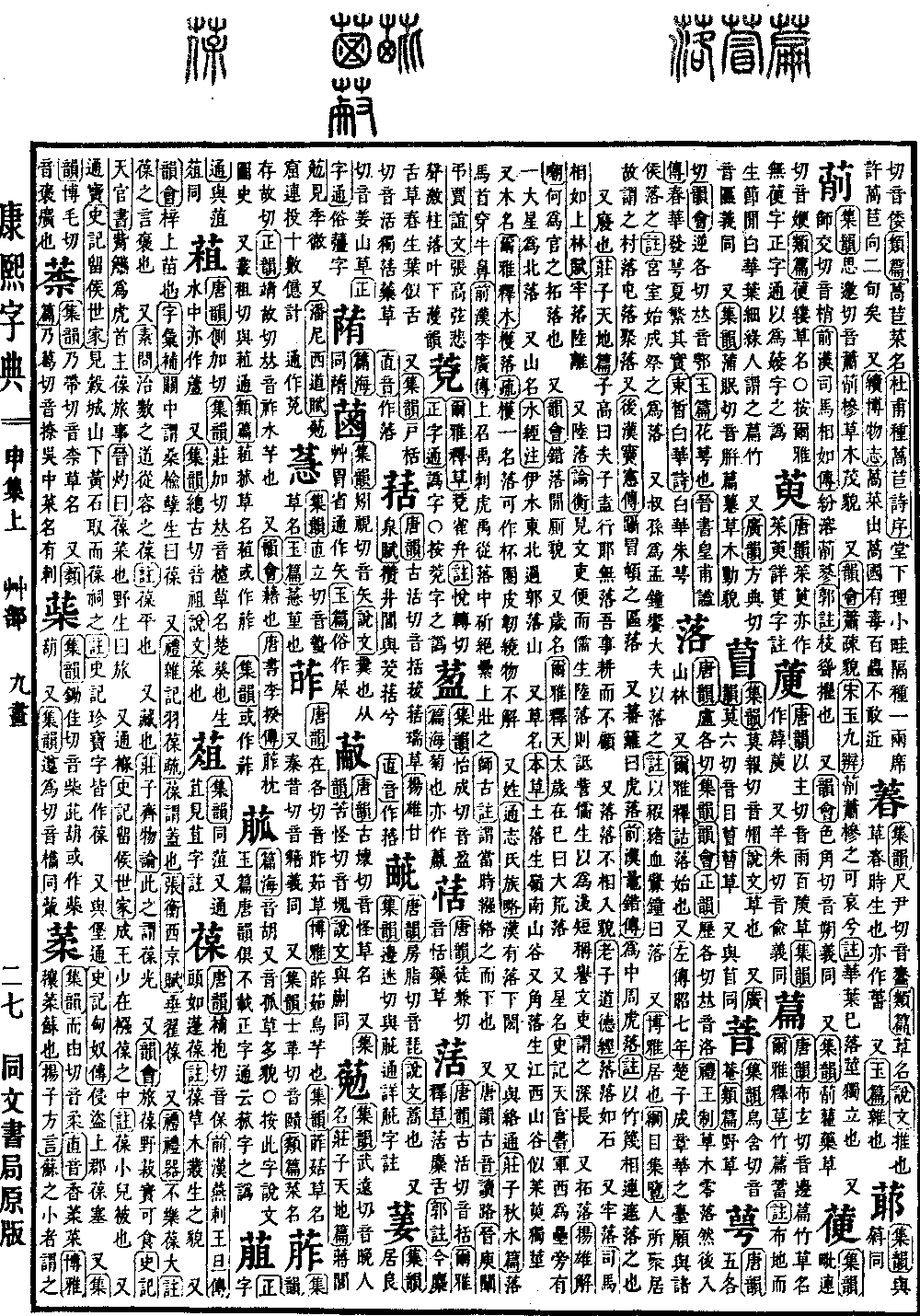
Page 1043, Entry 11
Pronounced luo.
According to the Book of Rites (Liji), one may enter the mountains and forests to fell trees only after the vegetation has withered and fallen.
Also, according to the Erya: Shigu, the term luo signifies a beginning.
Also, in the Zuo Zhuan (Zuozhuan), when King Ling of Chu completed the Zhanghua Terrace, he wished to hold a completion sacrifice together with the feudal lords. The commentary notes that when a palace is newly built, the inaugural sacrifice is called luo.
Also, when Shusun cast a bell for Meng Bing, he hosted the grandees for a bell-consecration ceremony. The commentary notes that smearing a new bell with the blood of a piglet is called luo.
Also, according to the Guangya, it signifies a place of residence.
According to the Gangmu Jilan, places where people congregate are referred to as villages (cunluo), settlements (tunluo), or hamlets (juluo).
Also, in the History of the Later Han (Hou Hanshu), it refers to pacifying the tribes of Modu.
Also, a fence is called a huluo.
In the History of the Former Han (Qian Hanshu), it refers to installing an inner bamboo fence. The commentary notes this involves using bamboo strips connected to form a barrier.
Also, it means to decline or be abandoned.
In the Zhuangzi (Zhuangzi), Zigao said, Sir, why do you not move away and stop obstructing my work? Having said this, he buried his head in his plowing and did not look back.
Also, the reduplicated form luoluo describes an incompatible or alienated state.
In the Laozi (Daodejing), it describes a solitary appearance like a stone.
Also, the form laoluo describes a sparse, scattered, or adrift state.
In Sima Xiangru's Rhapsody on the Shanglin Park (Shanglin Fu), it describes a vast, empty, and scattered radiance.
Also, the form luoluo describes being frustrated or unfulfilled in one's ambitions.
In the Lunheng, it observes that when people see civil officials succeed and scholars suffer in obscurity (luopo), they disparage the scholars as superficial and praise the civil officials as brilliant.
Also, the form tuoluo describes being crestfallen or unsuccessful.
In Yang Xiong's Dispel of Ridicule (Jie Chao), it asks why one is so unsuccessful in official service.
Also, according to the Yunhui, the form cuoluo describes an intertwined or mixed appearance.
Also, it is a name for a year in the Jupiter cycle. According to the Erya: Shitian, the year when the Grand Duke (Jupiter) is in the position of Si is called Dahuangluo.
Also, it is the name of a star. In the Records of the Grand Historian (Shiji), it is noted that to the west of the military encampment stars, there is a large star called Beiluoxing.
Also, it is the name of a mountain. In the Commentary on the Water Classic (Shuijingzhu), it is noted that the Yi River flows northeast past Mount Guoluo.
Also, it is the name of an herb. In the Materia Medica (Bencao), Tuluo is described as growing in the valleys of Lingnan.
Also, a type that grows in the valleys of Jiangxi, resembling dogwood with a single stem.
Also, the name of a tree. According to the Erya: Shimu, the huoshu is also called luo. The commentary notes that the huoshu, also known as luo, can be used to make cups and plates, and its bark is flexible and durable enough for binding items without loosening.
Also, a surname. According to the Tongzhi: Zhilulue, there was a Luoxia Hong during the Han dynasty.
Also, it functions interchangeably with the character meaning to entangle or web (luo).
In the Zhuangzi (Zhuangzi), it refers to placing a halter on a horse's head and a tether through a bull's nose.
In the History of the Former Han (Qian Hanshu), the Emperor summoned Li Yu to spear a tiger; Li Yu cut the ropes of the net (to save the tiger), and the Emperor deemed him brave. The commentary by Shigudai notes this describes the practice of using rope nets to lower a tiger.
Also, in the ancient phonology of the Tangyun, it is pronounced lu.
In Yu Chan's Lament for Jia Yi (Diao Jia Yi Wen), the zither strings are taut with a mournful and intense melody, as if the bridge of the instrument were about to collapse. It rhymes with the character huo in the following line.