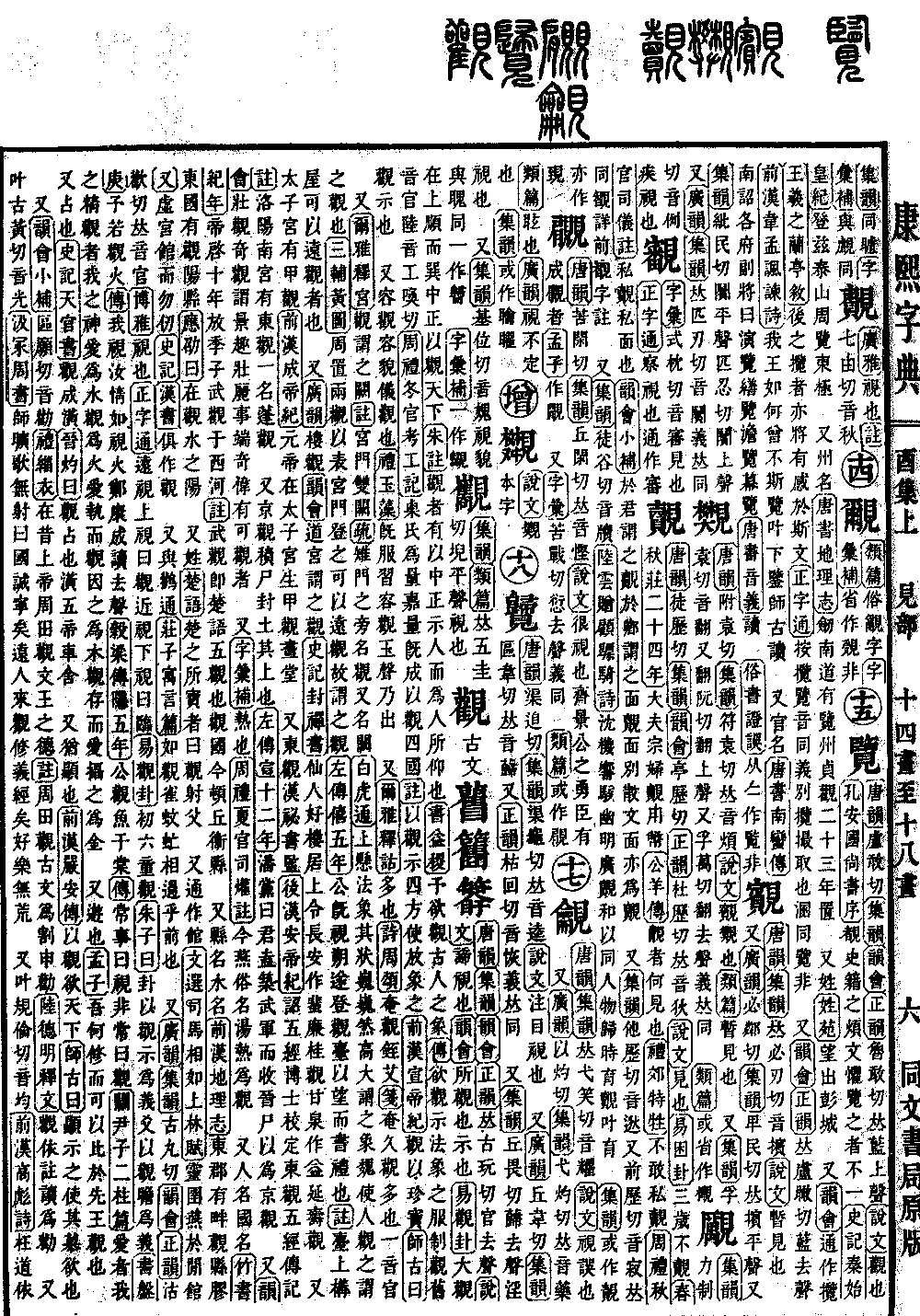
You Collection, Upper Volume
Radical: See (jiàn)
Kangxi Strokes: 22
Page 1138, Entry 01
Pronounced lan (rising tone).
Shuowen Jiezi (Explaining Single and Analyzing Compound Characters): To observe.
Kong Anguo, Preface to the Book of Documents (Shangshu): Seeing that the historical records and texts were complex and numerous, he feared that readers might not achieve a consistent understanding.
Records of the Grand Historian (Shiji), Annals of Qin Shi Huang: Ascending this Mount Tai, one observes everywhere to the extreme east.
Also a prefecture name.
Book of Tang (Tangshu), Treatise on Geography: In the Jiannan Circuit, there was a Lan Prefecture, established in the twenty-third year of the Zhenguan reign period.
Also a surname.
Xingyuan (Garden of Surnames): The commandery prominence originates from Pengcheng.
Also, in the Rhyme Collection (Yunhui), it is used interchangeably with lan (to grasp).
Wang Xizhi, Preface to the Orchid Pavilion Collection (Lanting Xu): Future readers will also have reflections upon these writings.
Zhengzitong (Guide to Correct Characters): Note that lan (to grasp) and lan (to observe) are pronounced the same but differ in meaning. Lan (to grasp) means to gather or take. Confusing it with lan (to observe) is incorrect.
Also pronounced lan (falling tone).
Book of Han (Hanshu), Wei Meng, Satirical Admonition Poem: How is our King, yet he does not perceive this? It rhymes with the following word jian (to mirror/scrutinize); this is how Yan Shigu read it.
Also an official title.
Book of Tang (Tangshu), Biography of the Southern Barbarians: In Nanzhao, the deputy generals of the various prefectures were called yanlan, shanlan, danlan, and mulan.
Book of Tang (Tangshu), Sound and Meaning: Read as lan.
Sushu Zhengwu (Correction of Common Errors in Writing): Writing it with the component ren (亽) as lan is incorrect.