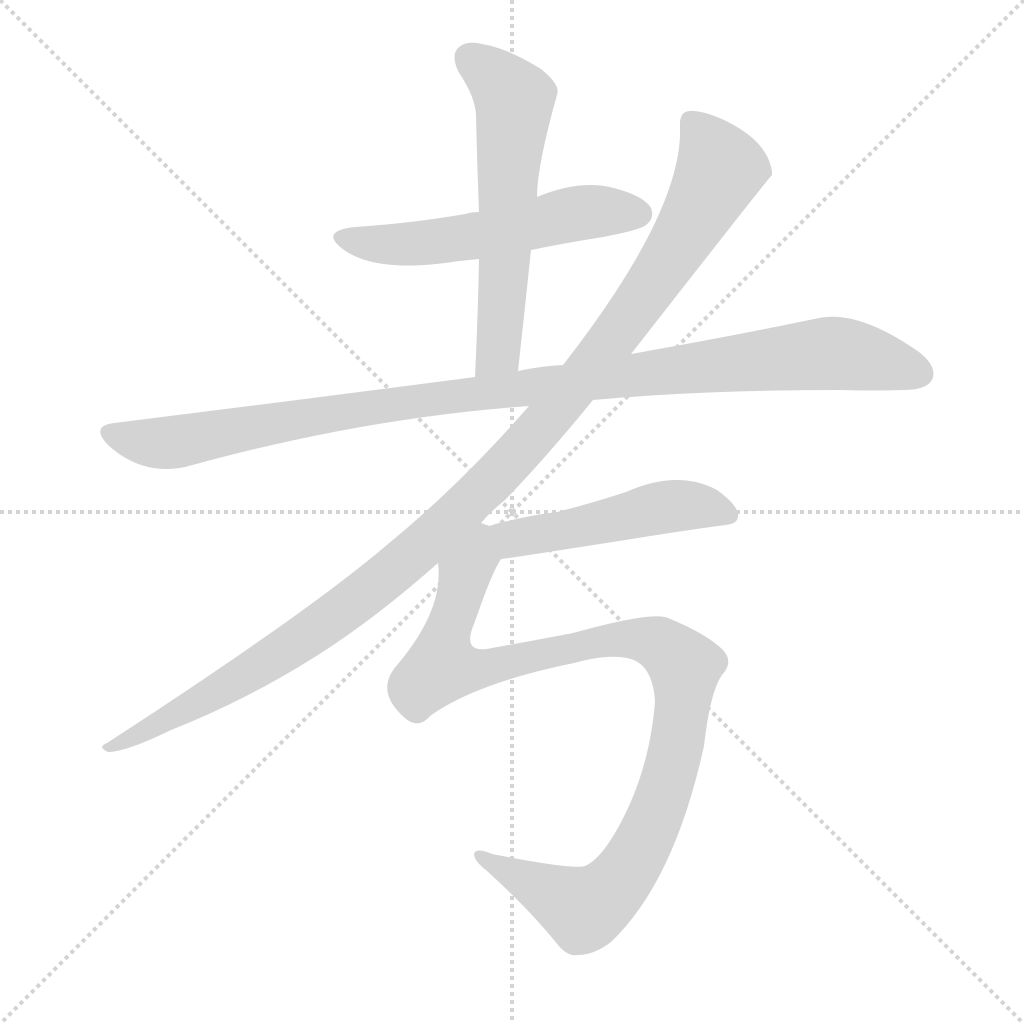
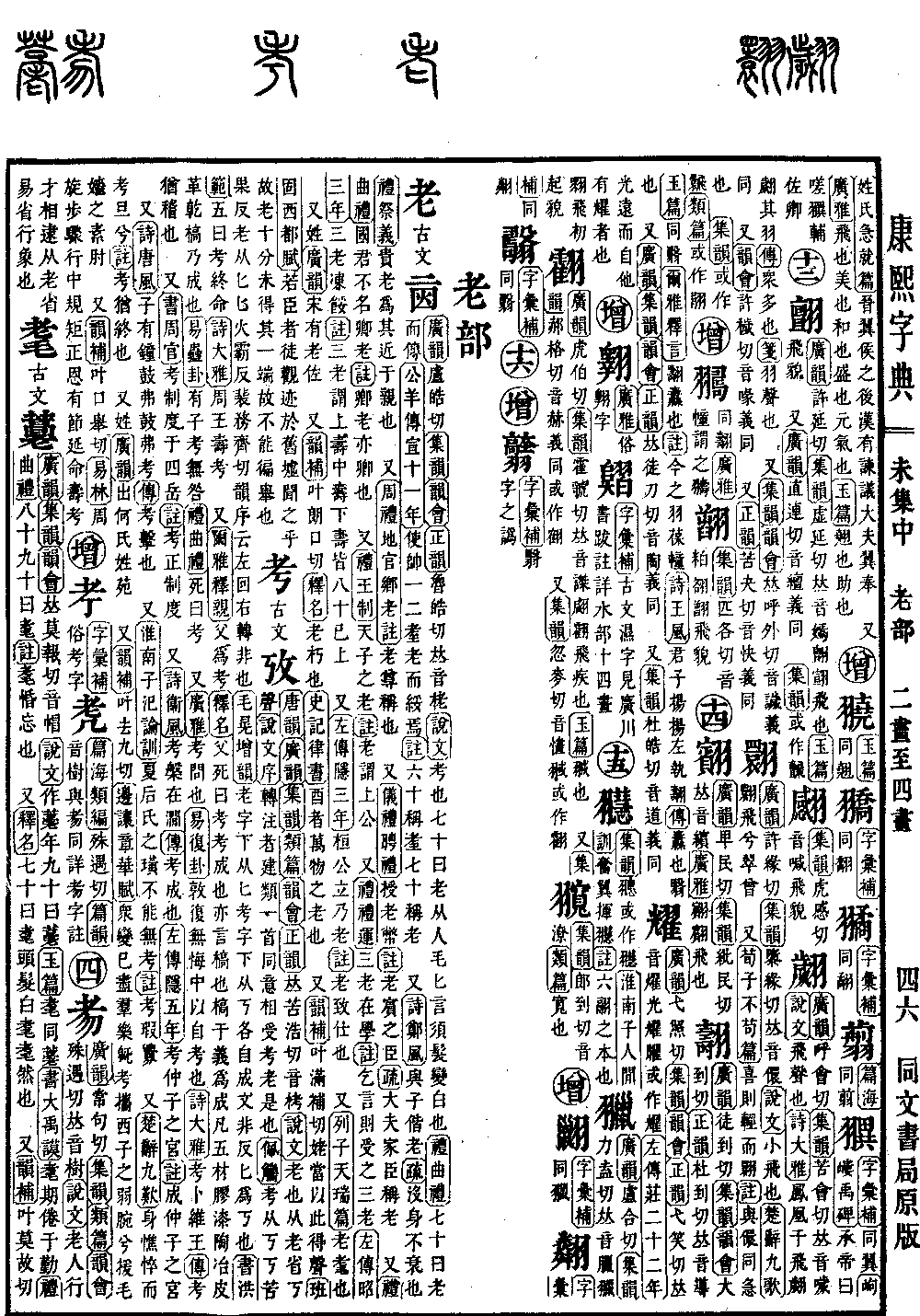
Wei Collection, Middle Volume. Radical: Old (lǎo). Page 960, Entry 27.
In ancient writing, it is written as a variant form (kǎo).
Tang Rhyme (Tangyun), Broad Rhymes (Guangyun), Collected Rhymes (Jiyun), Classified Chapters (Leipian), Rhyme Meeting (Yunhui), and Correct Rhymes (Zhengyun) all provide the pronunciation as kǎo (third tone). It is pronounced the same as kǎo (the word for mountain ash).
Analytical Dictionary of Characters (Shuowen Jiezi) defines it as meaning old. The character structure is composed of an abbreviated form of old and the phonetic component for kǎo.
Preface to the Analytical Dictionary of Characters (Shuowen Jiezi Xu) states: The method of derivative cognates (zhuanzhu) is to establish characters within the same radical that share similar meanings to explain one another; kǎo and lǎo are such examples.
Jade Pendant (Peixi) points out: The character kǎo is derived from the phonetic component for kǎo. The character for that phonetic component is pronounced kǎo (third tone). The character lǎo is derived from the component for dagger (bǐ). That component is pronounced huà (fourth tone). Pei Wuqi, in his Preface to the Cutting Rhymes (Qieyun Xu), states that left-turning and right-turning is incorrect.
Mao Huang, in Augmented Rhymes (Zengyun), states: The character lǎo has the dagger component at the bottom, and the character kǎo has the phonetic component for kǎo at the bottom; each is an independent character structure, and it is not the case that the dagger component is inverted to become the kǎo component.
Book of Documents (Shangshu), chapter Great Plan (Hongfan): The fifth of the five blessings is to reach a natural end of one's life.
Book of Odes (Shijing), Great Odes (Daya): The King of Zhou enjoyed a long life.
Furthermore, Approaching the Classics (Erya), chapter Explaining Kinship (Shiqin): A father is called kǎo.
Definition of Names (Shiming): When a father passes away, he is called kǎo. Kǎo means to complete. It also carries the meaning of being withered and dry; being withered and dry means to reach completion in essence, just as the five types of materials—glue, lacquer, potter's clay, smelted metal, and leather—must be dried and withered before they can be crafted into objects.
Classic of Changes (Yijing), Hexagram of Corruption (Gua): Having a son who succeeds to his father's work results in no calamity.
Book of Rites (Liji), chapter Royal Regulations (Quli): Death is referred to as kǎo.
Additionally, Extended Rhymes (Guangya) explains: Kǎo means to inquire.
Classic of Changes (Yijing), Hexagram of Return (Fu): To return to the correct path with honest integrity brings no regret, and one can introspect within.
Book of Odes (Shijing), Great Odes (Daya): It is the King who examines the divination.
Mao Commentary: Kǎo is similar to examining.
Furthermore, Book of Documents (Shangshu), chapter Officers of Zhou (Zhouguan): Examine and rectify the institutions at the four mountains.
Commentary: To examine and rectify the institutions.
Furthermore, Book of Odes (Shijing), Odes of Wei (Weifeng): The music of perfected virtue is in the mountain stream.
Mao Commentary: Kǎo means to complete or achieve.
Zuo Tradition (Zuo Zhuan), fifth year of Duke Yin: Constructing the temple palace for the descendant Zhongzi.
Commentary: Constructing the temple palace for the descendant Zhongzi.
Furthermore, Book of Odes (Shijing), Odes of Tang (Tangfeng): You have bells and drums, but do not strike or beat them.
Mao Commentary: Kǎo means to strike.
Furthermore, Master of Huainan (Huainanzi), chapter Discourses on General Matters (Fanlun Xun): Even the jade ring (huáng) of the Xia dynasty cannot be without flaws.
Commentary: Kǎo refers to flaws or defects.
Furthermore, Songs of Chu (Chuci), chapter Nine Sighs (Jiutan): Body and mind withered until the dawn.
Commentary: Kǎo is similar to ending (referring to until).
It is also a surname.
Broad Rhymes (Guangyun) records: It originates from He's Garden of Surnames (He Shi Xingyuan).
Additionally, for the rhyme-category reading, it is pronounced qī (first tone).
Bian Rang, Rhapsody on Zhanghua (Zhanghua Fu): All changes are exhausted, and the joy of the crowd has ended. Holding the delicate wrists of Xishi, pulling the white arms of Mao Qiang.
Additionally, for the rhyme-category reading, it is pronounced kǒu (third tone).
Forest of Changes (Yilin): Walking back and forth, one's actions conform to the rules. The grace is upright and restrained, prolonging life to enjoy a great old age.
Critical Correction: Jade Pendant (Peixi) states the character kǎo is derived from the phonetic component for kǎo. The component is pronounced kǎo (third tone). I respectfully note that the original text has been corrected from kǎo (third tone) to kǎo (third tone).