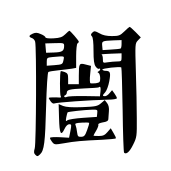
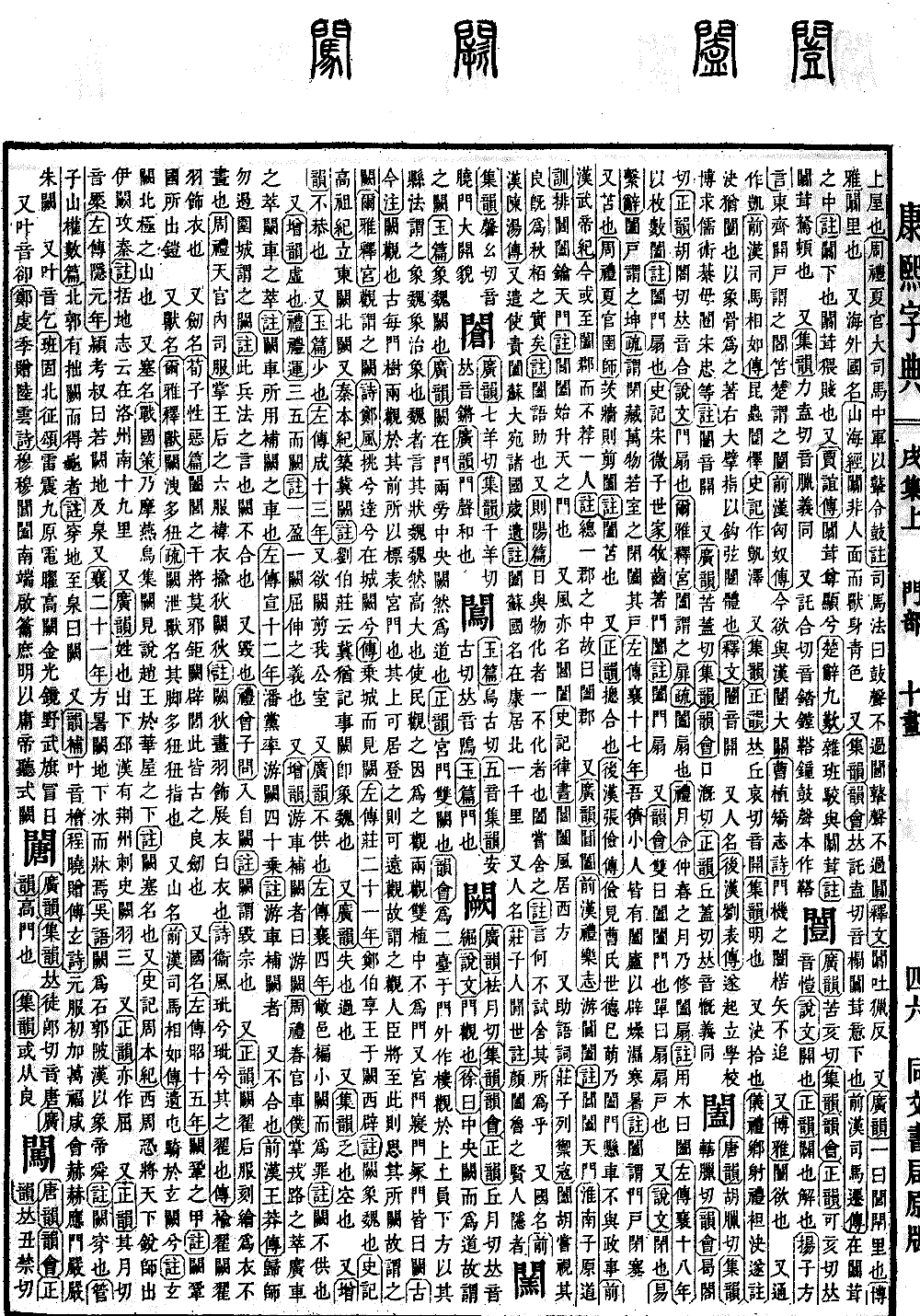
Xu Collection, Upper Volume
Radical: Gate (mén)
Kai
Kangxi Stroke Count: 18
Page 1340, Entry 01
Broad Rhymes (Guangyun): Pronounced kai (rising tone)
Collected Rhymes (Jiyun), Rhyme Meetings (Yunhui), Correct Rhymes (Zhengyun): Pronounced kai (rising tone)
Explanation of Graphs (Shuowen): To open.
Correct Rhymes (Zhengyun): To open, to release.
Regional Dialects (Fangyan): In Eastern Qi, opening a door is called yan zhan; in Chu, it is called kai.
History of the Former Han (Qianhan): Now we wish to open the great pass with the Han.
Cao Zhi, Poems on Correcting Ambitions: When the gate mechanism opens, the arrow is not pursued.
Also, Extensive Sophistry (Boya): Kai means to desire.
Also, written as the variant form (kai).
History of the Former Han (Qianhan): Insects and creatures are opened and joyful.
Records of the Grand Historian (Shiji): Uses the variant form (kai) in the sense of joyful grace.
Also, Collected Rhymes (Jiyun), Correct Rhymes (Zhengyun): Pronounced kai (level tone).
Collected Rhymes (Jiyun): Bright. Also, an archer's thumb ring.
Book of Etiquette and Ceremonial (Yili), Rites of Rural Archery: The explanation of the thumb ring (jue) says it is like a kai, made of ivory, worn on the right thumb to hook the string and open the body.
Explication of Texts (Shiwen): Kai is pronounced kai (level tone).
Also, as a personal name.
History of the Later Han (Houhan), Biography of Liu Biao: Then he established schools, broadly seeking Confucian scholars, such as Qimu Kai, Song Zhong, and others.
Commentary: Kai is pronounced kai (level tone).
Also, Broad Rhymes (Guangyun): Pronounced kai (falling tone)
Collected Rhymes (Jiyun), Rhyme Meetings (Yunhui), Correct Rhymes (Zhengyun): Pronounced kai (falling tone)
Meaning is the same.