Wu Collection, Lower Volume
Radical: Stone (shí)
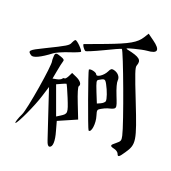
Character: Ke
Kangxi Stroke Count: 10
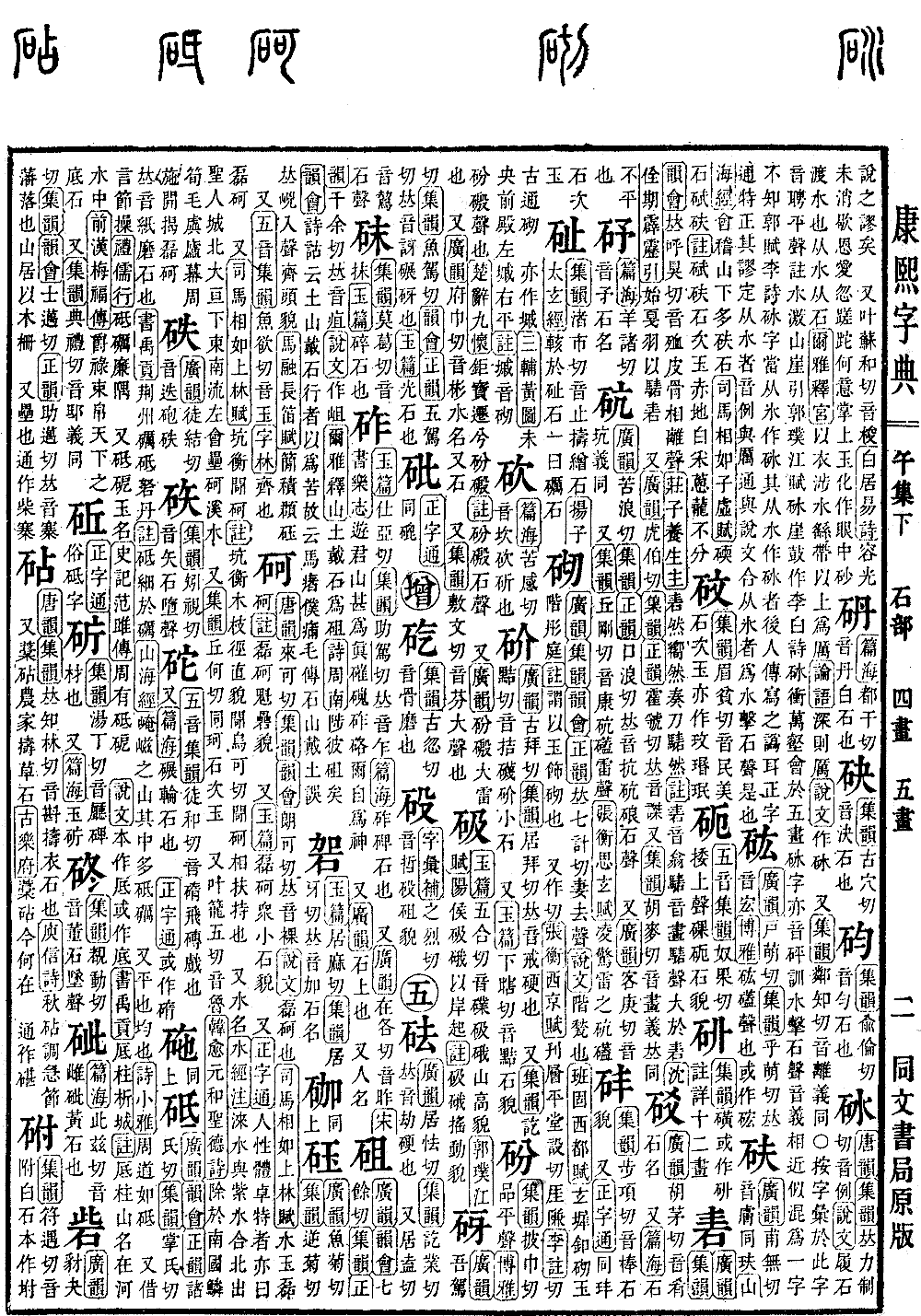
Page 828, Entry 32
Pronounced luo (rising tone).
According to the Explanation of Graphs and Analysis of Characters (Shuowen Jiezi), it refers to a pile of stones.
In the poem Upper Forest Rhapsody (Shanglin Fu) by Sima Xiangru, it is written as jade stones piled up. The commentary notes that this describes the appearance of large, prominent boulders.
According to the Comprehensive Dictionary (Yupian), it describes the appearance of a multitude of small stones.
According to the Guide to Correct Characters (Zhengzitong), a person of exceptional character is also described as being like these piled stones.
In the same poem, Upper Forest Rhapsody (Shanglin Fu), it is used in the phrase referring to tangled, interlocking tree branches. The commentary notes that this describes branches that are straight and support one another.
It is also the name of a river. According to the Commentary on the Classic of Waterways (Shuijing Zhu), the Lai River merges with the Zi River, flows north, and meets the Leike Creek.
According to the Collection of Rhymes (Jiyun), it is also written as a variant form (ke), meaning a stone inferior to jade.
It also rhymes with the syllable lu (falling-rising tone). In the poem On the Imperial Virtue of the Yuanhe Period (Yuanhe Shengde Shi) by Han Yu, it is used to describe the expansive and grand display of silk tents and awnings.