Si Collection, Middle Volume
Radical: Fire (huǒ)
Kuang
Kangxi strokes: 19
Page 686, Entry 24
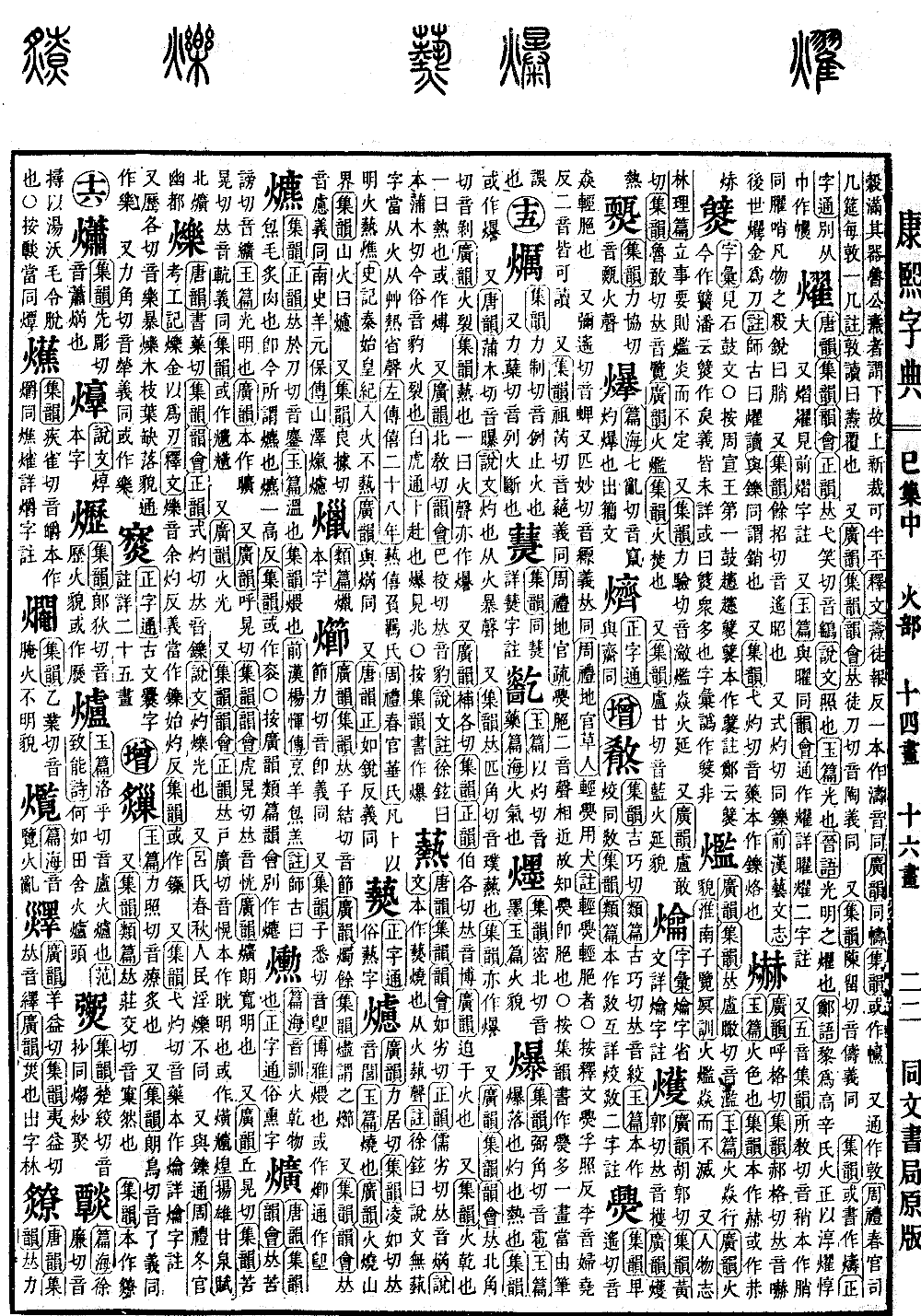
According to Tang Rhyme (Tangyun), Collected Rhymes (Jiyun), and Rhyme Compilation (Yunhui), pronounced kuang (falling tone), same sound as kuang.
Yu Pian (Jade Chapters) defines it as bright.
Guang Yun (Broad Rhymes) notes it was originally written as kuang.
Also, according to Guang Yun, pronounced huang (rising tone); according to Jiyun and Yunhui, pronounced huang (rising tone), same sound as huang. Guang Yun defines kuang-lang as wide and bright.
Also, according to Guang Yun, pronounced kuang (rising tone); according to Jiyun, pronounced kuang (rising tone), same sound. The meaning is the same. Jiyun notes it is sometimes written as a variant form (huang) or variant form (huang).
Also, according to Guang Yun, it refers to the light of a fire.
Also, according to Jiyun, Yunhui, and Zheng Yun (Correct Rhymes), pronounced huang (falling tone), same sound as huang. It was originally written as variant form (huang), meaning bright. It is also written as variant form (huang), variant form (huang), or variant form (huang).
The Ganquan Fu (Rhapsody on the Sweet Springs) by Yang Xiong contains the line: Reaching the far northern regions (bei kuang you du).