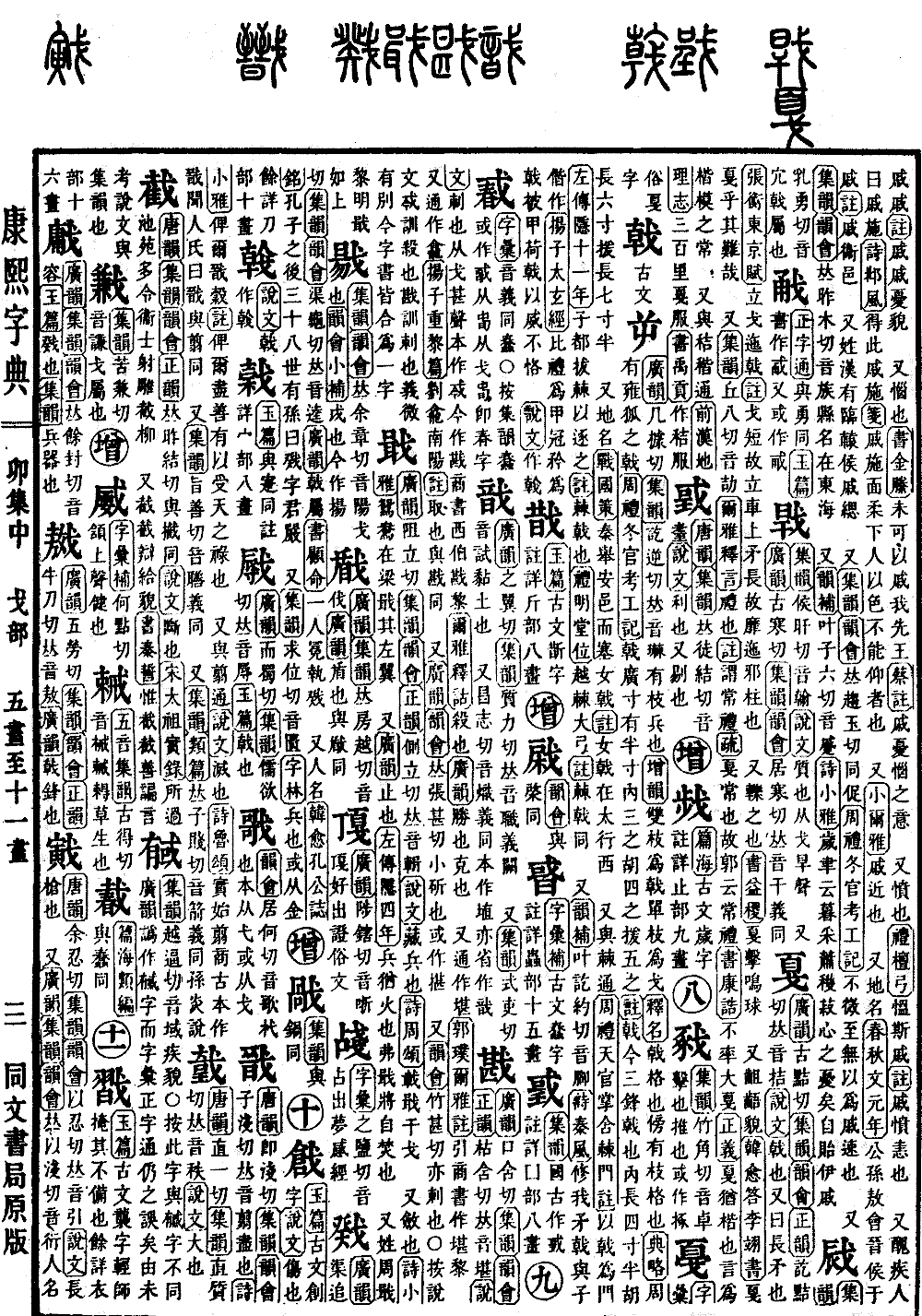
Mao Collection, Middle Volume
Radical: Halberd (gē)
Kangxi stroke count: 12
Page 413, Entry 09
Ancient form is written as a character meaning to disobey.
Pronounced ji. A type of weapon with side branches.
Extended Rhymes (Zengyun) states that a weapon with two branches is called a halberd, and one with a single branch is called a spear (ge).
Explanation of Names (Shiming) states: The halberd (ji) is so named because it serves to parry (ge), as it has branches on the side to block.
Classic Strategy (Dianlue) notes that the Zhou dynasty had the Yonghu halberd.
Rites of Zhou (Zhouli), Winter Officers, Artificer's Record (Kaogongji) states: The blade of a halberd is one and a half inches wide; its inner part is three times the width, the hu (curved part) is four times, and the yuan (main blade) is five times.
Commentary: The halberd here refers to the modern three-pointed halberd. The inner part is four and a half inches long, the hu is six inches long, and the yuan is seven and a half inches long.
Also a place name.
Strategies of the Warring States (Zhan Guo Ce) states: The state of Qin captured Anyi and blocked Nuji.
Commentary: Nuji is located west of the Taihang Mountains.
Also interchangeable with the character meaning thorns (ji).
Rites of Zhou (Zhouli), Heaven Officers, Overseer of Dwellings, Commentary on Thorns Gate (Jimen): Using halberds to form a gate.
Zuo Tradition (Zuo Zhuan), Year 11 of Duke Yin: Zidu pulled out a thorny branch (ji) to chase him.
Commentary: The thorny branch (ji) refers to a halberd.
Book of Rites (Liji), Hall of Distinction (Mingtangwei): Yueji great bows.
Commentary: The character for thorns (ji) is the same as halberd (ji).
Also, Supplement to the Rhymes (Yunbu) notes an alternative pronunciation as jiao.
Book of Odes (Shijing), Odes of Qin: Repairing my spears and halberds, to march with you.
Yangzi, Great Mystery (Taixuanjing): Comparing wooden tablets to armor, and collars to halberds. Wearing armor and carrying halberds, used to intimidate those who are disrespectful.
Analytical Dictionary of Characters (Shuowen) writes it as a variant.
Textual research note: The original text read comparing rites to armor; following the original Yangzi text, it has been corrected to comparing tablets to armor.