You Collection, Lower Volume
Radical: Carriage (chē)
Kangxi stroke count: 9
Page: 1239
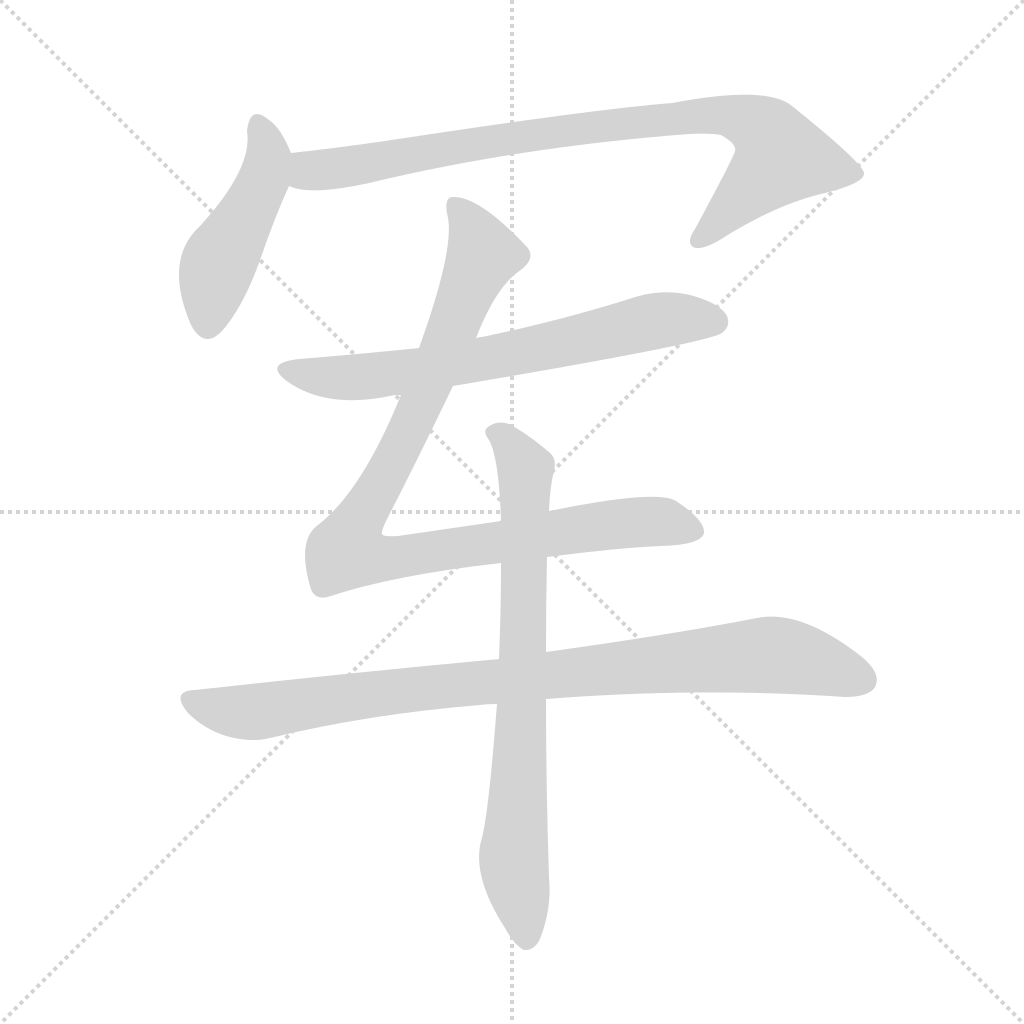
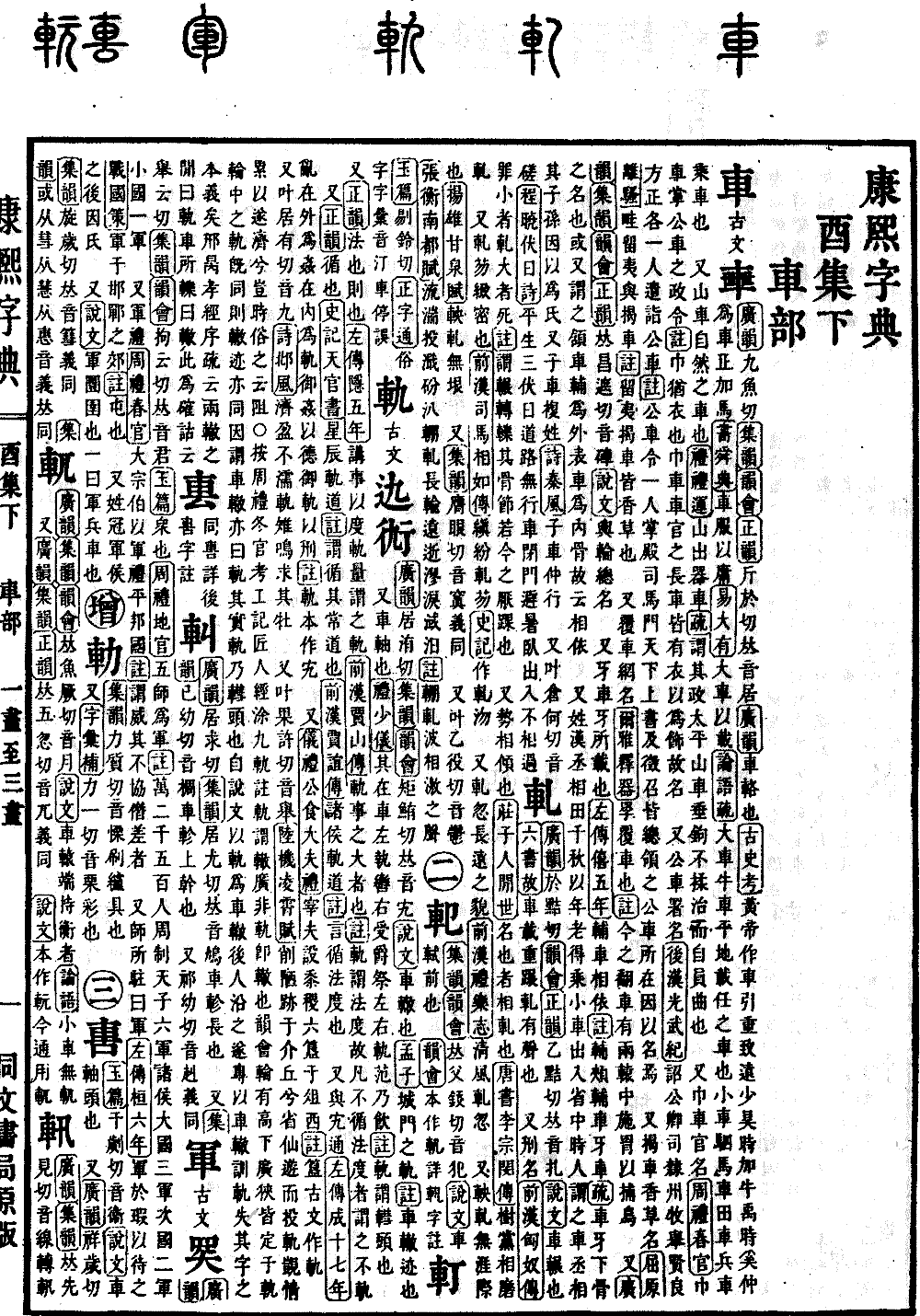
Ancient form. In Guangyun (Guǎngyùn), the pronunciation is given as jǔ yún qiè. In Jiyun (Jíyùn) and Yunhui (Yùnhuì), it is jū yún qiè, with the sound jūn. In Yupian (Yùpiān): Multitude, crowd. In the Rites of Zhou (Zhōulǐ), Earth Officers section: "Five divisions form a jūn." Commentary: "Twelve thousand five hundred people." According to the Zhou system: The Son of Heaven commanded six jūn. Large vassal states commanded three jūn, secondary states two jūn, and small states one jūn. Also, military rites. In the Rites of Zhou, Spring Officers section: "The Grand Master of Ancestral Temples used military rites to pacify states." Commentary: "This means to awe those who are uncooperative or disrespectful." Also, the place where troops are stationed is called jūn. In the Zuo Tradition (Zuǒzhuàn), Duke Huan, Year 6: "Stationed the jūn at Xia to await them." In the Strategies of the Warring States (Zhànguócè): "Stationed the jūn in the suburbs of Handan." Commentary: "Encampment." Also, a surname. Descended from the Marquis of Guanjun, they adopted this as their clan name. Also, in the Shuowen Jiezi (Shuōwén Jiězì): "Jūn means a circular enclosure." Another interpretation is: "Jūn means war chariots."