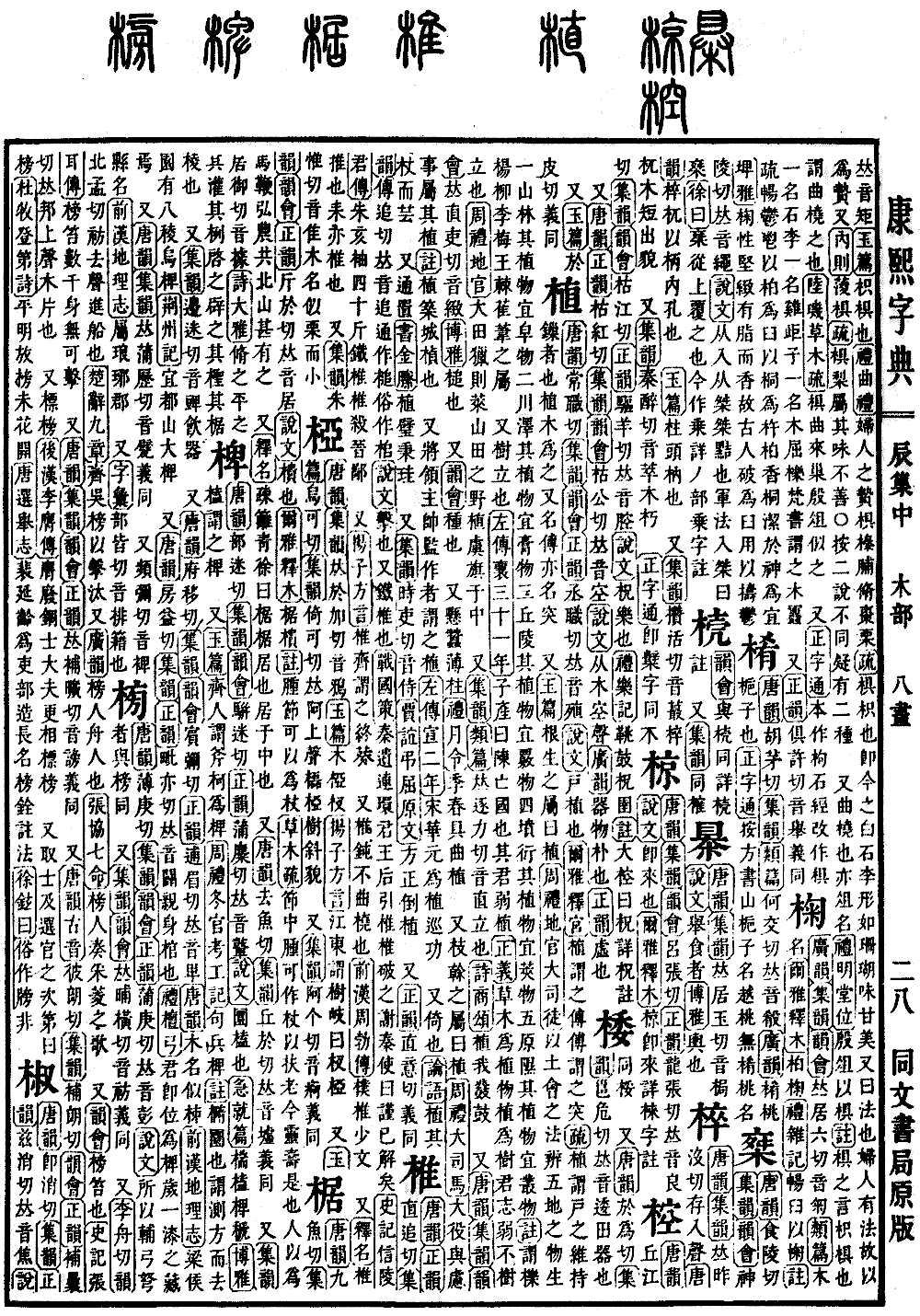
Chen Collection, Middle Volume
Radical: Tree (mù)
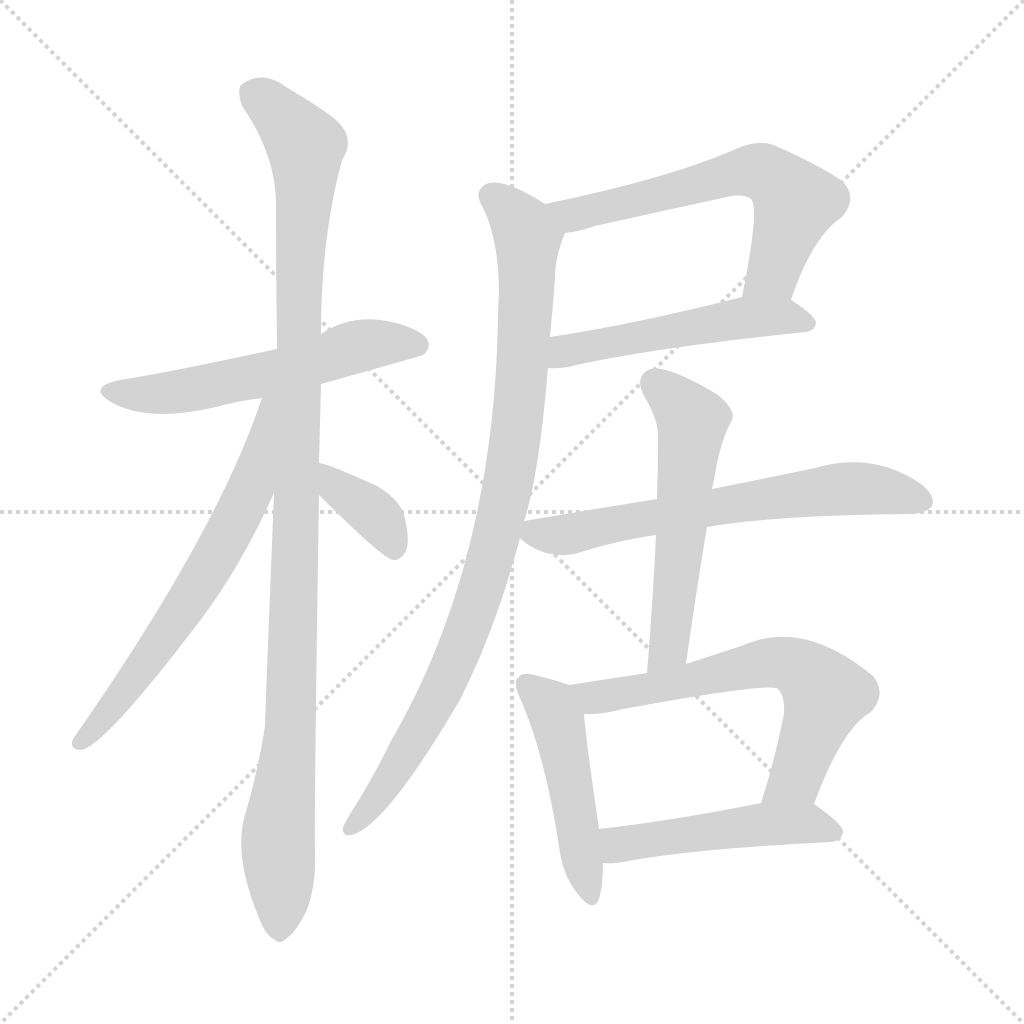
Entry: Ju
Kangxi Stroke Count: 12
Page 536, Entry 13
Tang Dynasty Rhyme Dictionary (Tangyun) states the pronunciation is jiū (level tone). Collected Rhymes (Jiyun), Rhyme Compendium (Yunhui), and Correct Rhymes (Zhengyun) state the pronunciation is jīn yú, pronounced jū.
Shuowen Jiezi states it is a ju tree.
Erya: Interpretation of Trees states that ju is a ju tree. Commentary states its swollen nodes can be used to make canes. The Cao Mu Shu states that the nodes are swollen and can be used to make canes to support the elderly; the plant known today as lingshou is this. People use it as a horse whip; the northern mountains of Hongnong have many of these.
Shiming states that for a sparse fence, in the regions of Qing and Xu it is called ju. Ju implies dwelling, meaning to dwell in the middle.
Tang Dynasty Rhyme Dictionary (Tangyun) states the pronunciation is qù yú. Collected Rhymes (Jiyun) states the pronunciation is qiū yú, pronounced xū. The meaning is the same.
Collected Rhymes (Jiyun) states the pronunciation is jū yù, pronounced jù.
Book of Odes (Shijing), Great Odes (Daya): Open it and clear it, its tamarisk and its ju. Push it aside and prune it, its mountain mulberry and its wild mulberry.
Textual Research: Book of Odes (Shijing), Great Odes (Daya): Prune it and level it, its shrubs and its sorbaria; open it and clear it, its tamarisk and its ju. I note that ju rhymes with wild mulberry and does not rhyme with sorbaria. In accordance with the rhyme of the original text, it is revised to: Open it and clear it, its tamarisk and its ju. Push it aside and prune it, its mountain mulberry and its wild mulberry.