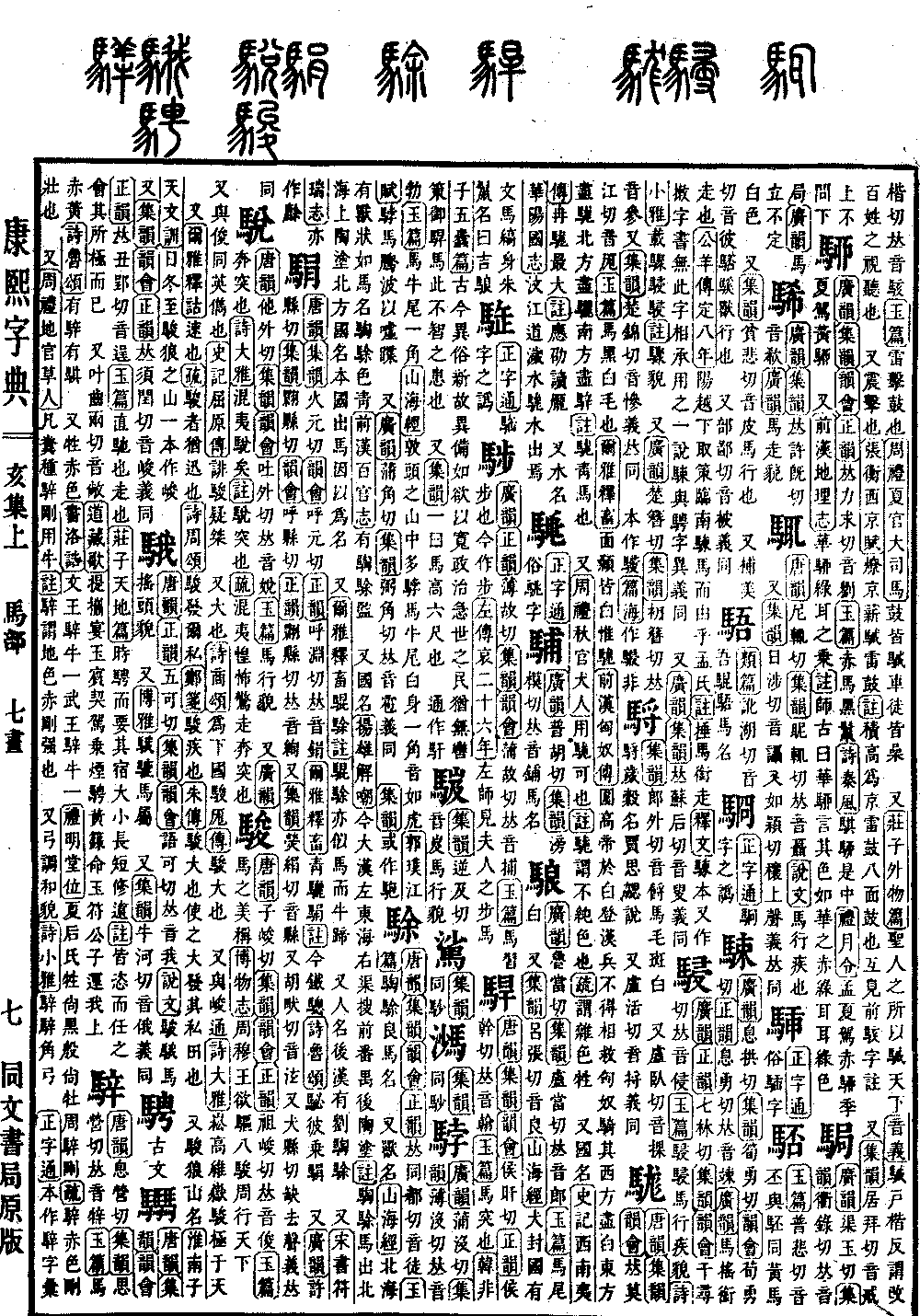
Hai Collection, Upper Volume
Radical: Horse (mǎ)
駿
Kangxi strokes: 17
Page 1439, Entry 01
Pronounced jun (falling tone).
In the Jade Chapter (Yupian), it is defined as a beautiful term for a horse. In the Records of Wide-Ranging Matters (Bowuzhi), it is stated that King Mu of Zhou wished to ride eight fine horses to travel throughout the world.
It is also identical to the character meaning talented or outstanding. It refers to people who are exceptionally gifted or wise. In the Records of the Grand Historian (Shiji), Biography of Qu Yuan, it mentions slandering the virtuous and talented, and being suspicious of heroes.
It also indicates greatness. In the Book of Odes (Shijing), Eulogies of Shang, it is written as serving as the shelter and reliance for feudal states. The commentary defines it as meaning great.
It is also used interchangeably with the character for tall or steep. In the Book of Odes (Shijing), Greater Odes, it describes the high mountains of the four peaks rising up to the clouds.
In the Erya (Approaching Elegance), Explaining Ancient Words, it is defined as meaning rapid or swift. The sub-commentary states that it is synonymous with speed. In the Book of Odes (Shijing), Eulogies of Zhou, it says to quickly cultivate your private fields. The Zheng commentary defines it as meaning speed. The Zhu commentary defines it as meaning great, signifying to vigorously cultivate your private fields.
It also refers to Junlang, the name of a mountain. In the Huainanzi (Masters of Huainan), Teachings on Astronomy, it says that at the winter solstice, the sun travels to Junlang Mountain. One version of the text writes it as the character for steep.
Pronounced jun (falling tone). The meaning is the same.