Wu Collection, Upper Volume
Radical: Field (tián)
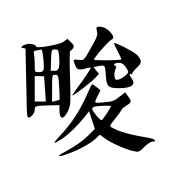
畯
Kangxi strokes: 12
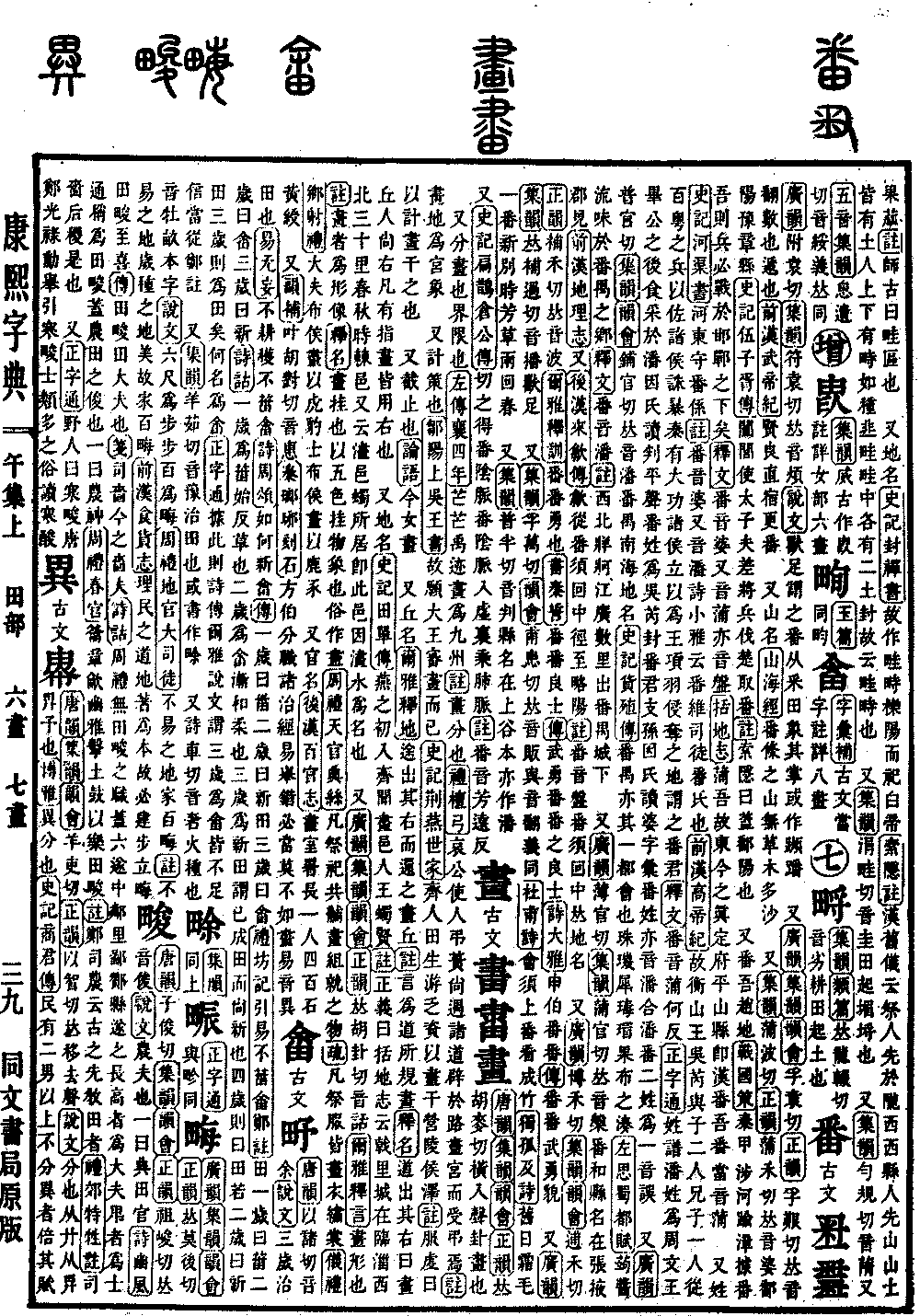
Page 763, Entry 17
Pronounced jun.
According to the Shuo Wen Jie Zi (Explaining Graphs and Analyzing Characters), it refers to a farmer. Another definition identifies it as an official in charge of fields.
Book of Odes (Shijing), Bin Feng: The field superintendent arrives, full of joy.
Commentary: The field superintendent is a field official.
Explication: The minister of agriculture, now known as the sese fu (local agricultural official).
Shijing Gu (Commentary on the Book of Odes): There is no position titled field superintendent in the Rites of Zhou (Zhouli). It likely refers to the leaders of the six sui (administrative divisions), including the lin, li, bi, zan, xian, and sui. The higher-ranking ones were called dafu (great officials), and the lower-ranking ones were called shi (gentlemen). They were collectively called field superintendents, representing the outstanding people of the agricultural fields.
Another source says it refers to the god of agriculture.
Rites of Zhou (Zhouli), Spring Officials: The master of the flute plays the Bin Ya and beats the earthen drum to bring joy to the field superintendent.
Annotation: Zheng Sinong says this refers to the ancient figures who first taught the people how to farm.
Rites of Record (Liji), Jiao Te Sheng, Annotation: The minister of agriculture is Houji.
Additionally, according to the Zheng Zi Tong (Correction of Characters), a man from the wild is called a han jun (poor, obscure scholar). Zheng Guanglu of the Tang dynasty frequently recommended scholars from this class. It is colloquially read as han suan (poor and sour).