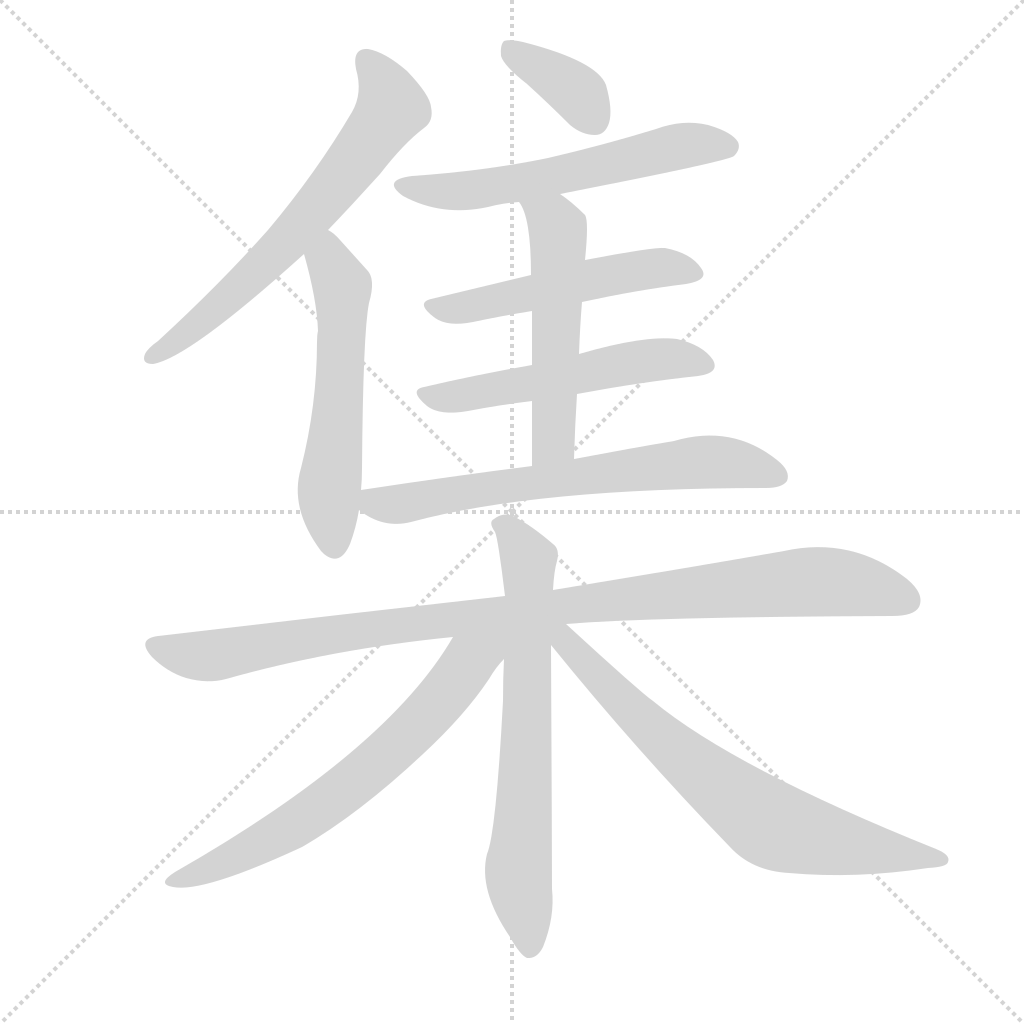
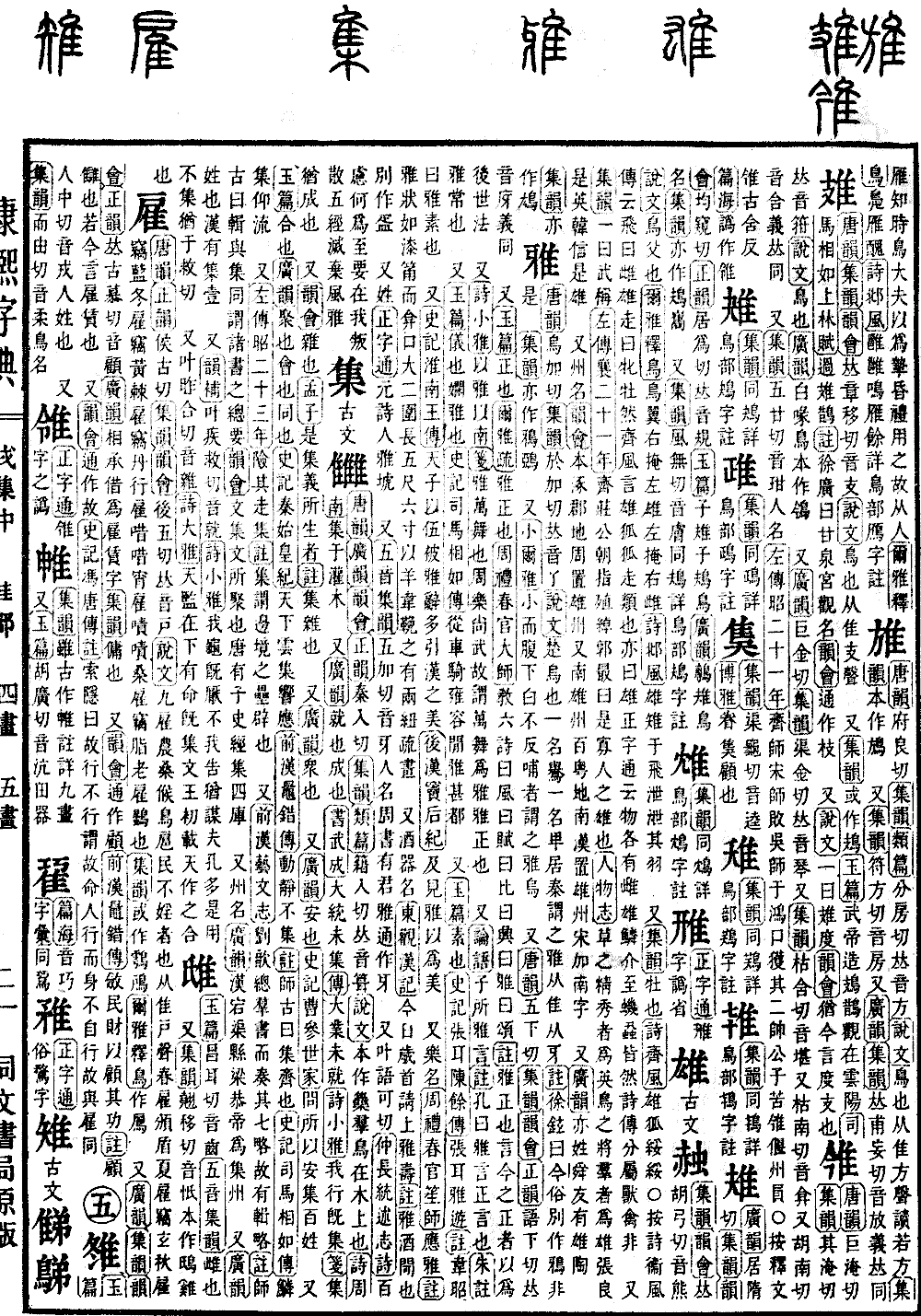
Xu Collection, Middle Volume
Radical: Short-tailed Bird (zhuī)
Kangxi Strokes: 12
Page 1365, Entry 15
In ancient writing, it is written as a variant form (chóu).
Pronounced qin (entering tone) according to Tang Rhymes (Tangyun) and Broad Rhymes (Guangyun), and according to Rhyme Collection (Yunhui) and Correct Rhymes (Zhengyun). Pronounced ji (entering tone) according to Collected Rhymes (Jiyun) and Classified Chapters (Leipian). The pronunciation is the same as for (ji).
Explaining the original character in Explaining Graphs and Analyzing Characters (Shuowen Jiezi) as a gathering of birds on a tree.
The Book of Odes (Shijing) contains the line, gathered in the bushes.
It also means to approach or to complete.
The Book of Documents (Shangshu) contains the phrase, the great task is not yet completed, which the commentary explains as the great undertaking is not yet finished.
The Book of Odes (Shijing) contains the phrase, my journey is already completed, which the commentary explains as finished.
Also explained in Rhyme Collection (Yunhui) as to mix.
The Mencius contains the phrase, this is what is produced by accumulated righteousness, which the commentary explains as mixed.
Also explained in Broad Rhymes (Guangyun) as numerous.
Also explained in Broad Rhymes (Guangyun) as to pacify.
Records of the Grand Historian (Shiji) contains the phrase, asking how to pacify the common people.
Also explained in Jade Almanac (Yupian) as to gather.
Broad Rhymes (Guangyun) explains it as to assemble, to meet, or identical.
Records of the Grand Historian (Shiji) contains the phrase, the world gathered like clouds and responded like an echo.
History of the Former Han (Qian Hanshu) contains the phrase, actions and stillness are not aligned, which the commentary by Shigu explains as meaning orderly and consistent.
Records of the Grand Historian (Shiji) contains the phrase, gathered like fish scales and looking upward.
Also, Zuo Tradition (Zuozhuan) contains the phrase, to block their escape routes and assembly points, which the commentary explains as referring to border fortifications.
Also, History of the Former Han (Qian Hanshu) records that Liu Xin compiled various books and presented the Seven Outlines, hence the term collected outlines. The commentary by Shigu says that the meaning is the same as gather; it refers to the general outline of various books.
Rhyme Collection (Yunhui) states: a literary collection is a place where writings are gathered. During the Tang dynasty, there were the four libraries of masters, history, classics, and collections.
It is also the name of a prefecture. Broad Rhymes (Guangyun) records that during the Han dynasty there was Dangqu County, and during the reign of Emperor Gong of the Liang dynasty, it was established as Ji Prefecture.
Also, Broad Rhymes (Guangyun) records it as a surname. In the Han dynasty, there was a person named Ji Yi.
Also, in Rhyme Supplement (Yunbu), it is pronounced jiu (falling tone), the same as (jiu).
The Book of Odes (Shijing) contains the line, my tortoise oracle is already weary, and does not inform me of plans. The planners are many, yet this is why it does not succeed. (The character for plans is pronounced in the jiu rhyme group).
Also pronounced za (entering tone), the same as (za).
The Book of Odes (Shijing) contains the line, Heaven observes from below, the mandate is already settled. In the first year of King Wen, Heaven formed this union.
Textual research: In Zuo Tradition (Zuozhuan), the phrase is to block their escape routes and assembly points. The original commentary read, the assembly point refers to border fortifications. Note: The character for assembly point was missing the word escape in the commentary, and an extra word was present. It is now corrected to read: escape routes and assembly points refers to border fortifications.