You Collection, Lower Volume
Radical: Carriage (chē)
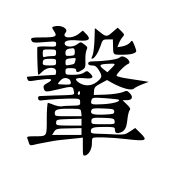
Character: Jì
Kangxi Stroke Count: 20
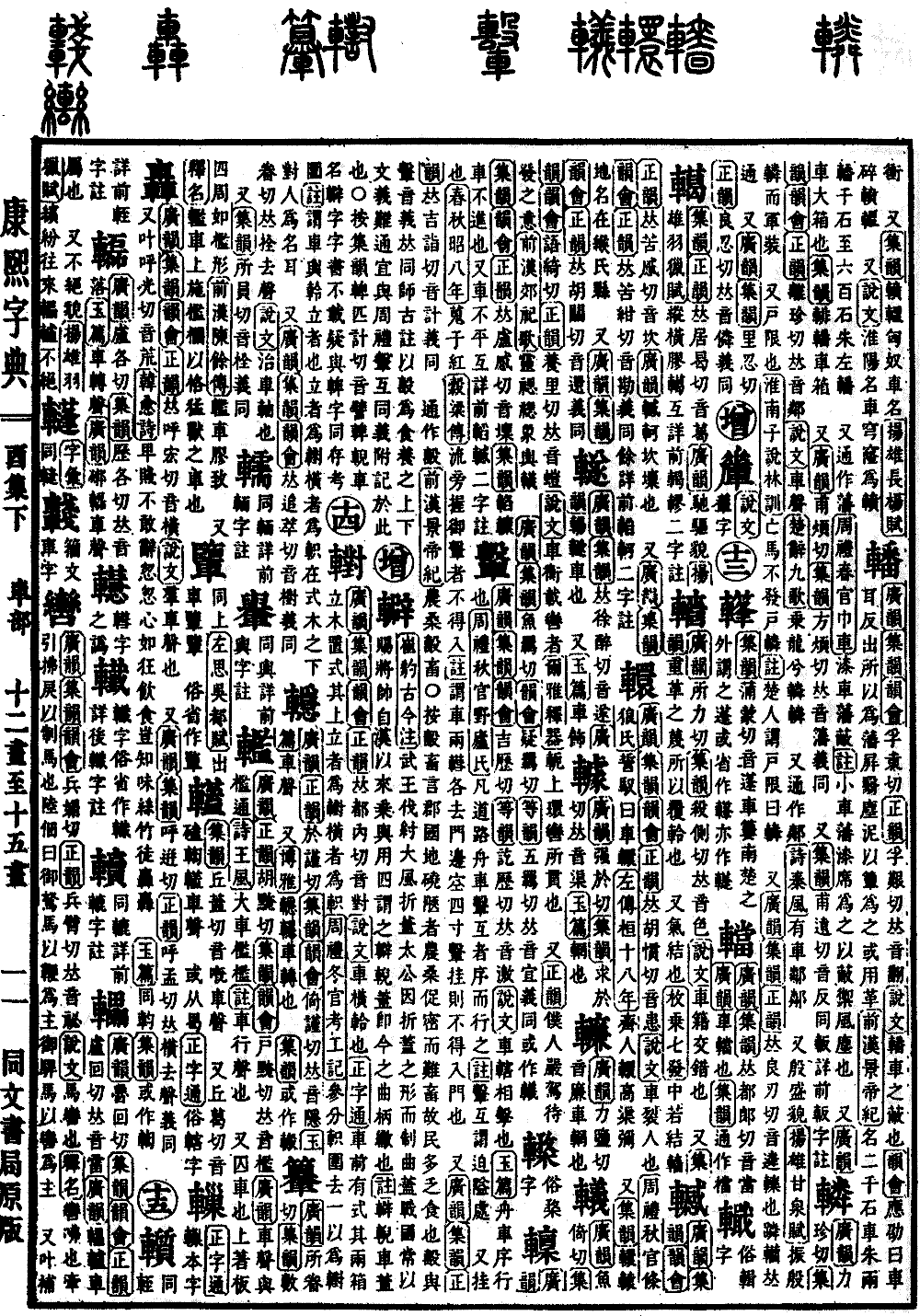
Page 1249, Entry 17
According to the Extensive Rhymes (Guangyun), Collected Rhymes (Jiyun), and Rhyme Collections (Yunhui), the pronunciation is jí, as in the sound of jí. According to the Equalized Rhymes (Dengyun), the pronunciation is qì, as in the sound of jí.
According to the Explanations of Simple and Compound Characters (Shuowen), it refers to the linchpins of a carriage striking one another.
According to the Collected Rhymes (Jiyun), it refers to boats and carriages moving in sequence.
In the Rites of Zhou (Zhouli), Autumn Offices, Field Shelter Official: Whenever boats and carriages are moving in sequence at a narrow pass. Commentary: The term jì-hù refers to a cramped and narrow place.
It also means to become snagged.
In the Spring and Autumn Annals (Chunqiu), Eighth Year of Duke Zhao: A military review at Hong. The Gongyang Commentary (Guliang zhuan) states: The carriages moving in rows and those holding the reins were not permitted to enter. Commentary: This refers to the two linchpins of the carriage; each had a clearance of four inches from the side of the gate. If they became snagged, they could not enter the gate.
Also pronounced jì. The meaning is the same. It is commonly written as a variant form.
In the History of the Former Han (Qian Hanshu), Annals of Emperor Jing: Agriculture, sericulture, and animal husbandry. Note: The character xù (to raise/nurture) is used here because, in regions where the land is rocky and narrow, agricultural and sericultural activities are crowded and dense, making them difficult to sustain, which is why the people often lacked food. The sound and meaning are the same as jì. The commentary by Shigu suggests it refers to food and nourishment, but the context of the preceding and following text makes this difficult to reconcile. It should likely be interpreted with the same meaning as jì-hù in the Rites of Zhou (Zhouli), and is appended here for reference.
Textual verification: The Gem Dictionary (Yupian) defines it as boats and carriages moving in sequence. Note: This phrase actually appears in the Collected Rhymes (Jiyun) under the twelfth tone of the qù (departing) category, not in the Gem Dictionary (Yupian). The Gem Dictionary (Yupian) has now been corrected to read Collected Rhymes (Jiyun).