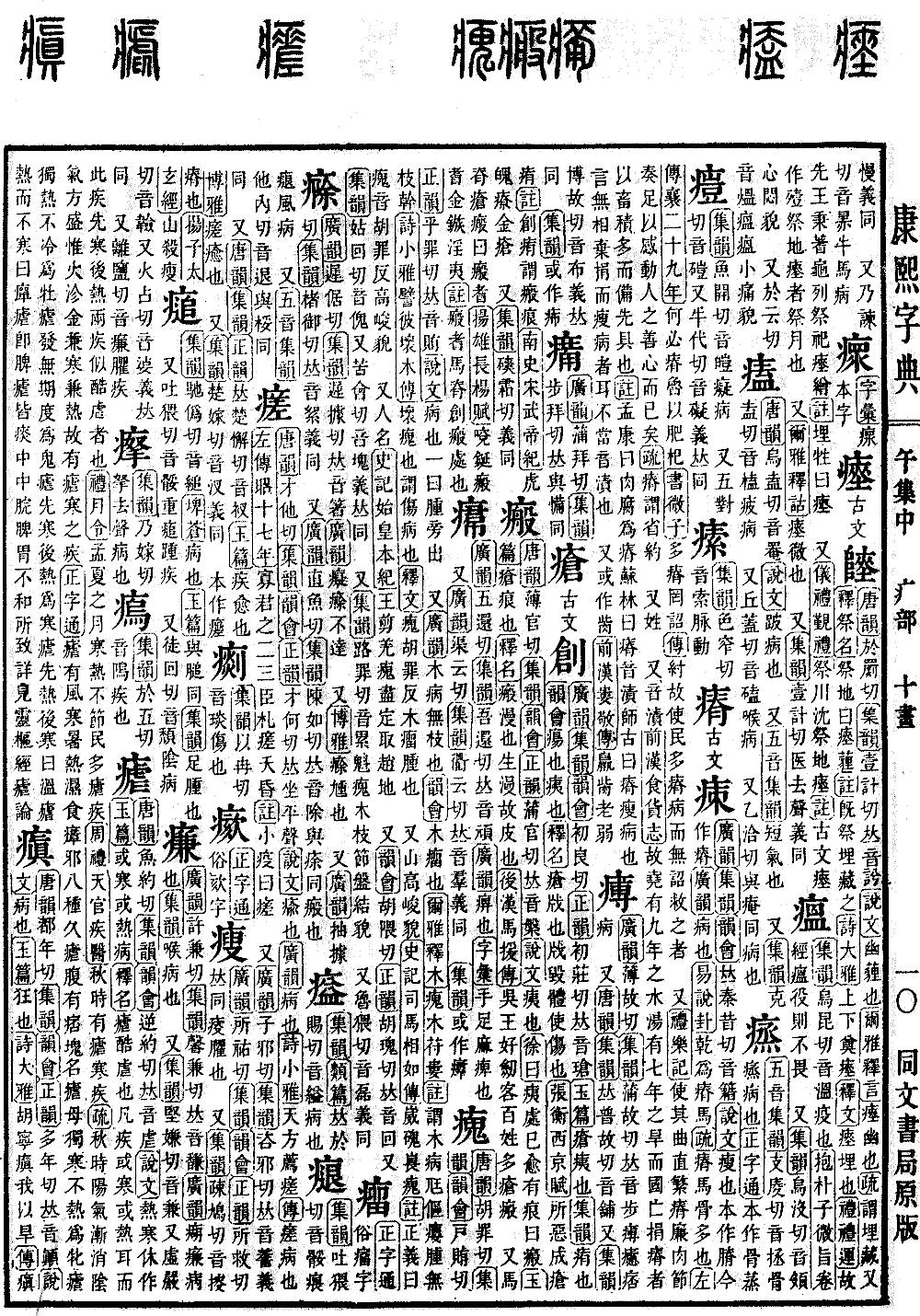
Wu Collection, Middle Volume
Radical: Sickness (bìng)
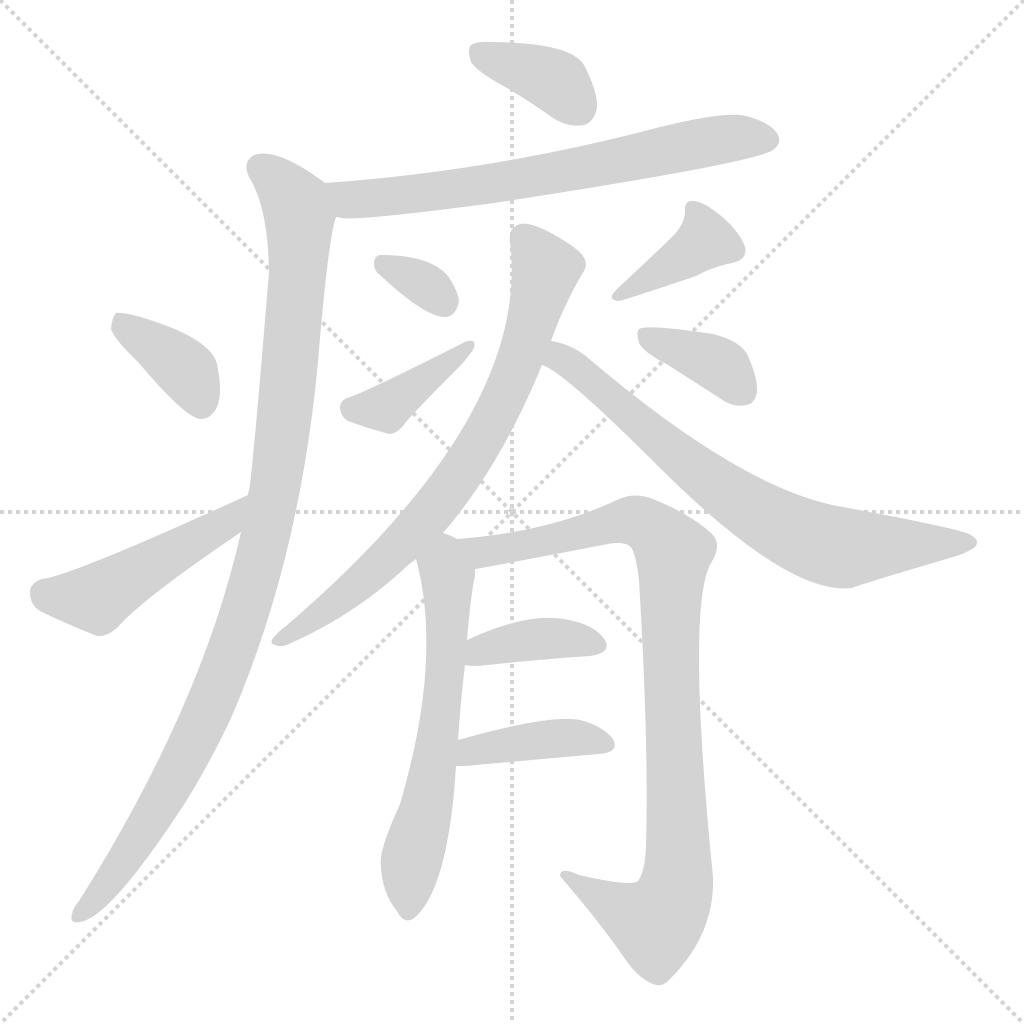
瘠
Kangxi strokes: 15
Page 778, Entry 09
Ancient script form. According to the Broad Rhyme (Guangyun), the Collected Rhymes (Jiyun), and the Rhyme Collection (Yunhui), the pronunciation is ji (rising tone).
In the Discussion of Writing (Shuowen), it means thin. Originally written as the character for lean flesh. Now written as 瘠.
In the Broad Rhyme (Guangyun), it means illness.
In the Book of Changes (Yijing), regarding the Hexagrams of Discussion, it says: The Qian trigram represents a thin horse. The commentary states: A thin horse is one with prominent bones.
In the Zuo Tradition (Zuozhuan), twenty-ninth year of Duke Xiang: Why must you impoverish the state of Lu to enrich yourself?
In the Book of Documents (Shujing), in the Announcement of the Viscount of Wei: Many were suffering and without guidance. The commentary states: King Zhou caused the people to suffer many illnesses without providing instruction or relief.
In the Book of Rites (Liji), in the Record of Music: Let its melodies be straight or crooked, simple or complex, refined or rich, with measured rhythms, so that they are sufficient to move the good hearts of the people. The commentary states: Thin refers to simplicity and restraint.
Also a surname.
Also pronounced zi (falling tone).
In the History of the Former Han (Qianhan shu), in the Treatise on Food and Money: Thus, even when Emperor Yao faced nine years of flooding and Emperor Tang faced seven years of drought, the state suffered no starvation or emaciation, because the accumulated stores were abundant and preparations were made in advance. The commentary notes: Meng Kang says: Rotting flesh is called zi. Su Lin says: It is pronounced zi (falling tone). Yan Shigu says: It means thin and sick. It only means that people were not abandoned or left to suffer from emaciation and illness, so it should not be pronounced zi (falling tone).
Sometimes also written in a variant form (zì).
In the History of the Former Han (Qianhan shu), in the Biography of Lou Jing: Emaciated, decaying, old, and weak.