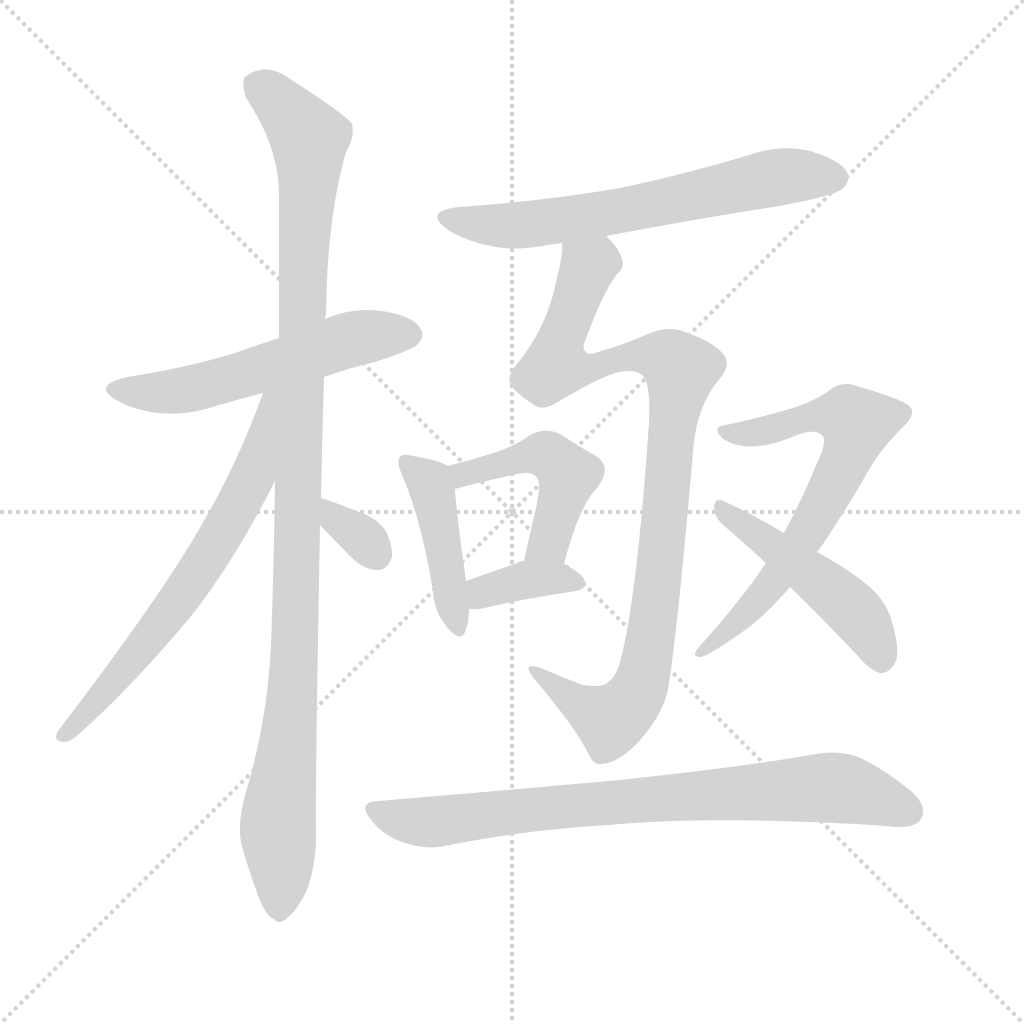
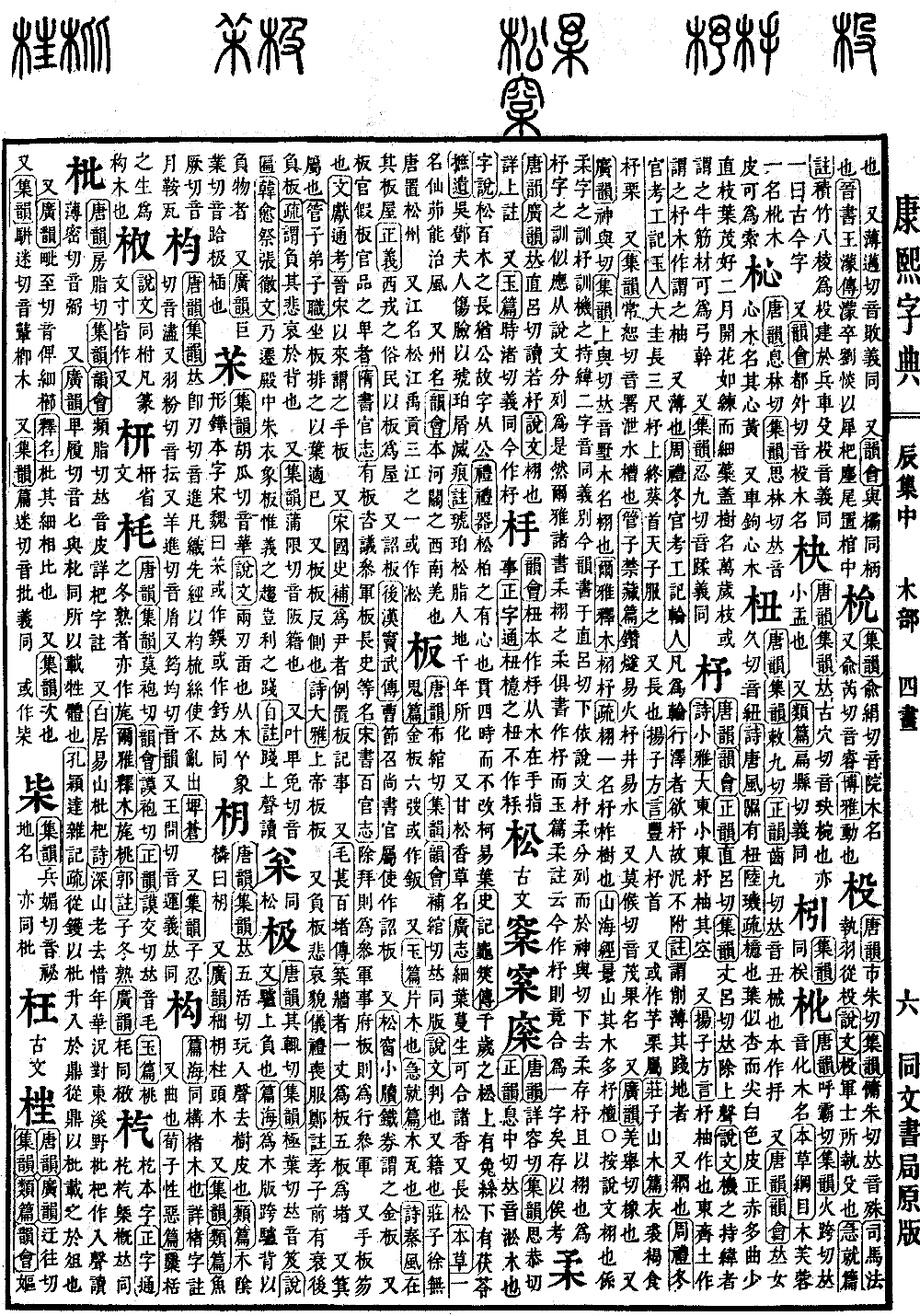
Chen Collection, Middle Volume. Radical: Tree (mù). Kangxi stroke count: 13. Page 514, Entry 01.
Pronounced ji (entering tone).
According to the Explaining Graphs and Analyzing Characters (Shuowen Jiezi), it refers to the ridgepole of a house. Xu Shen comments: The ridgepole is the main beam of a roof; contemporary usage employs the term to denote highness or the superlative, a meaning derived from this original sense.
Also, the state before heaven and earth were divided is called the Supreme Ultimate (Taiji). Book of Changes (Yijing), Appended Remarks (Xici): The Changes have the Supreme Ultimate, which generates the two polarities. Commentary: It is a term for that which cannot be named, named because one cannot otherwise refer to it.
Also, the Royal Ultimate (Huangji) refers to the Great Middle. Book of Documents (Shangshu), Great Plan (Hongfan): The sovereign establishes his standards. Commentary: The ruler is the master of the people, and he must establish the path of uprightness.
Also, the North Star is called the North Pole, and Canopus is called the South Pole. Book of Documents (Shangshu), Canon of Shun (Shundian), Correct Meaning (Zhengyi): Citing Wang Fan's Theory of the Celestial Sphere: The North Pole rises thirty-six degrees above the horizon, the South Pole is submerged thirty-six degrees below the horizon, and Mount Song lies at the very center of the heavens.
Also, the three ultimates refer to the three powers (Sancai). Book of Changes (Yijing), Appended Remarks (Xici): The way of the three ultimates. Commentary: This refers to the utmost principles of heaven, earth, and humanity.
Also, according to the Literary Expositor (Erya), Interpretation of Locations (Shidi), the four limits (Siji) are: east to Taiyuan, west to Bingguo, south to Puqian, and north to Zhuli.
Also, the five ultimates refer to the center of the five constants. Book of Documents (Shangshu), Punishments of Lu (Lüxing): If one aligns with the five ultimates and all accord with uprightness, one shall have blessings.
Also, the six extremes (Liuji) refer to extreme misfortunes. Book of Documents (Shangshu), Great Plan (Hongfan): The sovereign uses the six extremes: first, premature death; second, illness; third, sorrow; fourth, poverty; fifth, ugliness; and sixth, weakness.
Also, the four directions plus above and below are also called the six limits. Zhuangzi, Heaven's Revolution (Tianyun): Heaven has six limits.
Also, the eight limits (Baji). Collection of Rhymes (Yunhui): The four limits are the furthest boundaries of the four cardinal directions. Huainanzi, Training for the Essential (Benjing Xun): Governing the eight limits and planning the six harmonies.
Also, it means "to reach." Book of Odes (Shijing), Eulogies of Zhou (Zhousong): Nurturing all my people, there is nothing that your grace does not reach.
Also, it means to take as a standard. Book of Odes (Shijing), Greater Odes (Daya): Do not harm the people, do not be urgent, the royal kingdom takes this as a standard.
Also, it means to exhaust or reach the end. Book of Changes (Yijing), Appended Remarks (Xici): Exhausting the numbers so as to determine the images of the world.
Also, it means to release. Book of Etiquette and Ceremonial (Yili), Great Archery Rite (Dasheyi): Assisting in setting the thumb ring, with a red strap. Commentary: The term refers to the release of the arrow. Made of red leather, it is used to pull the bowstring to facilitate release.
Also, according to the Literary Expositor (Erya), Interpretation of Heaven (Shitian), when the moon is in the gui position, it is called the limit.
Also, the name of a state. Spring and Autumn Annals (Chunqiu), Duke Yin, Year 2: Wuhai led his troops and entered the state of Ji.
Also, it means tired. Records of Things Heard in the World (Shishuo): Gu He visited Wang Dao, and Wang Dao was somewhat tired and dozed off while facing him.
Also, according to the Correct Rhymes (Zhengyun), pronounced ji (entering tone). The same as the character meaning urgent. Xunzi, Inscription on the Staff (Zhenfu): Repeatedly and unexpectedly urgent.
Also, according to the Collection of Rhymes (Yunhui), pronounced ji (entering tone). It means exceptional or different.
Also, pronounced ji (rising tone). Huainanzi, Training for the Spirit (Jingshen Xun): To treat others as lowly without hatred, to honor them without joy, following their natural disposition while remaining settled in it without seeking the absolute.
Also, according to the Extensive Dictionary of Rhymes (Guangyun), pronounced ji (falling tone). Songs of Chu (Chucheng), Heavenly Questions (Tianwen): Where did that sprout originate, and what was its intent? The jade terrace is ten stories high, and where does it finally end?