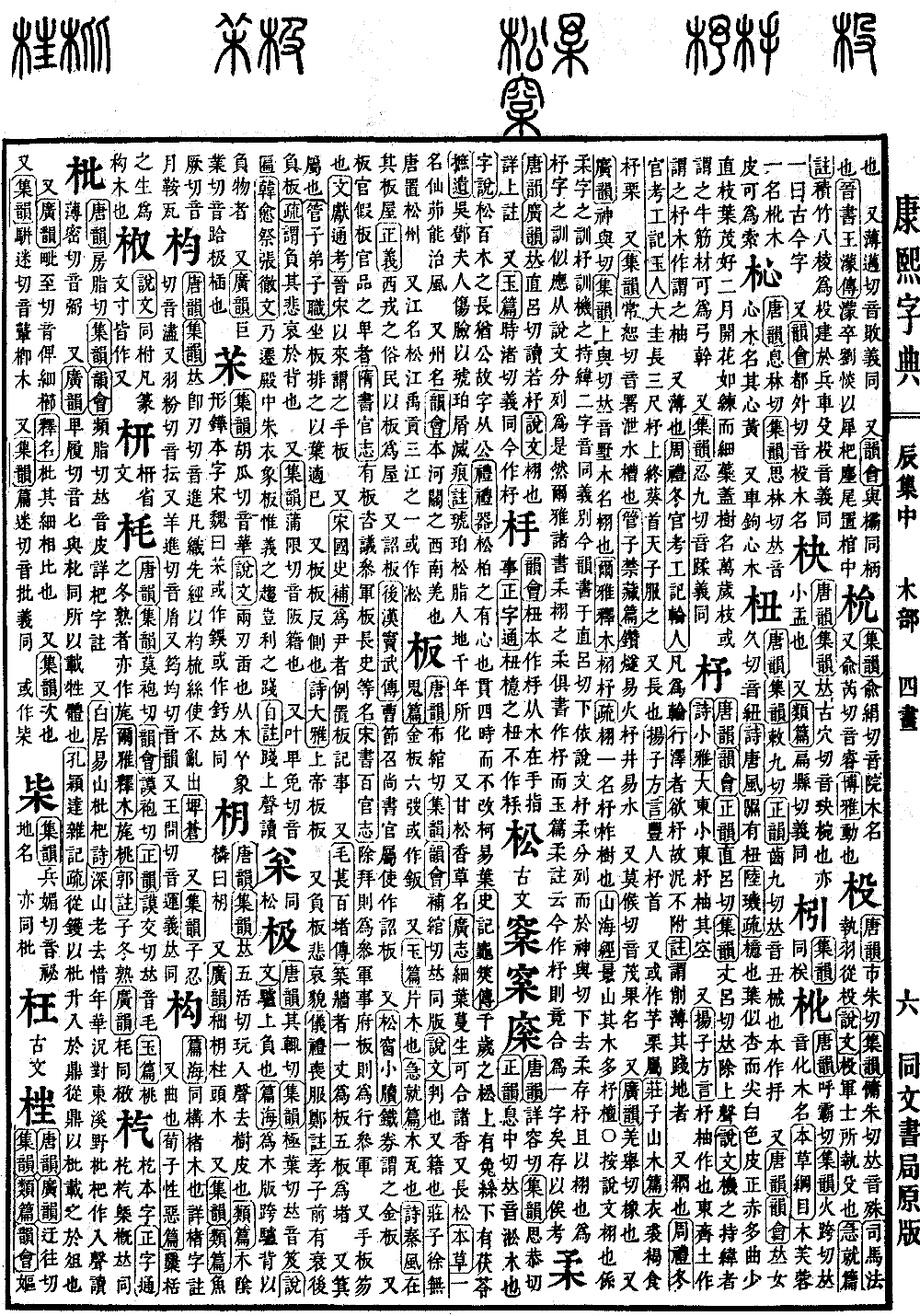
Chen Collection, Middle Volume
Radical: Tree (mù)
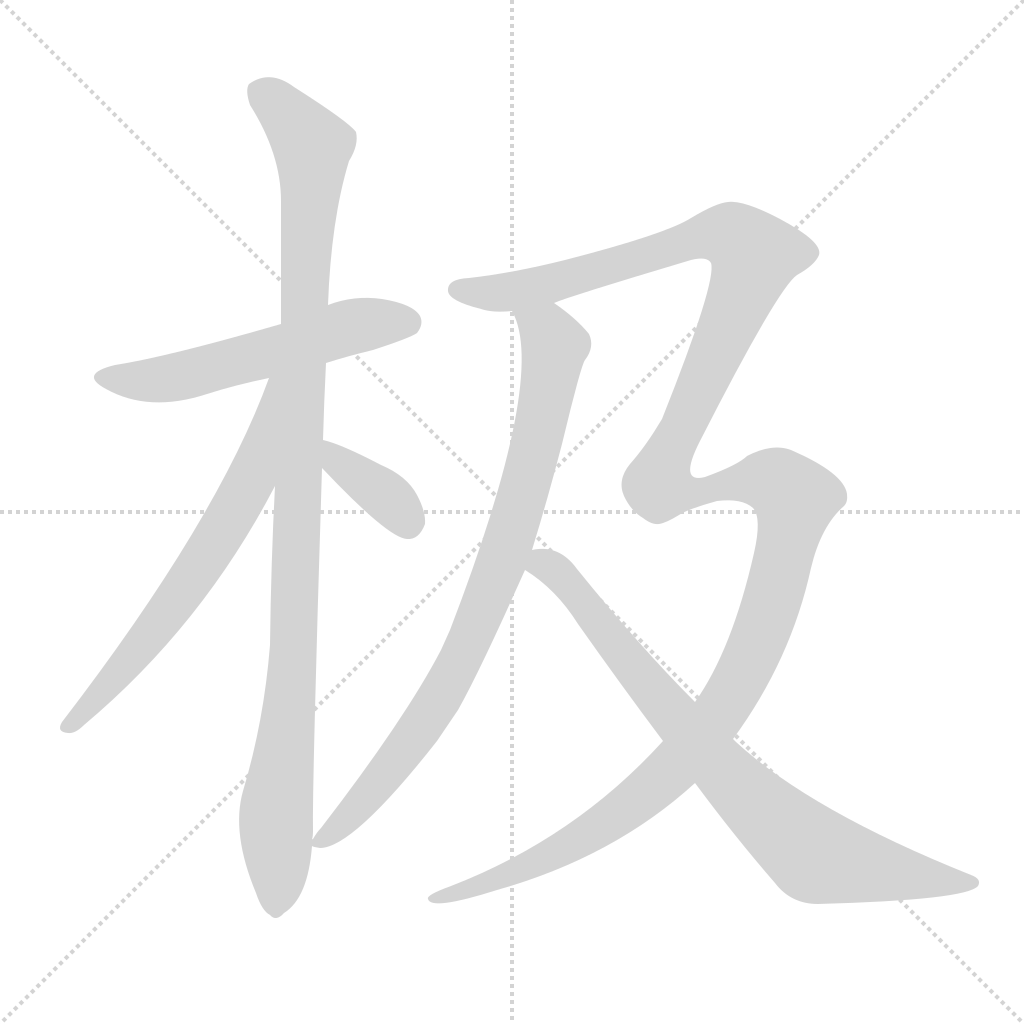
极
Kangxi strokes: 13
Page 514, Entry 17
Pronounced ji. According to the Explaining Graphs and Analyzing Characters (Shuowen), this refers to the burden carried on a donkey's back. The Encyclopedia of Sea (Pianhai) defines it as a wooden board spanning a donkey's back used to carry objects.
Pronounced jia. To insert.
Pronounced ji (entering tone). According to the Explaining Graphs and Analyzing Characters (Shuowen), this refers to a ridgepole. Xu states: The ridgepole is the highest beam of a house; the modern usage of the word to mean high or extreme originates from this meaning. Also, the state before the separation of Heaven and Earth is called the Great Ultimate (Taiji). In the Book of Changes (Yijing), in the Appended Remarks (Xici), it is written: The Book of Changes contains the Great Ultimate, which gives birth to the two modes. The commentary states: It is a name given to that which has no name, for it cannot be named. Also, the Royal Ultimate (Huangji) refers to the Great Center. In the Book of Documents (Shujing), in the chapter Great Plan (Hongfan), it is written: The sovereign establishes his standard. The sub-commentary explains: The ruler, as the master of the people, must establish the path of the center. Also, the North Star is called the North Pole, and the Old Man star is called the South Pole. In the Book of Documents (Shujing), in the Canon of Shun (Shundian), the sub-commentary cites Wang Fan's Theory of the Celestial Sphere (Huntian shuo): The North Pole is thirty-six degrees above the earth, the South Pole is thirty-six degrees below the earth, and Mount Song stands exactly at the central zenith. Also, the three poles refer to the three powers of Heaven, Earth, and Humanity. In the Book of Changes (Yijing), in the Appended Remarks (Xici), it is written: The way of the three poles. The sub-commentary explains: This refers to the ultimate path of the three powers: Heaven, Earth, and Humanity. Also, in the Erya, in the chapter Explaining Earth (Shidi), it states: To the east reaching Taiyuan, to the west reaching Bingguo, to the south reaching Puqian, and to the north reaching Zhuli is called the four poles. Also, the five poles are the central correctness of the five constant virtues. In the Book of Documents (Shujing), in the Counsels of Lu (Lv), it is written: Belongs to the five poles, all possess celebration. Also, the six poles are the extreme of evil events. In the Book of Documents (Shujing), in the Great Plan (Hongfan), it is written: The power uses the six poles: first, premature death; second, illness; third, sorrow; fourth, poverty; fifth, ugliness; sixth, weakness. Also, the four cardinal directions plus above and below are also called the six poles. In the Zhuangzi, in the chapter The Revolution of Heaven (Tianyun), it is written: Heaven has six poles. Also, the eight poles. According to the Rhyme Collection (Yunhui), the four poles are the limits of the four corners. In the Huainanzi, in the chapter Original Essence (Benjing xun), it is written: Regulate the eight poles, and govern the six directions. Also, to reach or arrive. In the Book of Odes (Shijing), in the chapter Zhou Eulogies (Zhousong), it is written: Establishing our common people, none are without your reach. Also, to take rest or stop. In the Book of Odes (Shijing), in the chapter Greater Odes (Daya), it is written: Not a disease, not a thorn, the kingdom comes to rest. Also, to exhaust or complete. In the Book of Changes (Yijing), in the Appended Remarks (Xici), it is written: Exhaust its numbers, and determine the phenomena of the world. Also, to release or loosen. In the Book of Etiquette and Ceremonial (Yili), in the chapter Great Archery Ritual (Dashe yi), it is written: Assist in setting the archer's ring, a red release guard of three. The commentary states: Release guard, a release device. It is made of red leather to protect the finger and facilitate the release of the bowstring. Also, in the Erya, in the chapter Explaining Heaven (Shitian), it states: When the moon is in the position of Gui, it is called the pole. Also, a state name. In the Spring and Autumn Annals (Chunqiu), in the second year of Duke Yin, it is written: Wuhai led an army into Ji. Also, to be tired. In the New Account of Tales of the World (Shishuo), it is written: Gu He visited Wang Dao, and Wang Dao was a little tired, dozing off while facing him. Also, pronounced ji (entering tone). Identical to the variant form (ji). In the Xunzi, in the chapter Encouraging Learning (Zhen fu), it is written: Repeatedly very urgent. Also, pronounced ji. To distinguish. Also, pronounced ji. In the Huainanzi, in the chapter Spiritual Training (Jingshen xun), it is written: If one holds him in contempt, he does not resent it; if one respects him, he does not rejoice; he follows his natural endowment and rests in it without exhaustion. Also, pronounced ji. In the Songs of Chu (Chuzhu), in the chapter Heavenly Questions (Tianwen), it is written: Since its beginning lies in the origin, what is intended? The ten levels of the Jasper Terrace, where does it end?