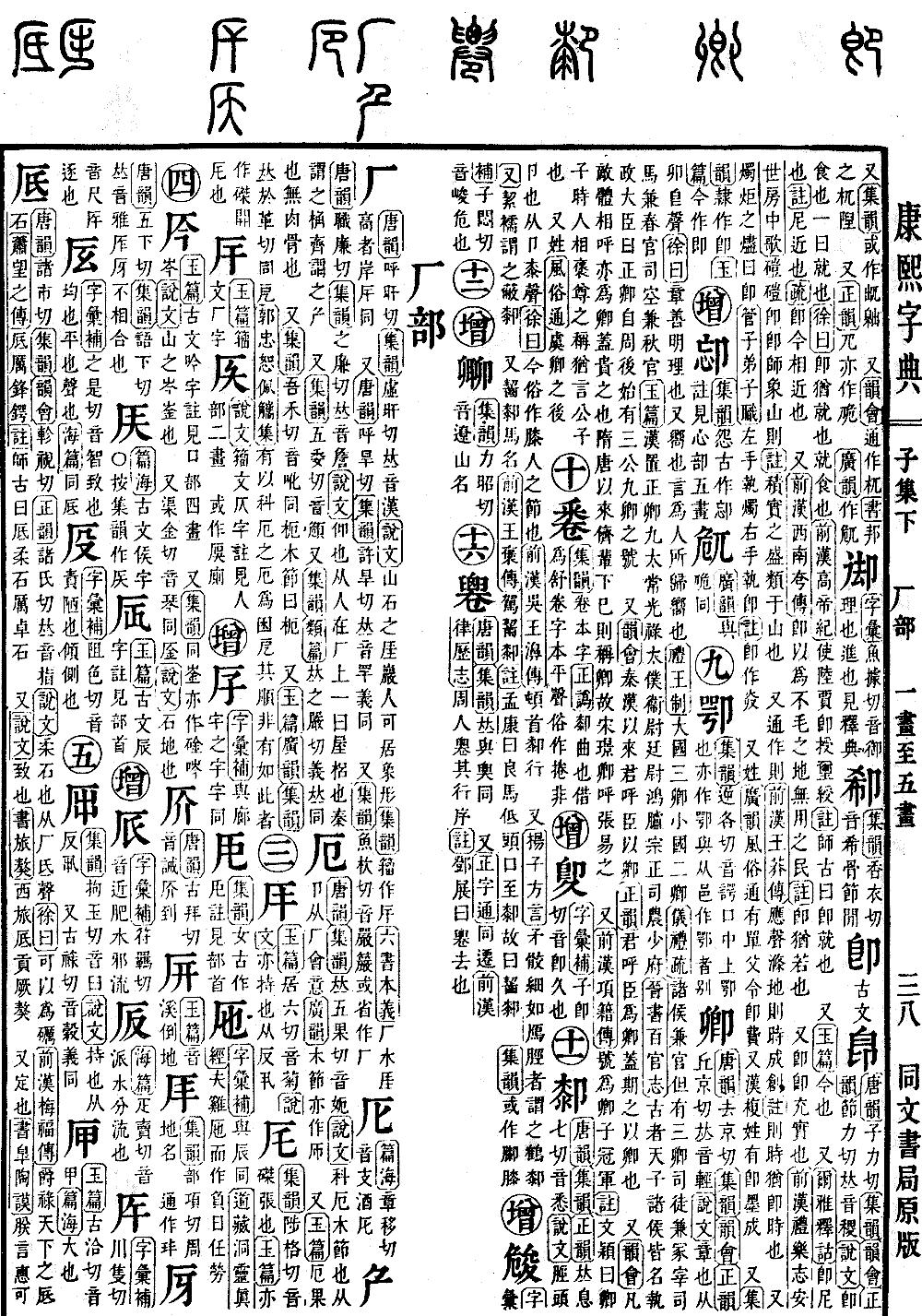
Zi Collection, Page Position: Lower
Radical: Seal (jié)
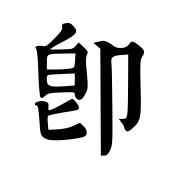
Word: Jí; Kangxi Strokes: 9; Page: 160, Entry 03
Anciently written with a variant character.
In Tangyun (Tángyùn), pronounced zǐlì qiè. In Jiyun (Jíyùn), Yunhui (Yùnhuì), and Zhengyun (Zhèngyùn), pronounced jiélì qiè. It has the same pronunciation as jì.
Shuowen Jiezi (Shuōwén Jiězì) explains it as "to go and eat." Another explanation is "to go to."
Xu Yue (Xú Yuē) explains that jí is like the meaning of "to go to" (jiù), which is to go forward and eat.
In the Book of Han (Qiánhàn shū), Annals of Emperor Gao: "He ordered Lu Jia (Lù Jiǎ) to immediately present the imperial seals and ribbons."
Note: Yan Shigu (Yán Shīgǔ) stated that jí means "to go to."
Further, Yupian (Yùpiān) explains it as "now."
Further, Erya (Ěryǎ), Explanations of Evidence: jí means "ní."
Note: Ní means "close" or "near."
Commentary explains that jí is what is now called "to be close to each other."
Further, in the Book of Han, Treatise on the Southwest: "They then considered it barren land, with useless people."
Note: Jí is like the meaning of "ruò," meaning "as if."
Also, jíjí means "full" or "substantial."
In the Book of Han, Treatise on Rites and Music, Songs for the Ancestral Temple: "Crushing and full, a teacher resembling a mountain."
Note: Describes the grandeur of accumulation and fullness, resembling a mountain.
Also used interchangeably with "zé."
In the Book of Han, Biography of Wang Mang: "Responding to the sound, it swept the ground, then wounds were immediately formed."
Note: Zéshí is like jíshí, meaning "immediately."
Also, the ashes of a candle are called jí.
In Guanzi (Guǎnzǐ), Duties of Disciples: "Holding a candle in the right hand, arranging the comb in the left hand." In the commentary to the Classic of Rites (Lǐjì), Tan Gong (Tángōng), the character for "comb" (zhì) is written as jí.
Also a surname.
Guangyun (Guǎngyùn) and Fengsu Tong (Fēngsú Tōng) record a Magistrate of Shanfu named Jí Fèi.
In the Han dynasty, there were also compound surnames, such as Jímò Chéng.
Further, in Jiyun (Jíyùn), in clerical script, it is written as jí.
Yupian (Yùpiān) states that it is now written as jí. Its character form is composed of "fire" (huǒ) and "receive" (shōu).
Textual Correction: The original phrasing "holding a candle in the left hand" should be "holding a candle in the right hand." The phrase "holding a jí in the right hand" should be "arranging the comb in the left hand." The note stating "jí is written as yàn" is not from a Guanzi (Guǎnzǐ) commentary; instead, only in the commentary to the Classic of Rites (Lǐjì), Tan Gong (Tángōng), is "comb" (zhì) written as jí when cited. Thus, it should be revised to: "In the commentary to Tan Gong (Tángōng), the character for "comb" (zhì) is written as jí."