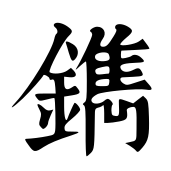
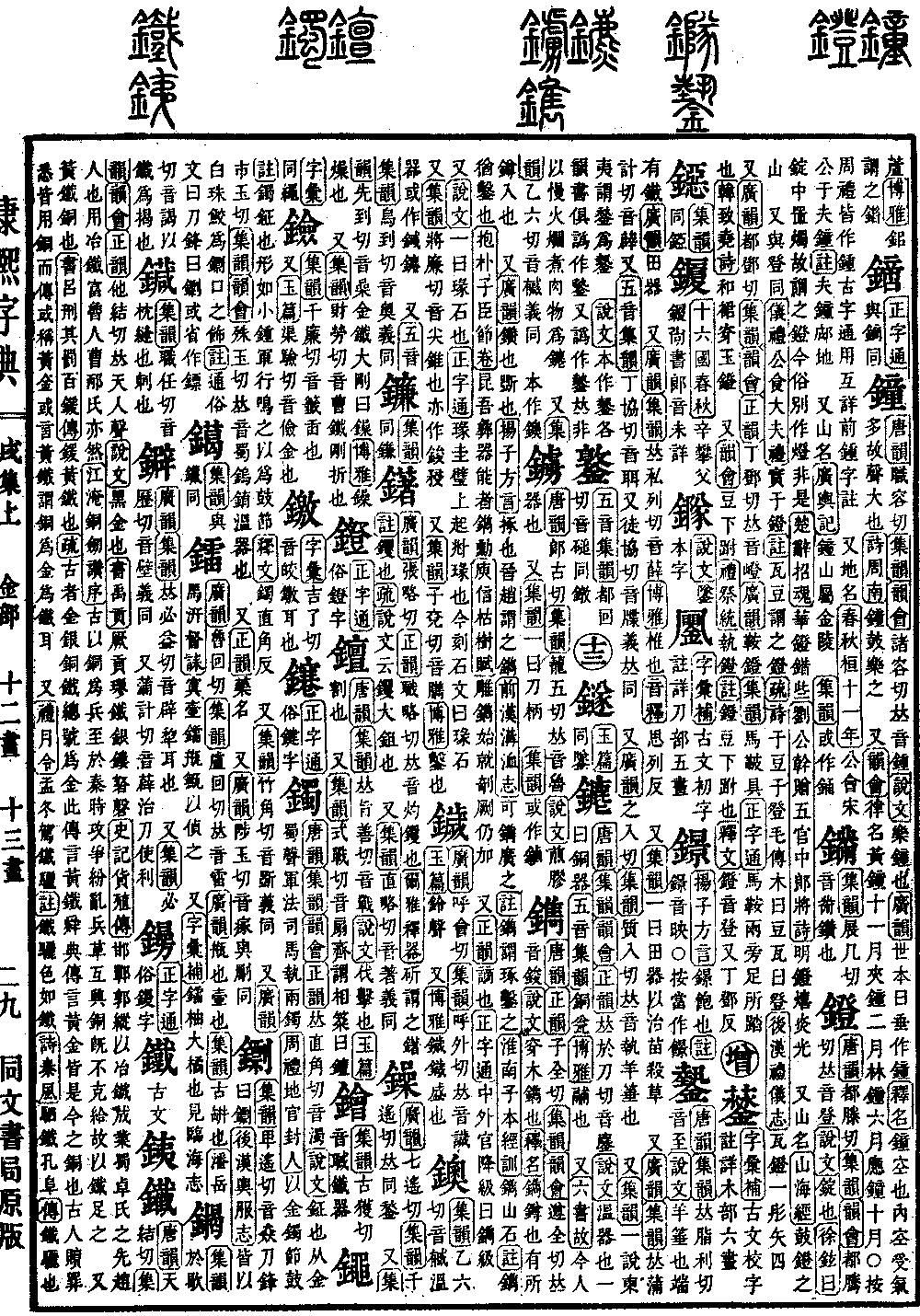
Xu Collection, Upper Volume
Radical: Metal (jīn)
Juan
Kangxi Strokes: 21
Page 1323, Entry 16
Tang Rhymes (Tangyun) and Correct Rhymes (Zhengyun): zi quan qie, Collected Rhymes (Jiyun) and Rhyme Collection (Yunhui): zun quan qie, pronounced zuan.
Explanation of Characters (Shuowen): To drill wood or engrave.
Explanation of Names (Shiming): To engrave means to chisel, implying something carved into an object.
Also, Broad Rhymes (Guangyun): To drill, to hew.
Dialects (Fangyan) by Yang Xiong: To carve. In the state of Jin and Zhao, this is called juan.
History of the Former Han (Qianhan), Treatise on Waterways and Irrigation: It can be engraved and widened.
Commentary: To engrave means to polish and chisel.
Masters of Huainan (Huainanzi), Original Nature (Benjing Xun): To engrave mountain rock.
Commentary: To engrave is the same as to chisel.
Master Who Embraces Simplicity (Baopuzi), Chapter on Ministerial Conduct (Chenjie Juan): Regarding the sacrificial vessels of Kunwu, those with skill engrave achievements upon them.
Yu Xin, Rhapsody on the Withered Tree (Kushu Fu): Carving and engraving were just completed, the chisels and knives were applied once more.
Also, Correct Rhymes (Zhengyun): To demote.
Correct Meaning (Zhengzitong): For officials within the central government or in the provinces, to be demoted in rank is called juanji.
Also, Explanation of Characters (Shuowen): Another meaning is to carve stone.
Correct Meaning (Zhengzitong): Zhuan refers to the raised patterns on jade tablets or circular jade discs. Nowadays, engraving text on stone is called zhuanshi.
Also, Collected Rhymes (Jiyun): jiang lian qie, pronounced jian. An awl. Also written as zuan.
Also, Collected Rhymes (Jiyun): zi yan qie, pronounced juan.
Extensive Elegant (Boya): To chisel.