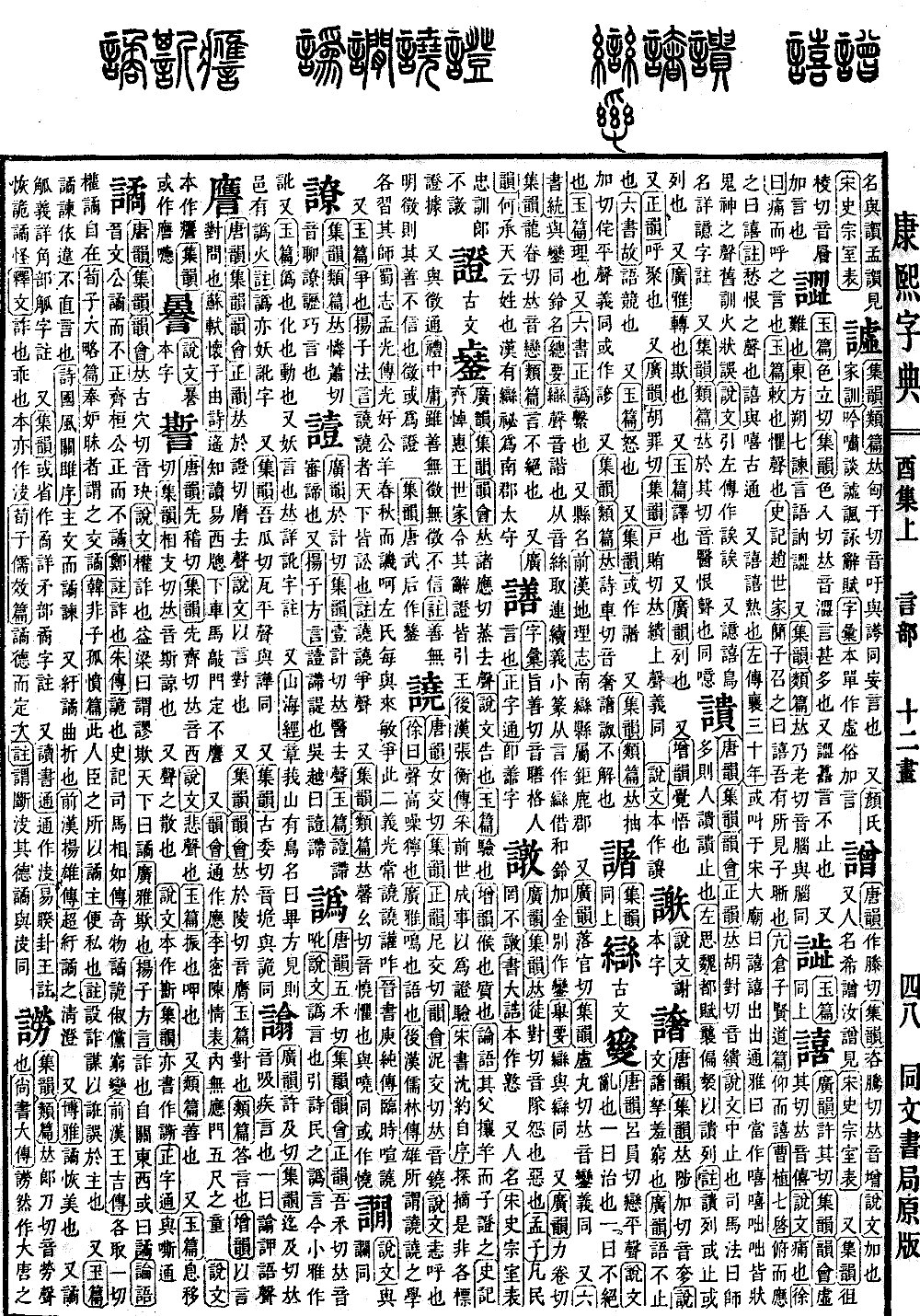
You Collection, Upper Volume
Radical: Speech (yán)
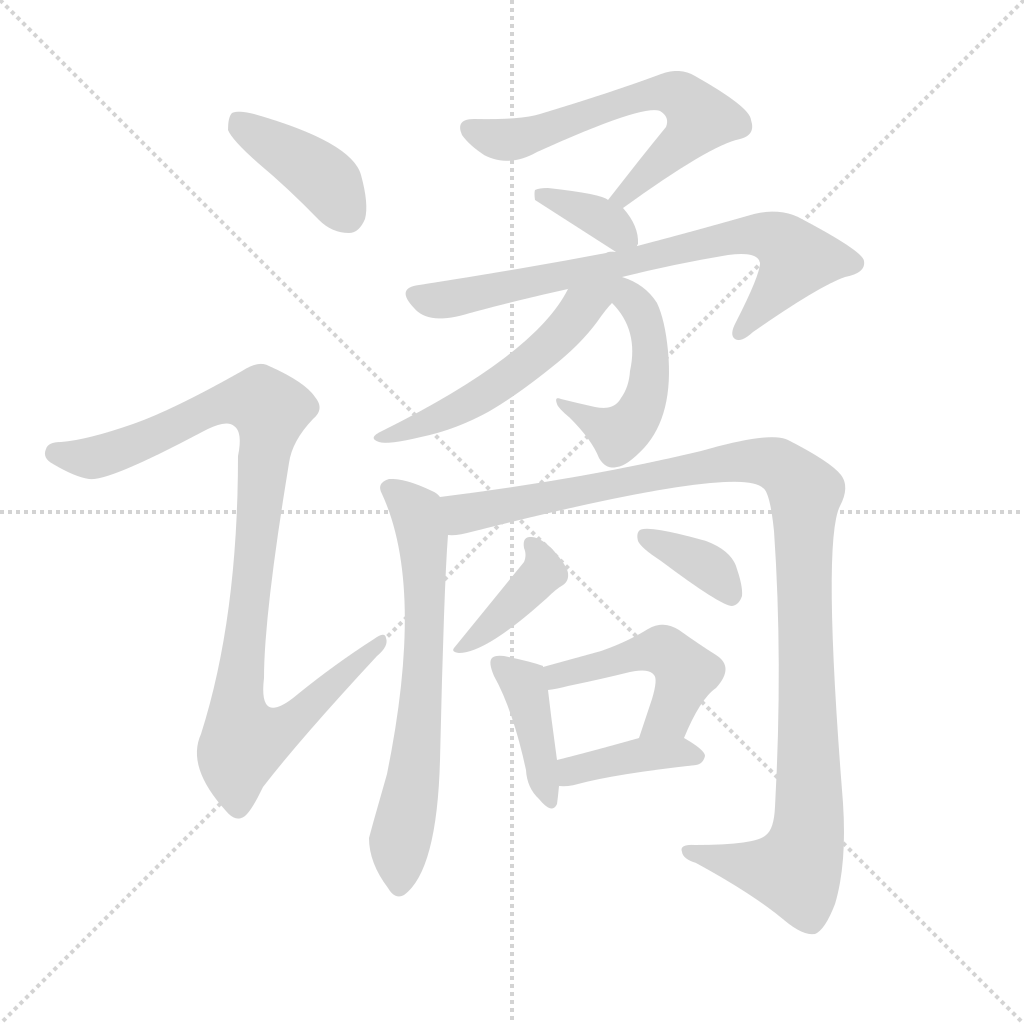
Jué
Kangxi stroke count: 19
Page 1180, Entry 03
Pronounced jué.
According to the Explaining Graphs and Analyzing Characters (Shuowen Jiezi), it means to act with deceit or cunning. In the regions of Yi and Liang, it is said that deceiving the world under false pretenses is called jué.
According to the Broad Matters (Guangya), it means to deceive.
According to the Regional Speech (Fangyan) by Yang Xiong, it means to use fraud. From the east to the west of the passes, some refer to this as jué.
Analects (Lunyu): Duke Wen of Jin was deceitful and not upright, whereas Duke Huan of Qi was upright and not deceitful.
Commentary by Zheng Xuan: It means to use fraud.
Commentary by Zhu Xi: It means to be guileful.
Records of the Grand Historian (Shiji), Biography of Sima Xiangru: Extraordinary objects and strange, deceitful phenomena, remarkable and boundless in their transformations.
History of the Former Han (Qianhan Shu), Biography of Wang Ji: Each took what they could for the moment, acting with deceit and arrogance as they pleased.
Xunzi, General Principles Chapter: Those who flatter the jealous and ignorant are said to be practicing corrupt deceit.
Han Feizi, Isolated Indignation Chapter: This is the means by which ministers deceive their rulers to serve their own private interests.
Commentary: This refers to establishing deceitful schemes to trick and mislead the ruler.
Also, according to the Jade Chapters (Yupian), juéjiàn refers to remonstrating indirectly rather than speaking directly.
Book of Odes (Shijing), Preface to Guanju: Prioritizing literary grace while employing indirect remonstrance.
Also, yūjué means winding or circuitous.
History of the Former Han (Qianhan Shu), Biography of Yang Xiong: Surpassing the clarity and depth of that which is winding and circuitous.
Also, according to the Broad Matters (Guangya), juéhuī means to be beautiful.
Also, juégū. For the meaning, refer to the note on the character gū in the Horn Radical (jiǎo) section.
Also, according to the Collected Rhymes (Jiyun), it is sometimes written in the simplified form (yù). Refer to the note on the character yù in the Spear Radical (máo) section.
Also, according to the General Guide to Reading (Dushutong), it is used interchangeably with the character (jué).
Book of Changes (Yijing), Kui Hexagram, Commentary by Wang Bi: Greatly guileful, deceitful, and strange.
Explanation of Sounds (Shiwen): It means to be deceitful or perverse. The original text also used the character (jué).
Xunzi, The Efficacy of the Confucians Chapter: To determine one’s virtue and settle the sequence.
Commentary: This means to sever or decide upon one’s virtue. Jué is used interchangeably with (jué).