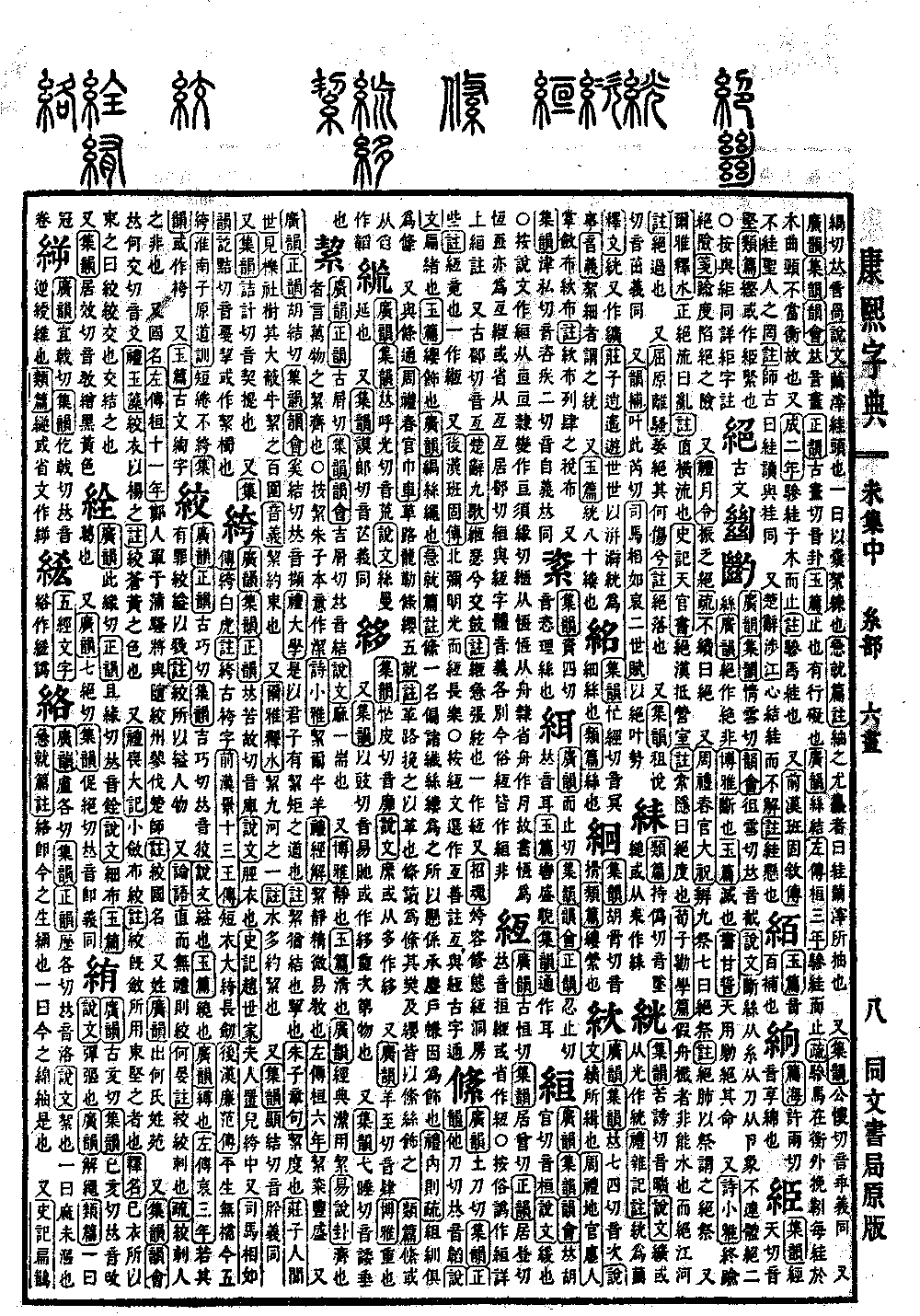
Wei Collection, Middle Volume
Radical: Silk (mì)
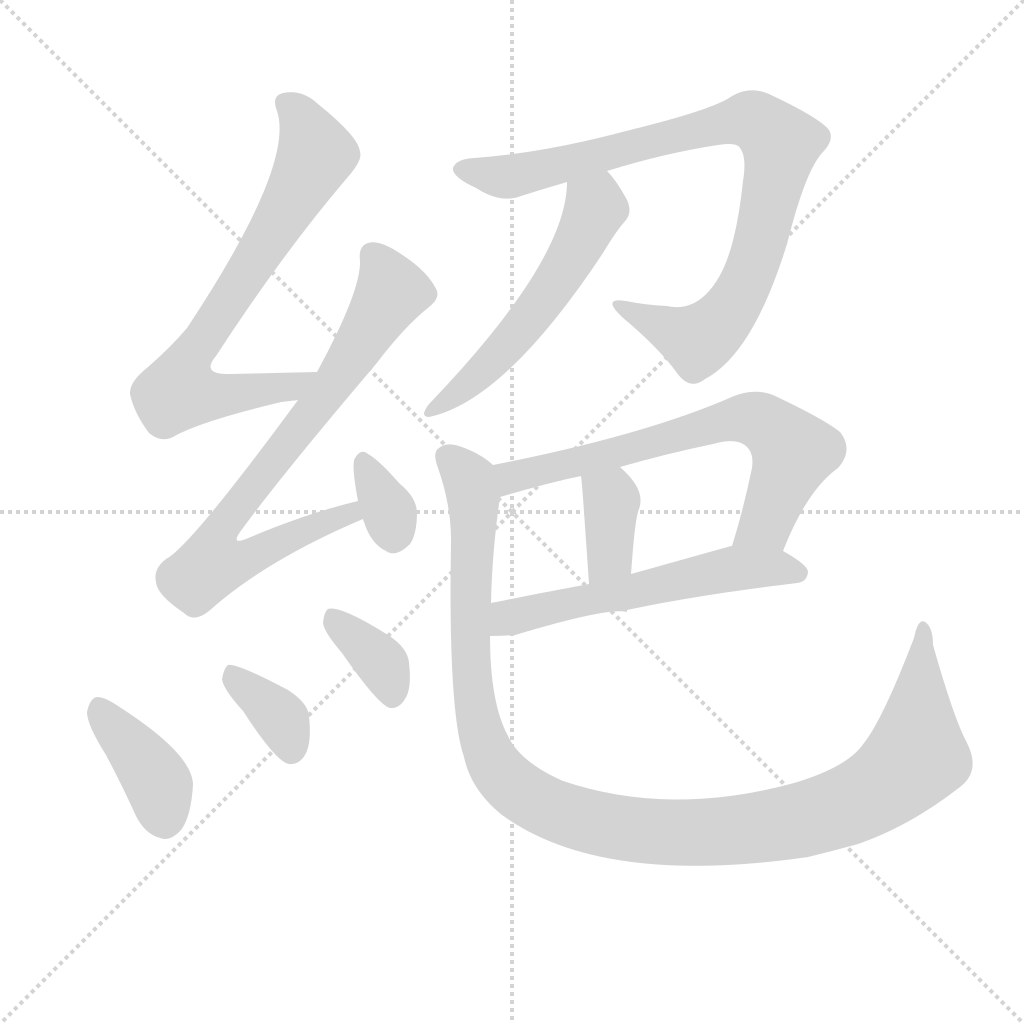
Jue
Kangxi stroke count: 12
Page 922, Entry 04
Ancient form. According to the Guangyun and the Jiyun, it is pronounced jie (rising tone); according to the Yunhui, it is pronounced jie (rising tone).
According to the Shuowen Jiezi, it means to break silk. It is composed of the radicals for silk, knife, and seal, representing the appearance of two threads that are not connected.
The Guangyun notes that writing the character as the variant form is incorrect.
According to the Guangya, it means to break or sever.
According to the Yupian, it means to extinguish.
In the Book of Documents (Shangshu), specifically the Oath at Gan (Gan Shi): Heaven has therefore cut off and terminated their mandate.
Also in the Book of Odes (Shijing), specifically in the Minor Odes of the Kingdom (Xiaoya): Finally, he crosses the sheer and dangerous pass. The commentary notes that this refers to crossing a treacherous and broken precipice.
In the Book of Rites (Liji), specifically the Monthly Ordinances (Yueling): To provide relief to the exhausted and destitute. The commentary explains that what does not continue is called jue.
In the Rites of Zhou (Zhouli), specifically the Spring Offices: To distinguish the nine types of sacrifices, the seventh of which is called the severed sacrifice. The commentary notes that this refers to using a severed piece of lung for the offering, which is called a severed sacrifice.
In the Erya, specifically the Explication of Trees: To go straight across a current is called luan. The commentary notes this means to cross directly over a flowing stream.
In the Records of the Grand Historian (Shiji), specifically the Treatise on Celestial Offices: It crosses the Milky Way and arrives at the Encampment mansion. The commentary notes that jue means to pass over.
In the Xunzi, specifically the Exhortation to Learning: Those who make use of a boat or oar are not necessarily able to swim, yet they cross rivers and streams. The commentary notes that jue means to pass over.
In the Li Sao by Qu Yuan: If they wither and fall, what is the harm? The commentary notes that jue means to fall.
According to the Jiyun, it is pronounced zhuo (entering tone), with the same meaning.
According to the Yunbu, it rhymes with rui (entering tone). In the Lament for the Two Emperors (Ai Er Shi Fu) by Sima Xiangru: So as to sever the influence of their lineage.