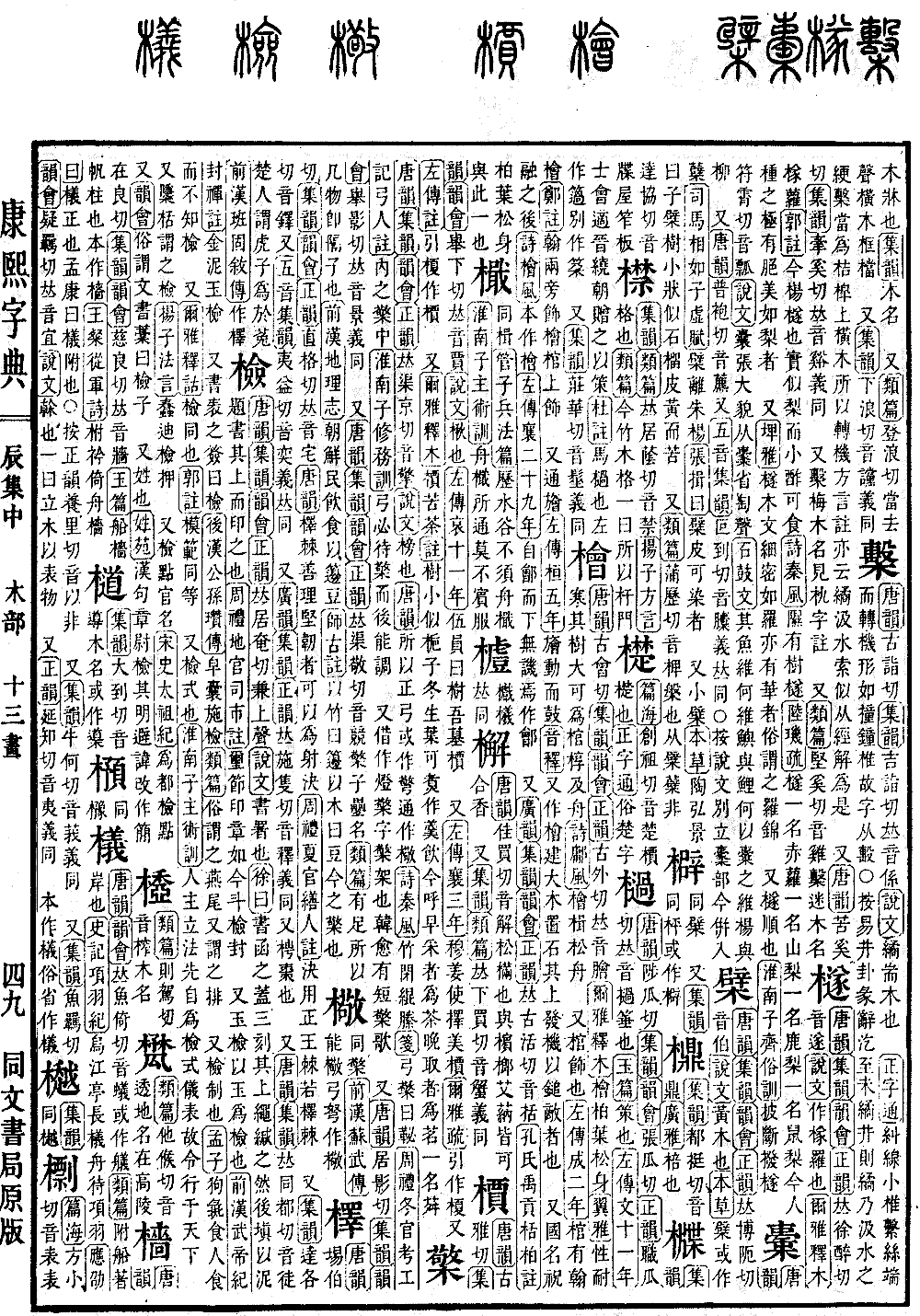
Chen Collection, Middle Volume
Radical: Wood (mù)
Page 557, Entry 17
Pronounced jian (rising tone).
According to the Explaining Graphs and Analyzing Characters (Shuowen Jiezi), it refers to the sealing of a document. Xu Shen comments that it is the cover of a document case, upon which three lines were carved; it was tied with string, sealed with clay, and then the text was written upon the clay and an official seal was impressed. In the Notes to the Office of Market Regulation in the Rites of Zhou (Zhouli), the seal and its official markings are likened to the modern method of sealing document covers.
It also refers to the jade seal or jade document cover. In the Notes to the Records of Emperor Wu of the Former Han (Qian Hanshu) regarding the Fengshan sacrifices, it is referred to as a golden clay and jade seal.
It is also used for the label on a book cover. In the Biography of Gongsun Zan in the History of the Later Han (Hou Hanshu), it is described as a black pouch secured with a seal. According to the Classified Chapters (Leipian), it is colloquially called a swallow tail, or also a partition.
It further means to control or restrict. In the Mencius, it describes pigs and dogs eating the food of men while the ruler fails to restrict them.
According to the Approaching Eulogies (Erya), it means to be the same. Guo Pu notes this refers to a standard or model of equality.
It also means a pattern or formula. In the Training in the Principles of Sovereignty in the Huainanzi, it is stated that a ruler who establishes laws must first provide a standard model for others, so that the laws may be enacted throughout the world.
It also refers to a tool used to straighten wood. In the Model Sayings (Fayan) by Yang Xiong, it describes the correction of errors.
It is also used as an official title. In the Basic Annals of Emperor Taizu in the History of Song (Songshi), one is noted as the Grand Controller.
According to the Collected Rhymes (Yunhui), a draft of a document is colloquially called a jianzi.
It is also a surname. According to the Garden of Surnames (Xingyuan), an official in the Han dynasty named Jian Qiming changed his name to avoid a naming taboo.