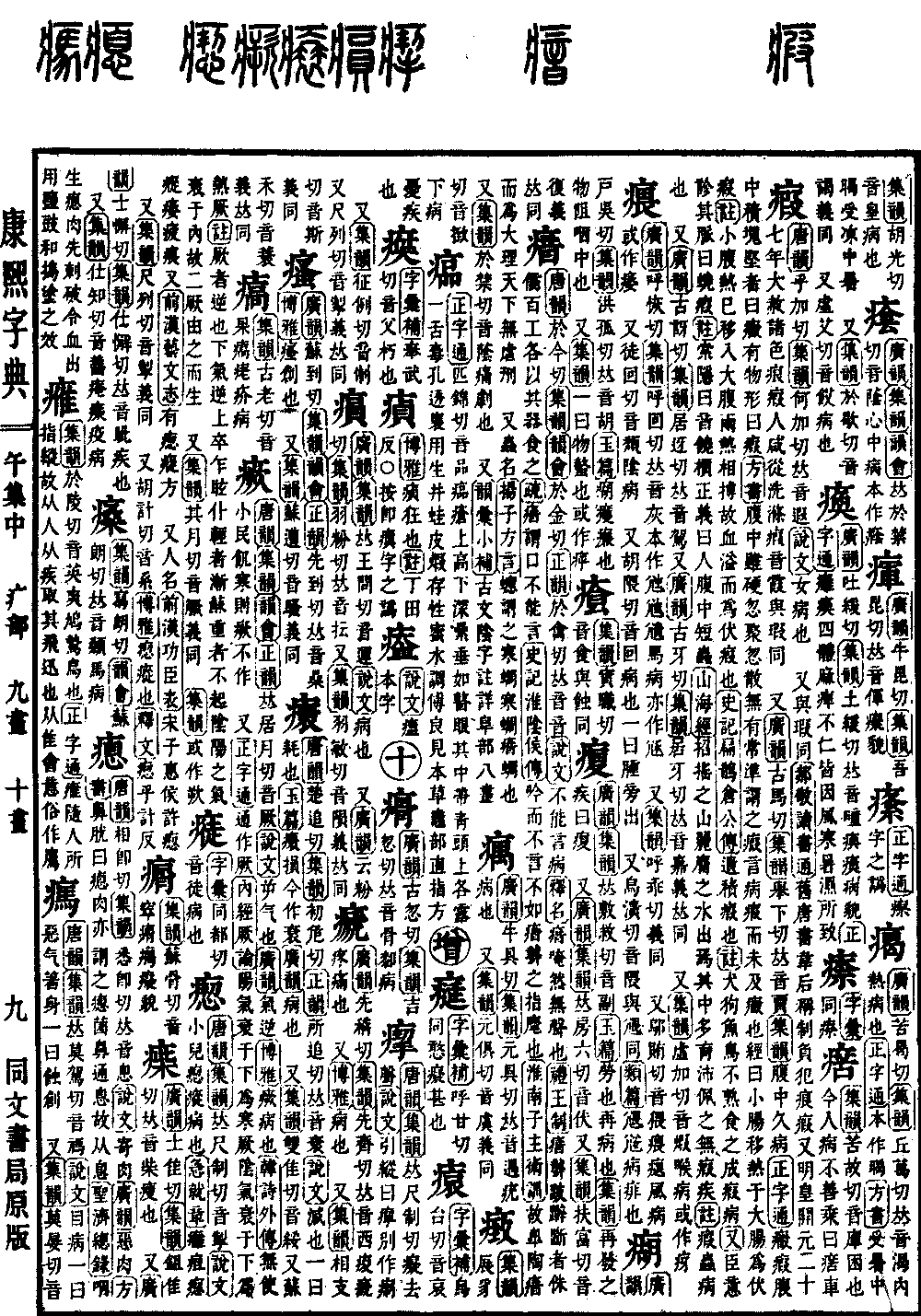
Wu Collection, Middle Volume
Radical: Sickness (bù)
Jiá
Kangxi strokes: 14
Page 777, Entry 08
Pronounced xiá.
According to the Shuo Wen Jiezi (Shuowen), it refers to a woman's illness.
Also identical to the character for flaw (xiá).
According to the Book of Reading Comprehension (Dushu Tong), the Old Book of Tang (Jiu Tangshu) states: When Empress Wei held power, those who committed offenses and bore traces of illness were pardoned. In the 27th year of the Kaiyuan era of Emperor Minghuang, there was a great amnesty for various kinds of people with persistent illnesses, all were pardoned. Jiá is pronounced xiá. Identical to flaw (xiá).
Pronounced jiǎ.
Refers to a chronic illness in the abdomen.
According to the Collection of Correct Characters (Zhengzitong), abdominal masses that are hard are called zhèng, and those that have a physical form are called jiá.
According to medical texts, an abdominal condition that is sometimes hard, sometimes gathers and disperses, and lacks a regular pattern, is called jiá. This refers to an illness that has not yet become a fixed mass (zhèng).
The classic says: Small intestine heat transferring to the large intestine causes latent jiá.
Annotation: When heat in the lower abdomen transfers into the large abdomen, the two heat sources collide, causing blood to overflow, resulting in latent jiá.
Records of the Grand Historian (Shiji), Biography of Bian Que and Cang Gong: Leaving behind accumulated jiá.
Annotation: Consuming raw dog, fish, or bird meat causes jiá disease.
Also: The official diagnosed the pulse as a parasitic jiá.
Annotation: The Suoyin commentary says: Pronounced ráo jiǎ. The Zhenggyi commentary says: Small parasites in the human abdomen.
Classic of Mountains and Seas (Shanhaijing): Mount Zhaoyao, from which the Li River flows. Within it are many yupèi plants; wearing them prevents jiá disease.
Annotation: Jiá is a parasitic illness.
Pronounced jià.
Pronounced jiā.
Meaning is the same.
Pronounced xiá.
A throat illness. Sometimes written as the variant form (jiǎng).