Wei Collection, Middle Volume
Radical: Silk (mì)
Kangxi Strokes: 8
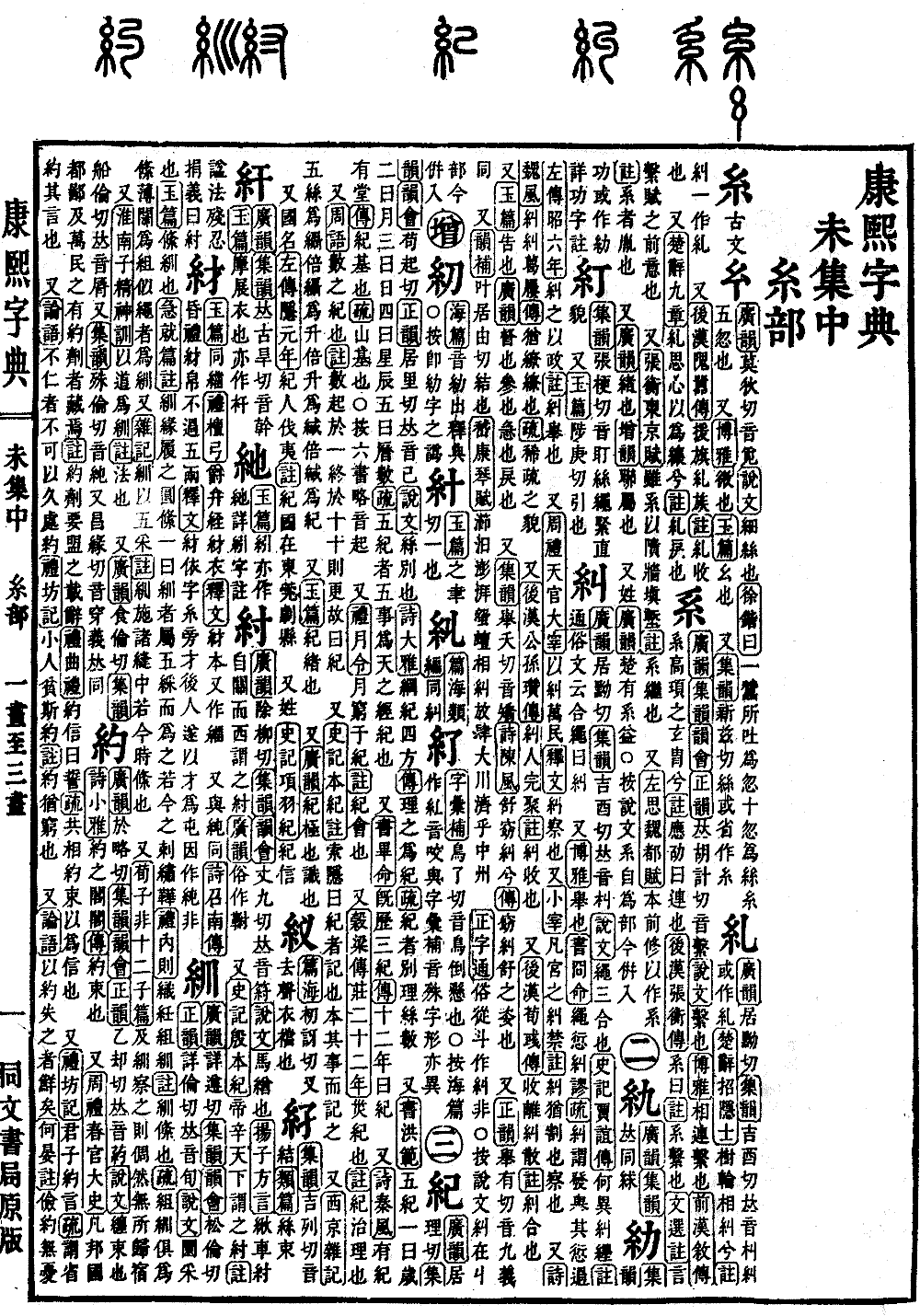
Page 915, Entry 08
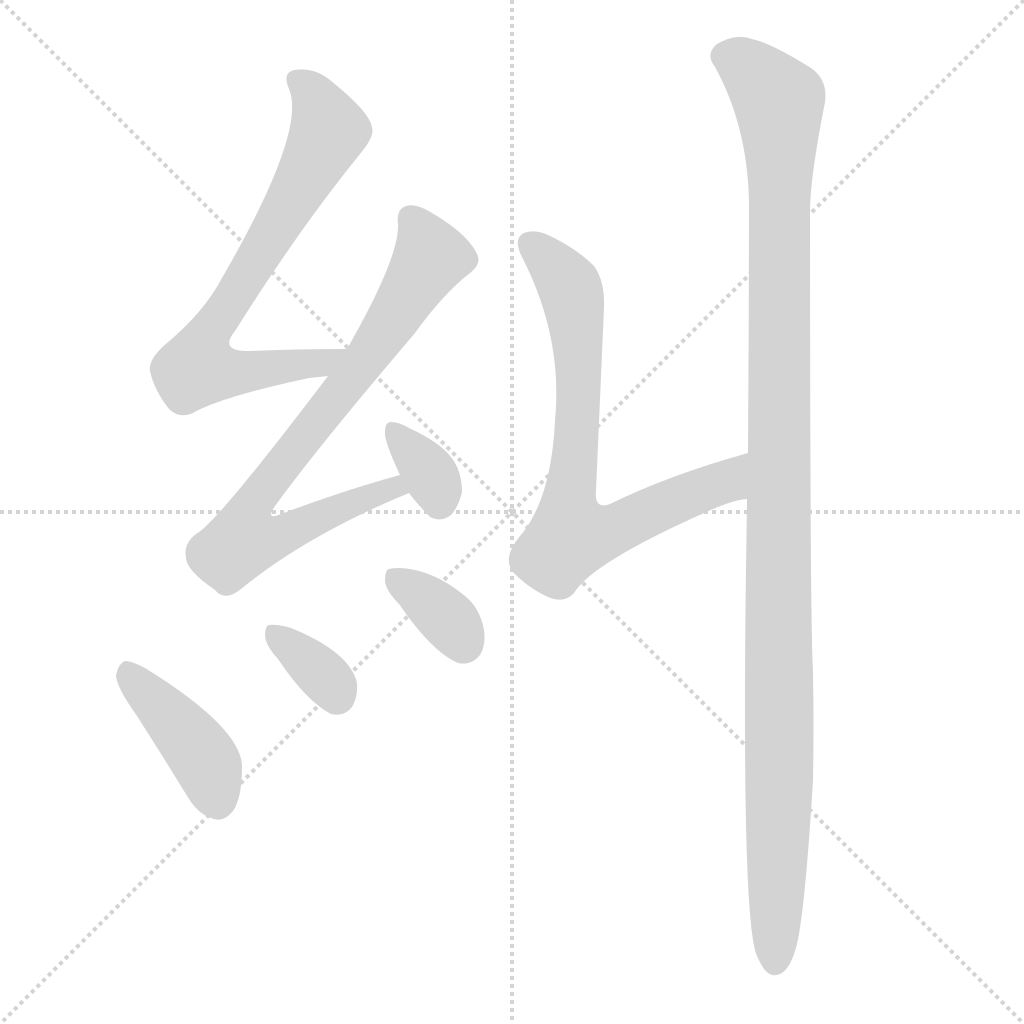
Pronounced jiu.
According to the Explaining Graphs and Analyzing Characters (Shuowen Jiezi), it refers to three ropes twisted together.
In the Biography of Jia Yi from the Records of the Grand Historian (Shiji), it states: How is this different from tangled rope? The commentary notes that the General Texts (Tongsuwen) says to twist ropes together is called jiu.
Also, the Extensive Admonitions (Boya) defines it as to lift up.
In the Charge to Jiong from the Book of Documents (Shujing), it says: Tie up faults and correct errors. The sub-commentary explains that jiu means to reveal or bring to light faults and errors.
In the Zuo Commentary (Zuozhuan) for the sixth year of Duke Zhao, it says: Regulate them with government policy. The commentary notes that jiu means to lift up or expose.
In the Offices of Heaven and the Great Administrator from the Rites of Zhou (Zhouli), it says: Thereby regulating the myriad people. The explanation of the text notes that jiu means to observe or inspect.
In the Minor Administrator section, it mentions all palace regulations and prohibitions. The commentary notes that jiu signifies to cut or to inspect.
In the Odes of Wei from the Book of Odes (Shijing), it says: The tangled hemp sandals. The commentary notes that it means winding or intertwined. The sub-commentary explains this as a sparse appearance.
In the Biography of Gongsun Zan from the Book of the Later Han (Hou Hanshu), it says: Gather people together. The commentary notes that jiu means to collect.
In the Biography of Xun Yu from the Book of the Later Han (Hou Hanshu), it says: Gather the scattered and unite the dispersed. The commentary notes that jiu means to combine.
According to the Jade Chapters (Yupian), it means to report.
According to the Broad Rhymes (Guangyun), it also means to supervise, to participate, to be urgent, and to be crooked or perverse.
Also pronounced jiao according to the Collected Rhymes (Jiyun).
In the Odes of Chen from the Book of Odes (Shijing), it says: Graceful and tangled. The commentary notes that this refers to a graceful and relaxed posture.
Also pronounced jiu according to the Correct Rhymes (Zhengyun), with the same meaning.
Additionally, according to the Rhyme Supplements (Yunbu), it rhymes as you and means to tie. In the Rhapsody on the Zither (Qinfu) by Ji Kang, it describes the turbulent waters, twisting and turning together, flowing into the great rivers and passing through the central regions.
The Correct Meaning (Zhengzitong) notes that the common usage adds the battle radical to form a variant, which is incorrect. Note that in the Explaining Graphs and Analyzing Characters (Shuowen Jiezi), this character was under the jiu radical, but is now merged into this one.