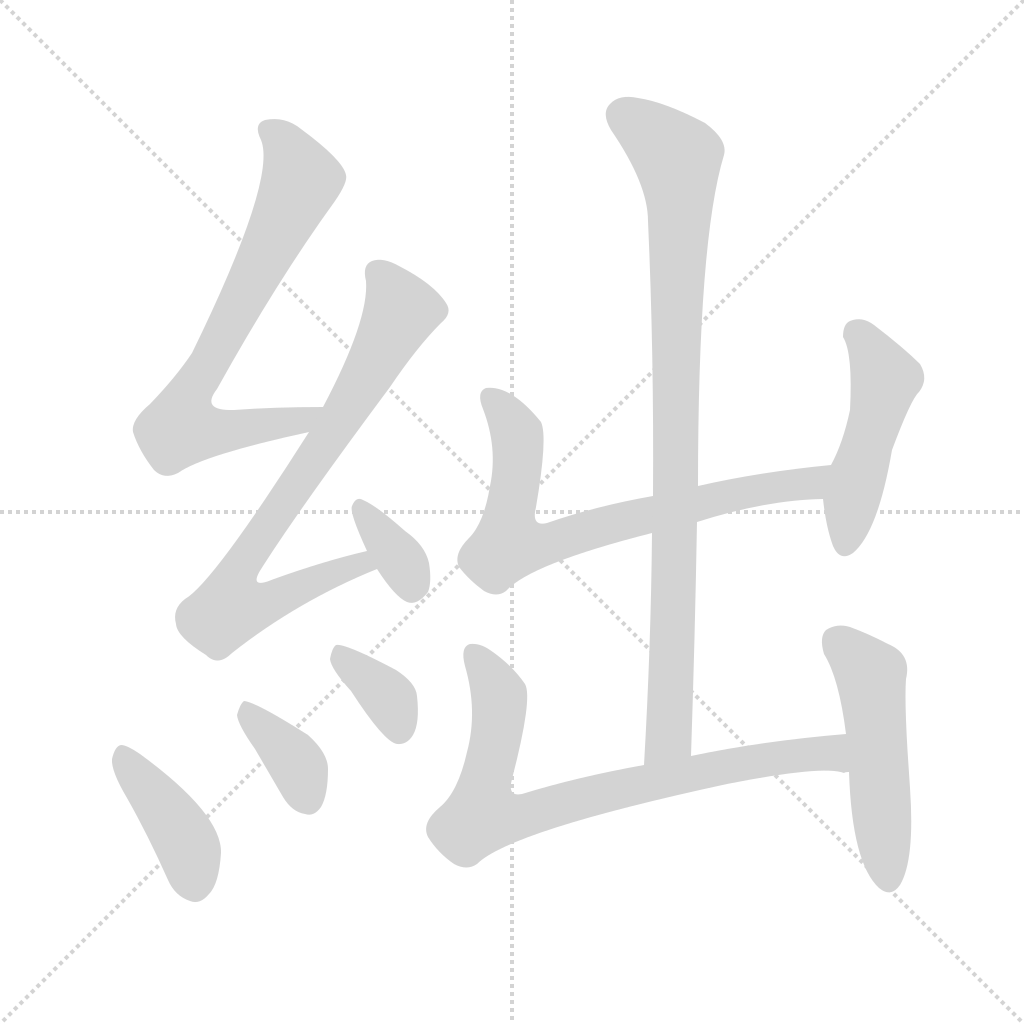
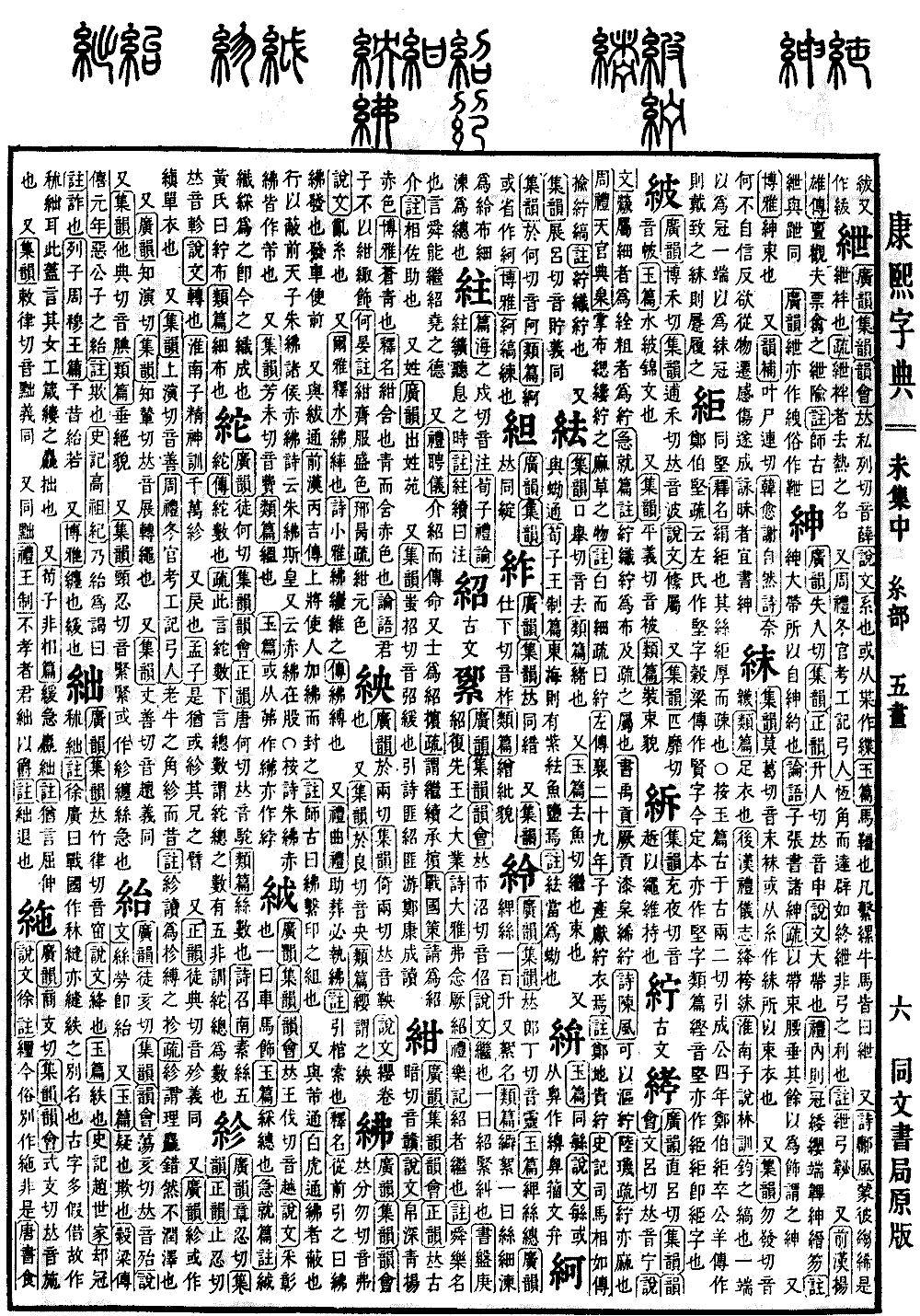
Wei Collection, Middle Volume
Radical: Silk (mì)
Kangxi Strokes: 11
Page 920, Entry 25
According to the Guangyun (Guangyun) and Jiyun (Jiyun), the pronunciation is zhu. It sounds the same as zhu.
According to the Shuowen Jiezi (Shuowen), it is defined as mending or patching. According to the Yupian (Yupian), it is defined as sewing or stitching.
In the Records of the Grand Historian (Shiji), House of Zhao, it is recorded as wearing a cap with a patched appearance. The commentary by Xu Guang states that the Strategies of the Warring States (Zhan Guo Ce) writes this as a patched appearance, which is another term for mending. Ancient characters were frequently used as phonetic loan characters (jiajie), which is why it is written as this character. This likely refers to needlework that is coarse or poorly crafted.
Also, in the Xunzi (Xunzi), chapter Non-Physiognomy (Feixiang), it appears in the phrase meaning to be slow or hurried, to stretch or contract (yingchu). The commentary explains this as to bend and extend.
Also, according to the Jiyun (Jiyun), the pronunciation is chu. It sounds the same as the character for dismiss. The meaning is the same. It is also a variant form (tong) of the character for dismiss. In the Book of Rites (Liji), section Royal Regulations (Wangzhi), it is recorded that those who are unfilial shall have their titles dismissed by the ruler. The commentary states that this character means to demote or retreat.
Textual Research: The original text in the Shuowen Jiezi (Shuowen) erroneously wrote this as a deep red color. According to the original source, we have corrected deep red to sewing. In the Records of the Grand Historian (Shiji), House of Zhao, the text reads wearing a cap with a patched appearance. The commentary by Xu Guang states that the Strategies of the Warring States (Zhan Guo Ce) uses the word for patch. We have added the character for Strategies to the mention of Warring States in accordance with the original source.