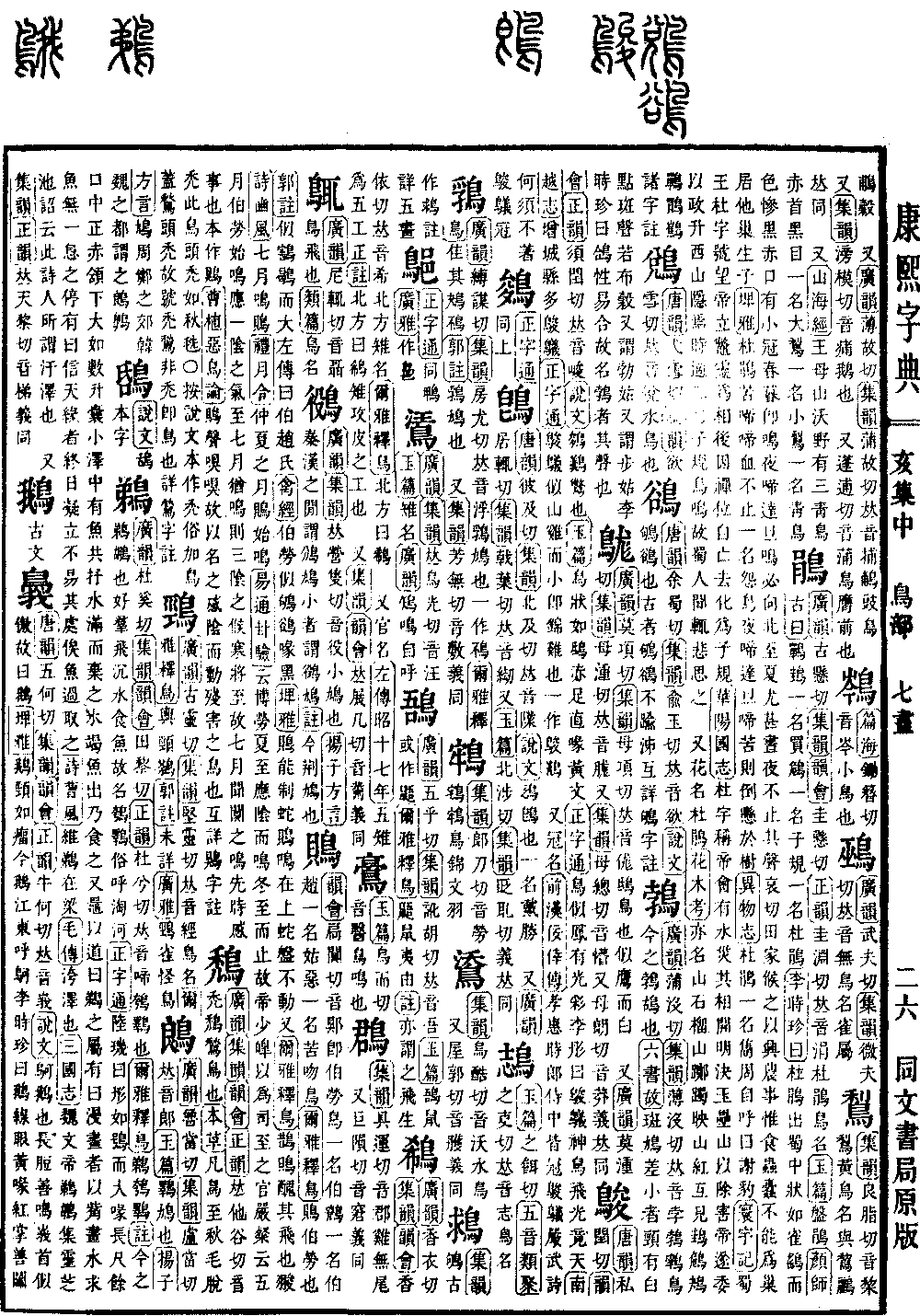
Hai Collection, Middle Volume
Radical: Bird (niǎo)
Juan
Kangxi Strokes: 18
Page 1490, Entry 04
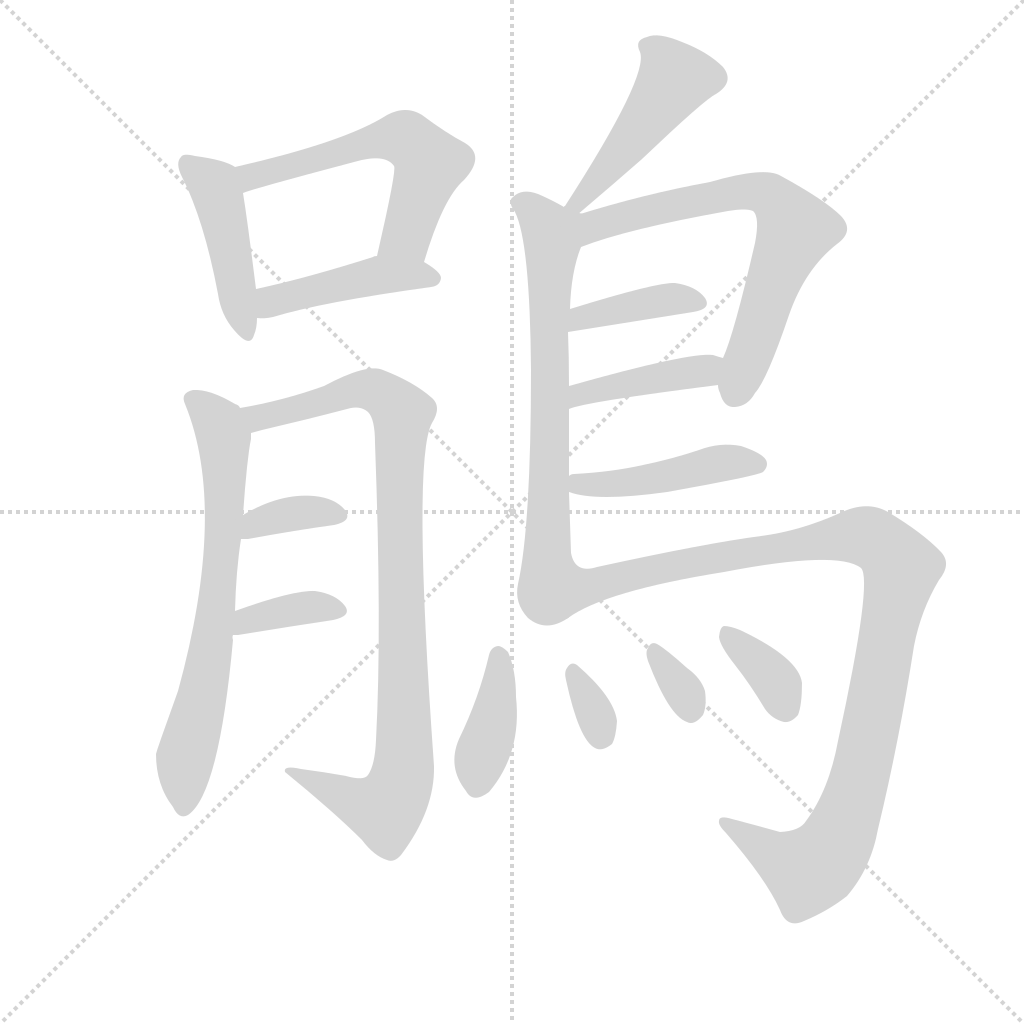
Pronounced juan. Dujuan, a type of bird.
Yupian (Yupian): Zhenjuan.
Yan Shigu says: The tian bird is also known as the mai, the zigui, and the dujuan.
Li Shizhen says: The dujuan originates from Shu. Its shape is like a sparrow hawk, but it is deep black in color, with a red beak and a small crest. It begins to call at the end of spring, crying through the night until daybreak. When it calls, it always faces north, especially frequently in summer, without ceasing day or night. Its voice is sorrowful and plaintive, and farmers use it to schedule agricultural work. It eats only harmful insects and does not build its own nest, but lays its eggs in the nests of other birds.
Piya (Piya): The dujuan cries bitterly, not stopping even when it cries blood; it is also called the bird of resentment, crying from night until daybreak, and when the crying is agonizing, it hangs upside down from a tree.
Yiwuzhi (Yiwuzhi): The dujuan is also called suizhou, and its own call sounds like xiebao.
Huanyuji (Huanyuji): The King of Shu, Duyu, was known as the Wang Emperor. He appointed Bieling as prime minister, and later, due to abdicating the throne, he departed and transformed into the zigui bird.
Huayangguozhi (Huayangguozhi): When Duyu was emperor, there was a flood. His prime minister, Kaiming, cut through Mount Yulei to eliminate the disaster, so the emperor entrusted the government to him and retired to the Western Mountains. It happened to be the second month when the zigui bird called, which is why the people of Shu feel sad and miss him whenever they hear it.
There is also a flower called dujuan.
Huamukao (Huamukao): Also called the mountain pomegranate, mountain azalea, and mountain-reflecting red.
Cross-references found in the entries for jue, tian, and juan.
The character sui was originally engraved with the bird radical and the jiong component. Sometimes written in a variant form (juan). The original engraving of the character was from the jiao component and the bird radical.
Textual research: In Yupian, it is written as panjuan. In accordance with the original text, it has been corrected to zhenjuan.