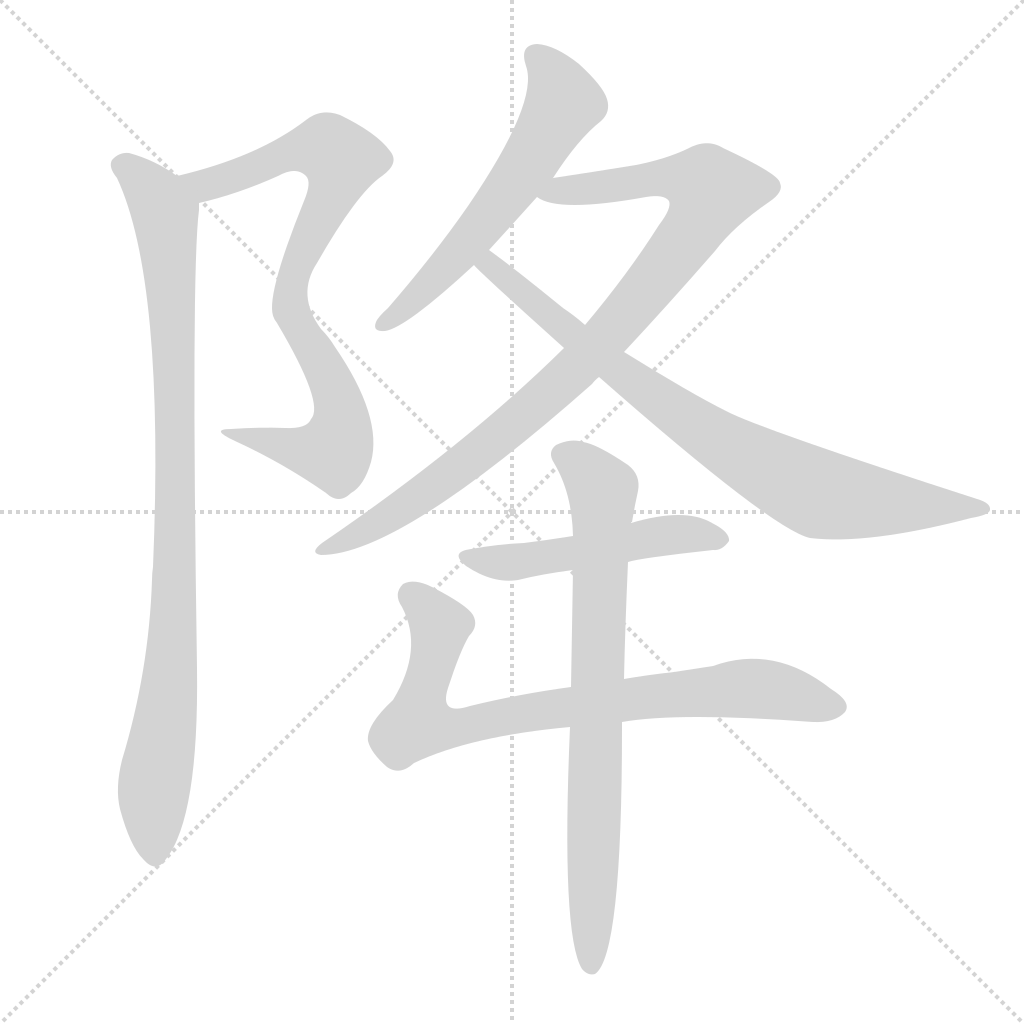
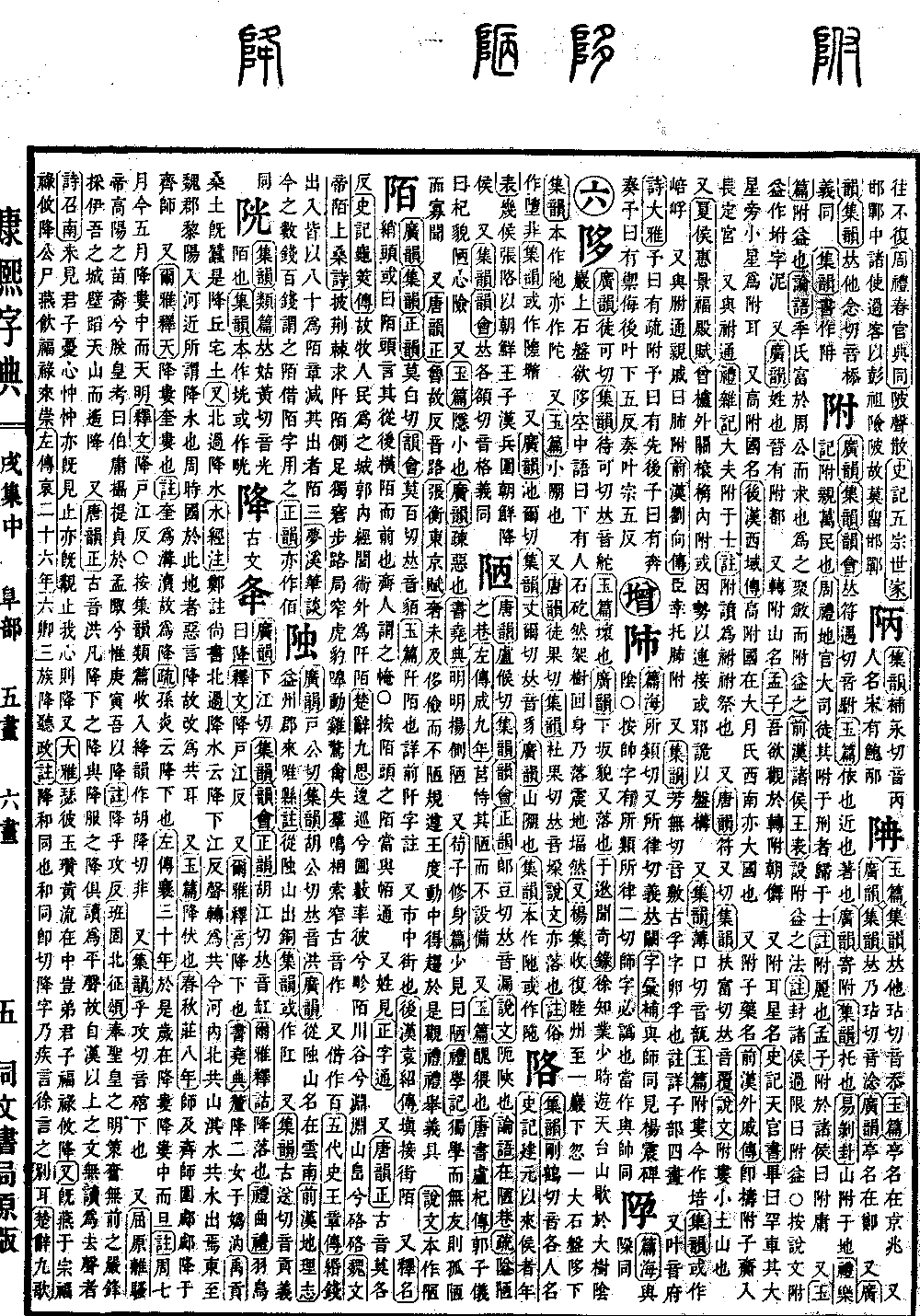
Xu Collection, Middle Volume; Radical: Mound (fù); Kangxi strokes: 14; Page: 1349, entry 12
Anciently written as a variant form pronounced jiàng.
The Guanyun (Guangyun) indicates the pronunciation xiàjiāng qiè. The Jiyun (Jíyùn), Yunhui (Yùnhuì), and Zhengyun (Zhèngyùn) indicate the pronunciation hújiāng qiè, pronounced similarly to gāng.
The Erya (Ěryǎ), Explanation of Words (Shìgǔ) explains: Jiang means to fall.
The Book of Rites (Lǐjì), Summary of the Rules of Propriety (Qūlǐ) records: A deceased flying bird is called jiàng.
The Shiwen (Shìwén) notes: Jiang is pronounced hùjiāng fǎn.
Also, the Erya, Explanation of Expressions (Shìyán) explains: Jiang means to descend.
The Classic of History (Shàngshū), Canon of Yao (Yáodiǎn) records: He commanded (Yao's two daughters) to marry into the bends of the Gui River.
The Tribute of Yu (Yǔgòng) records: The land of Mulberry and soil already reared silkworms, so people descended from the hills and dwelled on the plains.
Also recorded: Northward, passing through Jiangshui.
The Commentary on the Water Classic (Shuǐjīngzhù) quotes Zheng Xuan's (Zhèng Xuán) annotation of the Classic of History passage "Northward, passing through Jiangshui" as saying: Jiang is pronounced xiàjiāng fǎn, with the sound transforming to gòng. Today, Gong Mountain in northern Henei, from which the Qi River and Gong River originate, flows eastward to Liyang in Weijun and merges into the Yellow River, which is what is referred to as Jiangshui in modern times. During the Zhou dynasty, the people who established a state in this place disliked the character jiàng, so they changed it to gòng.
Also, the Yupian (Yùpiān) explains: Jiang means to subdue.
The Spring and Autumn Annals (Chūnqiū), Duke Zhuang, Year 8 records: Our army and the Qi army surrounded Cheng, and Cheng surrendered to the Qi army.
Also, the Erya, Explanation of Heaven (Shìtiān) records: Jianglou is the combined name for the constellations Kui and Lou.
The commentary says: The Kui constellation symbolizes a ditch, hence it is called jiàng.
The sub-commentary says: Sun Yan (Sūn Yán) says: Jiang means to descend.
The Zuo Commentary (Zuǒzhuàn), Duke Xiang, Year 30 records: In this year, Jupiter was in the Jianglou constellation, and the sky brightened when the Jianglou constellation was in the zenith.
The commentary says: The seventh month of the Zhou calendar, equivalent to the current fifth month, is when the sky brightens with the Jianglou constellation in the zenith.
The Shiwen notes: Jiang is pronounced hùjiāng fǎn. Annotation: The Jiyun and Leipian (Lèipiān) erroneously categorize this pronunciation under the jiàng rhyme, indicating hújiàng qiè.
Also, the Jiyun notes: hūgōng qiè, pronounced as gōng.
It means "to descend".
Also, a line from Qu Yuan's (Qū Yuán) poem "On Encountering Sorrow" (Lísāo): "I am a descendant of the ancient Emperor Gaoyang, and my deceased father was named Boyong. In the first month of early spring, in the year when Jupiter was in Yin, on a Gengyin day, I was born."
The commentary says: Jiang is pronounced hūgōng fǎn.
A line from Ban Gu's (Bān Gù) "Ode to the Northern Expedition" (Běizhēng Sòng): "Executing the strategies of the sagely and enlightened ruler, brandishing invincible sharp weapons. Capturing the city of Yiwa, stepping onto the Tianshan Mountains to subdue enemies from afar."
Also, the Tangyun Zheng (Tángyùn Zhèng) points out: The ancient pronunciation was hóng. All instances of jiàng meaning "to descend" and jiàng meaning "to surrender" were pronounced with a level tone (píngshēng). Therefore, texts before the Han dynasty did not have a falling tone (qùshēng) pronunciation.
A line from the Book of Odes (Shījīng), Shao and the South (Shàonán): "Not having seen the lord, my heart was troubled and restless. Now that I have seen him, now that I have met him, my heart has found peace."
Also, a line from the Book of Odes, Major Odes (Dàyǎ): "That brilliant scoop has a jade handle, fragrant wine fills the golden vessels. For the harmonious and gentle lord, blessings and emoluments descend."
Also a line: "Already a feast is spread in the ancestral temple, blessings and emoluments descend for you. The honored guest comes to feast and drink, blessings and emoluments gather."
The Zuo Commentary, Duke Ai, Year 26 records: The six ministers and three clans jointly administered government affairs.
The commentary says: Jiang means harmony and togetherness. "Harmony and togetherness" signifies the meaning of jiàng, with only a difference in tempo.
A line from the Songs of Chu (Chǔcí), Nine Songs (Jiǔgē): "The divine spirits splendidly have descended, then swiftly soared high to return to the clouds."
Also, a line from "Heavenly Questions" (Tiānwèn): "(Hou Yi's archery skills) could hit targets without harming himself, why was Hou Yi removed and Yu prospered (bòjiàng refers to flourishing and multiplying)?"
Annotation: The character jiàng, when meaning "to descend", is now pronounced with a falling tone, a long-standing practice. However, the Tangyun Zheng provides clear evidence that its teachings should be followed. It is incorrect that the Leipian does not list a level tone pronunciation for the character jiàng.
Also, the Tangyun, Jiyun, Yunhui, and Zhengyun note: gǔhàng qiè, pronounced similarly to jiàng.
The Yupian explains: It means "to descend", "to fall", "to return".
The Zhengyun explains: It means "to demote".
Annotation: The falling tone becoming the standard pronunciation for jiàng began with the Yupian.
Also, rhyming pronunciation: húláng qiè, pronounced similarly to háng.
A line from the Songs of Chu, Nine Songs: "Upper garment of green clouds, lower garment of white rainbow. Raising a long arrow to shoot at Sirius, holding my bow to return to lúnjiàng (lúnjiàng refers to descending)."
A line from Dongfang Shuo's (Dōngfāng Shuò) "Seven Admonitions" (Qījiàn): "Loyal and upright officials wish to admonish, but slanderous sycophants malign by their side. Autumn grasses are about to bear fruit, and light frost descends in the night."
Also, rhyming pronunciation: húgòng qiè, pronounced similarly to the falling tone of hóng.
A line from Guo Pu's (Guō Pú) "Encomium to Wu Xian from the Classic of Mountains and Seas" (Shānhǎijīng Wūxián Zàn): "Numerous shamans, ten in all, led by Wu Xian. Classical arts are perfected here, esoteric skills are gathered here. Gathering herbs on Spirit Mountain, ascending and descending with the seasons."
A line from Northern Qi's (Běiqí) "Hymns for Temple Offerings" (Xiǎngmiào Yuèzhāng): "Ritual vessels and wine jars used in due season, dragon reed mats alternately spread out. Using white grass as a base, there is no misfortune, and blessings and emoluments then descend."
Also, rhyming pronunciation: yúliàng qiè, pronounced similarly to yàng.
A line from Xi Zaochi's (Xí Záochǐ) "Lamp Poem" (Dēng Shī): "Brilliant are the night lamps, slender are the lights among the trees. The lamp flames flicker with the wind, wind and lamp flames rise and fall together."
Also, rhyming pronunciation under the tán rhyme.
A line from Liang Hong's (Liáng Hóng) "Poem on Going to Wu" (Shì Wú Shī): "Traveling through the old homeland, embarking on a distant journey, about to go far to the southeast. Heart sorrowful, painfully emaciated, thoughts scattered and fluctuating. Wishing to spur the horse with a whip, galloping freely, heartbroken that in my hometown there are slanderers."
Annotation: Various rhyme books do not record a rhyming pronunciation under the tán rhyme. This is preserved for further investigation.