Hai Collection, Upper Volume
Radical: Horse (mǎ)
Jia
Kangxi dictionary stroke count: 15
Page 1436, Entry 09
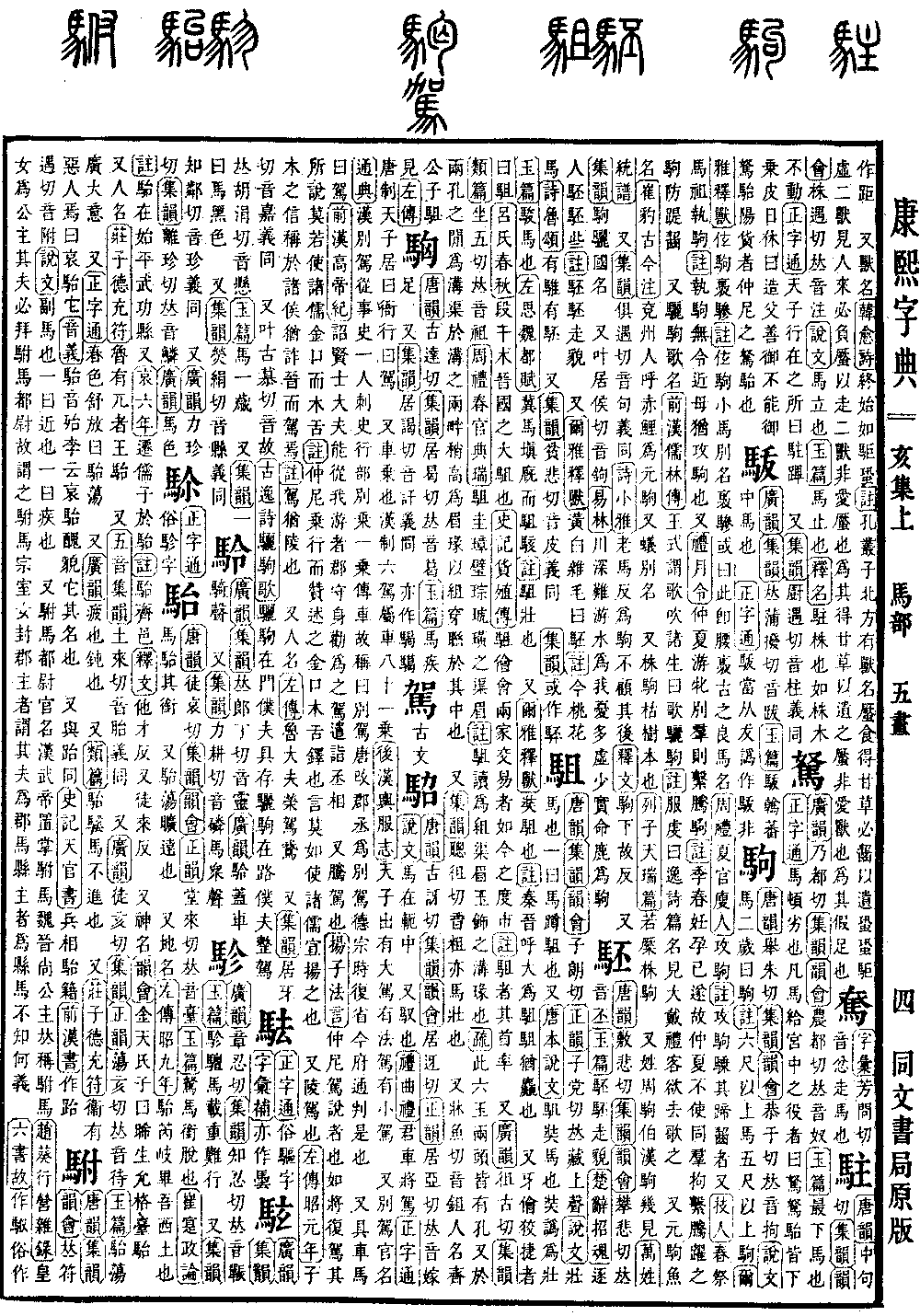
In ancient texts, according to the Tang Rhyme (Tangyun), the Collected Rhymes (Jiyun), and the Rhyme Compilation (Yunhui), the character is pronounced jia. According to the Correct Meaning Penetration (Zhengzitong), it is pronounced jia. According to the Shuowen Jiezi, it refers to a horse in a yoke. It also refers to driving or controlling a carriage. In the Book of Rites (Liji), it is written: The ruler's carriage is about to be harnessed. According to the Correct Meaning Penetration, under the Tang system, when the emperor resided, it was called ya, and when traveling, it was called jia. It also refers to a carriage or vehicle. Under the Han system, the imperial retinue consisted of eighty-one carriages. According to the History of the Later Han: Records of Carriages and Clothing (Houhan Shu, Yufu Zhi), when the emperor went out, there were grand processions, formal processions, and minor processions. It also refers to the Biejia, an official title. According to the Comprehensive Institutions (Tongdian), under the Han, a Biejia was an assistant who traveled in a separate carriage when the inspector toured his district, hence the name Biejia. During the Tang, the position of county vice-prefect was renamed Biejia; it was later abolished during the reign of Emperor Dezong, and is equivalent to the modern post of vice-prefect in a prefecture. It also refers to preparing a carriage and horses. According to the Book of Han: Annals of Emperor Gao (Qianhan Shu, Gaoji), a decree was issued stating that worthy scholars who could follow the emperor should be provided with carriages by the commandery governors and sent to the chancellor. It also refers to promoting or driving forward. According to Yang Xiong’s Model Sayings (Fayan), Confucius was one who drove his doctrines forward. If one were to drive forward his teachings again, it would be better to have the scholars act as bells with metal tongues and wooden clappers. The commentary explains that Confucius rode and propagated his teachings; the metal tongue and wooden clapper refer to a hand bell, implying that it is better to have scholars proclaim his words. It also refers to overriding or dominating. According to the Zuo Commentary (Zuozhuan), in the first year of Duke Zhao, the trustworthiness of Zimu was praised by the feudal lords, yet he deceived the Jin state and dominated them. The commentary notes that to dominate is to override. It is also used in personal names; the Zuo Commentary mentions Rong Jia'e, an official of the state of Lu. According to the Collected Rhymes, it is also pronounced jia with the same meaning. It is also read as gu, rhyming with the word mu. In the Ancient Lost Poems (Guyishi), the Liji Song states: The black colts are at the gate, the attendants are all present. The black colts are on the road, the attendants are ready with the carriage.