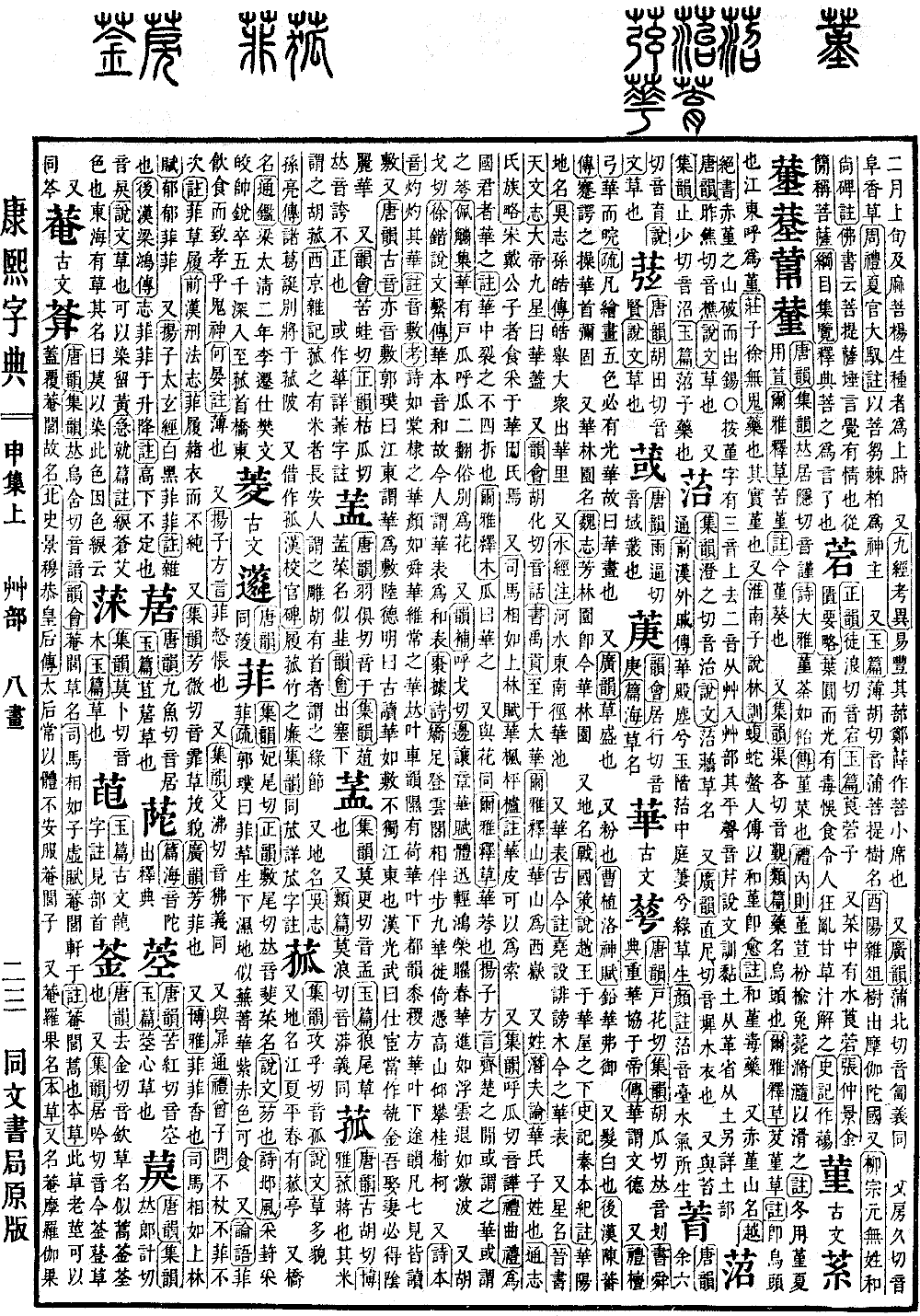
Shen Collection, Upper Volume
Radical: Grass (cǎo)
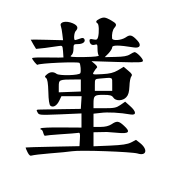
菫
Kangxi stroke count: 14
Page 1039, Entry 02
Ancient form
Tang Rhymes (Tangyun) and Collected Rhymes (Jiyun) state it is pronounced jin (rising tone).
Book of Odes (Shijing), Great Odes (Daya): The violet and bitter thistle are like maltose.
Commentary: The violet is a vegetable.
Book of Rites (Liji), Inner Chapters (Neize): Violet, yellow daylily, elm bark, and leaves are used to make soups smooth.
Note: Use violet in winter and yellow daylily in summer.
Approaching Elegance (Erya), Explanation of Grasses: Bitter violet.
Note: It is the modern violet mallow.
Also, Collected Rhymes (Jiyun) states it is pronounced jin (falling tone).
Classified Anthology (Leipian): Name of a medicinal herb, same as monkshood.
Approaching Elegance (Erya), Explanation of Grasses: Ji-violet herb.
Note: It is monkshood; people in the Jiangdong region call it violet.
Zhuangzi, Xu Wugui: It is a medicine, but in reality, it is monkshood.
Also, Huainanzi, Forest of Sayings (Shuolin Xun): When a viper bites a person, apply mixed monkshood to heal it.
Note: Mixed monkshood is a poisonous medicine.
Also, Chi-Jin (Red Violet), name of a mountain.
Annals of Yue (Yuejueshu): The mountain of Chi-Jin was broken to extract tin.
Note: The character jin has three pronunciations. The rising and falling tones belong to the Grass radical and are placed under the Grass radical. The level tone is pronounced qin. The Analytical Dictionary of Characters (Shuowen Jiezi) defines it as clay, with the radical for leather abbreviated, combined with the radical for earth. See the Earth radical for further details.
Analytical Dictionary of Characters (Shuowen Jiezi): Jin is clay. 菫 is the common variant of 堇.