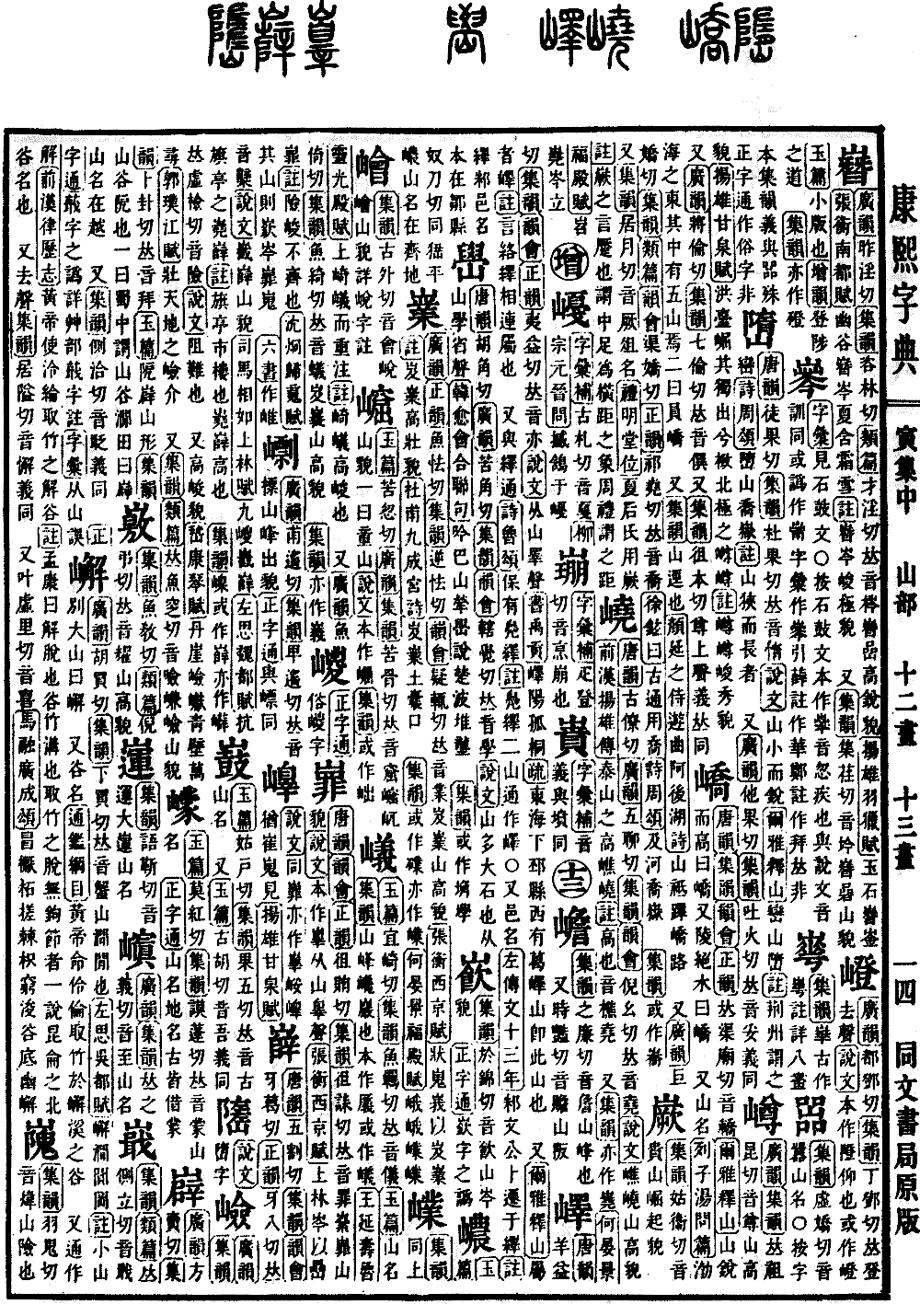
Yin Collection, Middle Volume
Radical: Mountain (shān)
Jiao (falling tone)
Kangxi stroke count: 15
Page 320, Entry 02
Tang Rhyme (Tangyun), Collected Rhymes (Jiyun), Dictionary of Rhymes (Yunhui), Correct Rhymes (Zhengyun): Pronounced jiao (falling tone).
Erya, Explanations of Mountains (Erya, Shishan): A mountain that is sharp and high is called jiao.
Collected Rhymes (Jiyun): Also means a precipitous rock rising above water.
Also a mountain name.
Liezi, Questions of Tang (Liezi, Tangwen pian): East of the Bohai Sea, there are five mountains, the second of which is named Yuanjiao.
Also, Collected Rhymes (Jiyun): A mountain path.
Yan Yanzhi, Poem Written While Attending an Excursion to the Rear Lake at Qu'e (Yan Yanzhi, Shiyou Qu'e houhu shi): The mountain god clears the mountain path.
Also, Extensive Rhymes (Guangyun): Pronounced jiao (level tone); Collected Rhymes (Jiyun), Classified Anthology (Leipian), Dictionary of Rhymes (Yunhui): Pronounced jiao (level tone); Correct Rhymes (Zhengyun): Pronounced qiao (level tone).
Xu Xuan states: In ancient times, it was used interchangeably with qiao.
Book of Odes, Odes of Zhou (Shijing, Zhousong): Reaching the high mountains of the river.
Collected Rhymes (Jiyun): Sometimes written in a variant form.
Textual research: Erya, Explanations of Mountains states: A mountain that is sharp and high is called jiao. Per the original text, the word is omitted. Also, a precipitous rock rising above water is called jiao. According to the Erya, this text does not exist; corrected according to the original text of the Jiyun to read: Collected Rhymes states it is a precipitous rock rising above water.