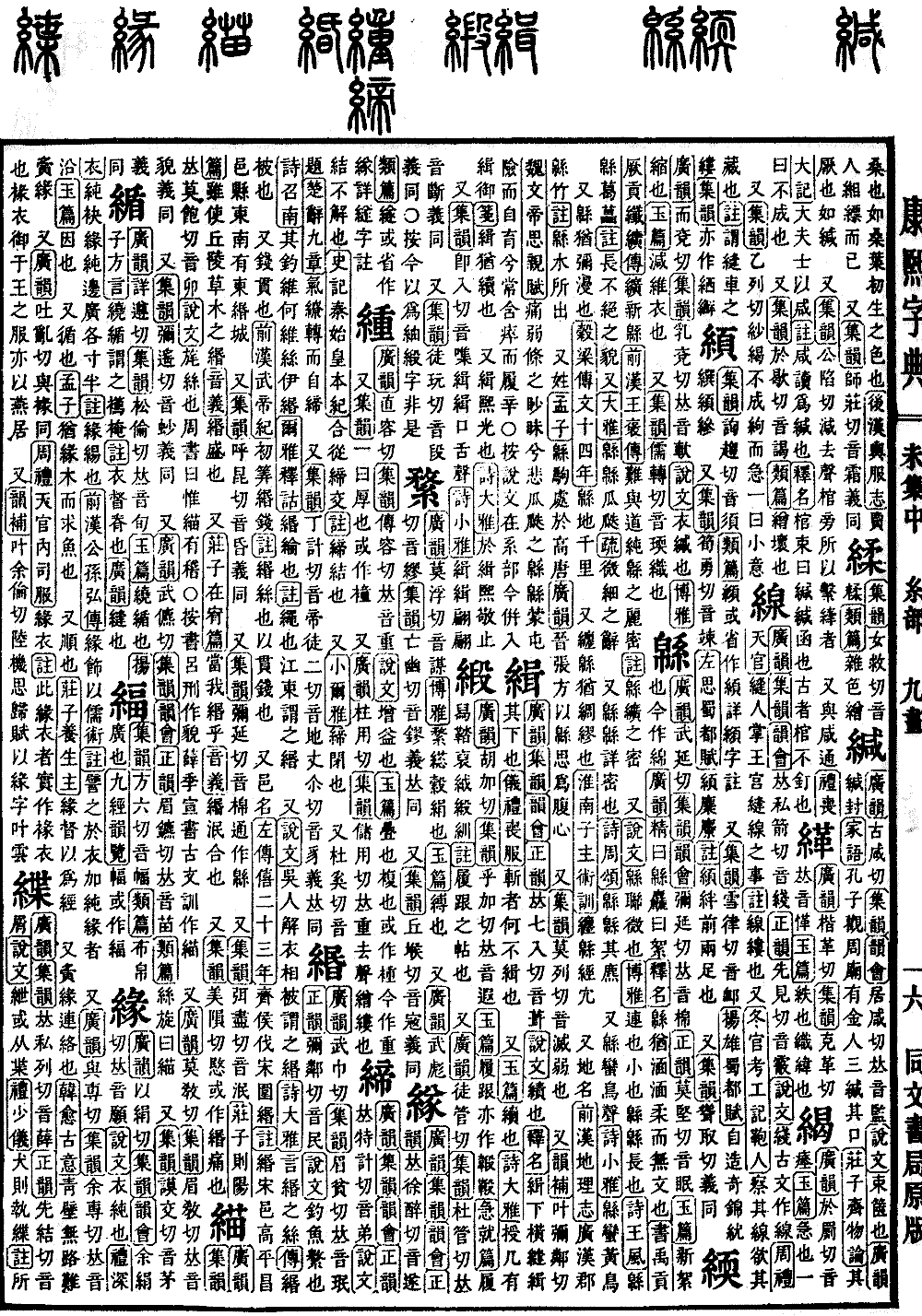
Wei Collection, Middle Volume
Radical: Silk (mì)
緘
Kangxi strokes: 15
Page 930, Entry 02
Pronounced jian
As defined in the Shuowen Jiezi (Shuowen), it refers to binding a box.
According to the Guangyun, it means to seal or close.
In the School Sayings of Confucius (Kongzi Jiayu), it is written: Confucius visited the Zhou ancestral temple and saw a metal statue with its mouth sealed three times.
In the Zhuangzi, under the section on the Uniformity of All Things (Qiwulun), it is written: Its state of stillness is like being sealed.
Also, according to the Jiyun, pronounced jian (falling tone). It refers to the ropes used to bind the sides of a coffin.
It is also used interchangeably with the character xian.
In the Book of Rites (Liji), specifically the section on the Greater Record of Mourning (Sang Daji), it mentions the use of xian for officials and scholars.
The commentary states that xian should be read as jian.
According to the Explanation of Names (Shiming), a binding on a coffin is called jian. Jian means to enclose or contain; in ancient times, coffins were not nailed shut.