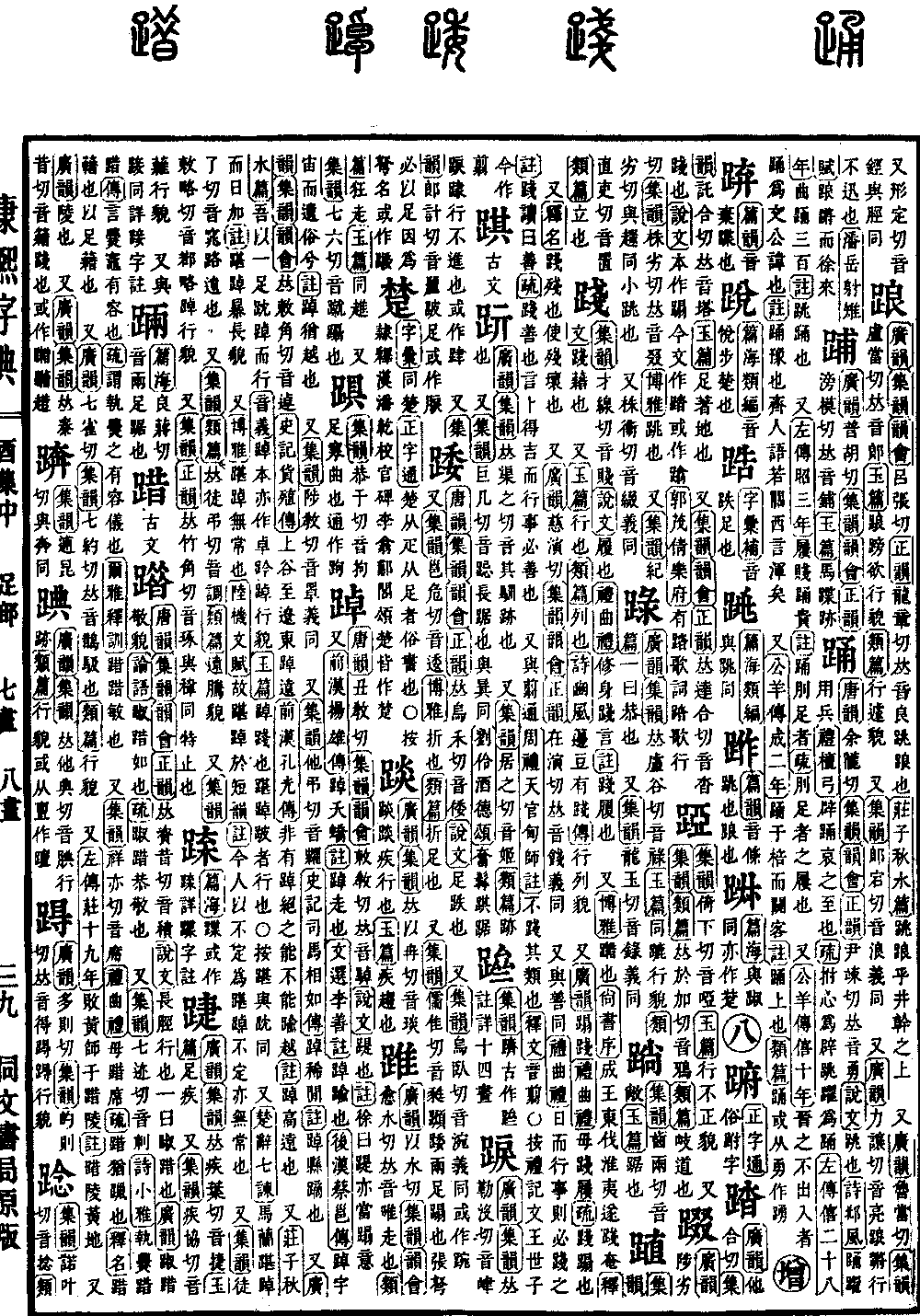
You Collection, Middle Volume
Radical: Foot (zú)
Page 1227, Entry 31
Historical records: Tang Rhyme (Tangyun), Collection of Rhymes (Jiyun), Rhyme Compilation (Yunhui), and Correct Rhymes (Zhengyun) all state it is pronounced ji. Explanation of Writing and Analysis of Characters (Shuowen Jiezi) defines it as the appearance of taking long strides while walking. Another interpretation describes the appearance of being respectful and uneasy. Broad Rhymes (Guangyun) defines the term cuji as a respectful appearance. The Analects of Confucius (Lunyu) records the phrase cuji ruye. The Commentary (Shu) explains: Cuji means respect.
Also, Collection of Rhymes (Jiyun) states it is pronounced ci. The Book of Odes (Shijing), Minor Odes, contains the phrase zhi cuan jiji. The Commentary (Zhuan) explains: This describes a proper and decorous demeanor when cooking at a stove. The Commentary (Shu) further explains: This describes the dignified manner of someone in charge of cooking. The Approaches to Interpretation (Erya) defines jiji as the appearance of being agile and diligent.
Also, Collection of Rhymes (Jiyun) states it is pronounced xi. The Book of Rites (Liji), Songs of Propriety (Quli), contains the regulation: Do not jixi (step on) the mat. The Commentary (Shu) explains: Ji means to step over or trample. The Explanation of Names (Shiming) explains: Ji means to trample or rely upon. It means using the feet to tread.
Also, Broad Rhymes (Guangyun) and Collection of Rhymes (Jiyun) state it is pronounced que. It means the appearance of a horse galloping. Classified Compilation (Leipian) defines it as the appearance of walking.
Also, Zuo Tradition (Zuozhuan), 19th year of Duke Zhuang, records: Defeated the Huang army at Jiling. The Commentary (Zhu) explains: Jiling is a place in the State of Huang.
Also, Broad Rhymes (Guangyun) defines it as bullying or oppressing.
Also, Broad Rhymes (Guangyun) and Collection of Rhymes (Jiyun) state it is pronounced ji. It means to trample. Sometimes also written in a variant form (zhuan) or a variant form (que).