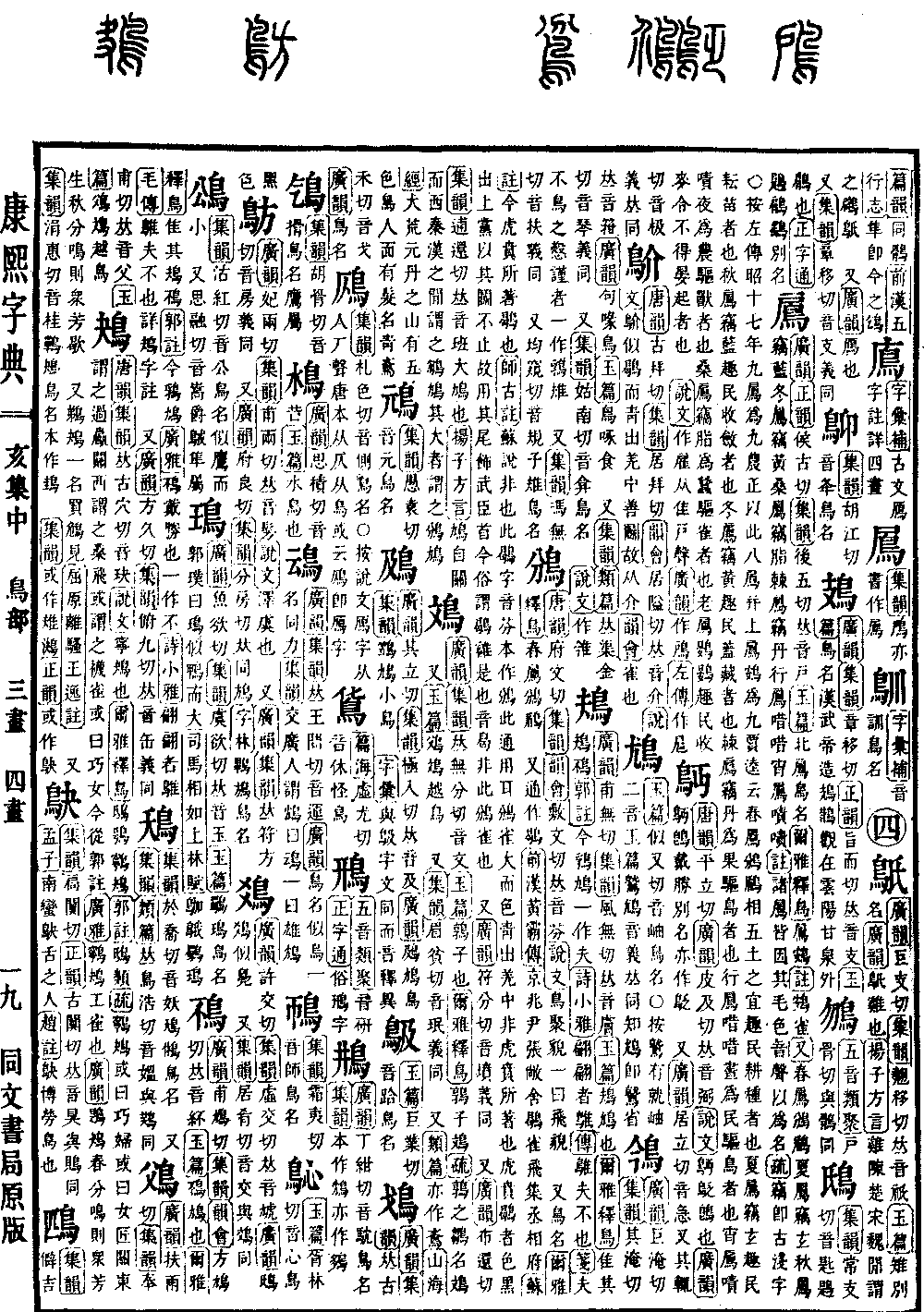
Hai Collection, Middle Volume
Radical: Bird (niǎo)
Kangxi Strokes: 15
Page 1483, Entry 09
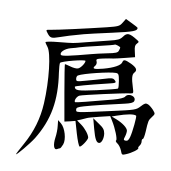
Pronounced hù.
According to the Yupian, the northern hù is the name of a bird.
According to the Erya, a dictionary of classical Chinese (Erya), the hù is the quail. The commentary notes that it is a type of small sparrow.
Furthermore, spring hù is called fēnchūn, summer hù is called qiè, autumn hù is called qièlán, winter hù is called qièhuáng, mulberry hù is called qièzhī, jujube hù is called qièdān, traveling hù is called jiéjié, and night hù is called zézé. The commentary notes that these hù are all named based on their feather colors and calls. The sub-commentary states that qiè is the ancient word for light or shallow.
According to the Zuo Commentary (Zuozhuan), the nine hù refer to nine agricultural officials. Eight types are listed here, which, when added to the previously mentioned quail hù, make a total of nine. Jia Kui explains: the spring hù, fēnchūn, is responsible for examining soil suitability and urging people to plow; the summer hù, qiè, urges people to weed the crops; the autumn hù, qièlán, urges people to harvest the grain; the winter hù, qièhuáng, urges people to store grain; the jujube hù, qièdān, drives birds away from fruit trees; the traveling hù, jiéjié, drives birds away during the day; the night hù, zézé, drives away wild beasts from the fields at night; the mulberry hù, qièzhī, drives sparrows away from silkworms; the old hù, yànyàn, urges people to harvest wheat and prevents them from sleeping in.
In the Explaining Graphs and Analyzing Characters (Shuowen Jiezi), it is written as a variant form (gù). The character structure is composed of the bird radical and the sound component hù.
In the Broad Rhymes (Guangyun), it is written in a variant form.
In the Zuo Commentary (Zuozhuan), it is written as hù.