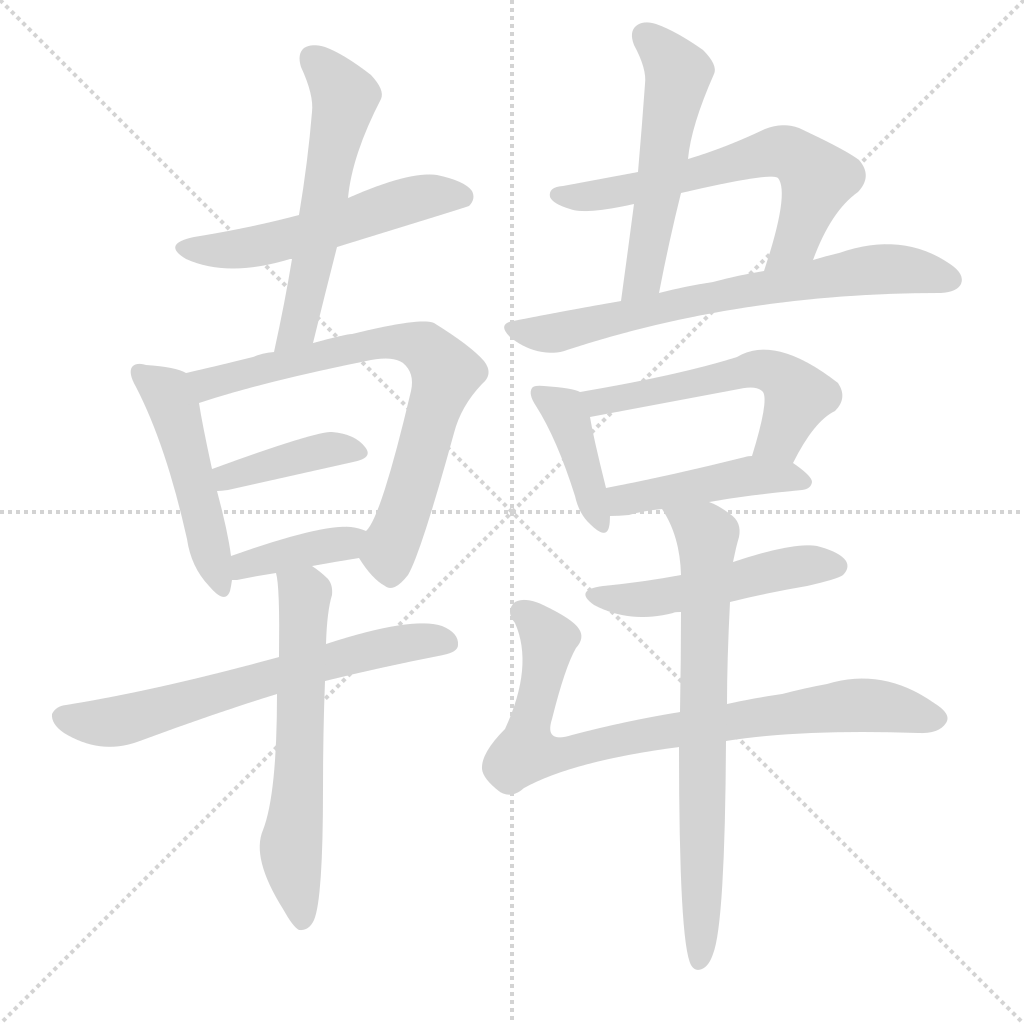
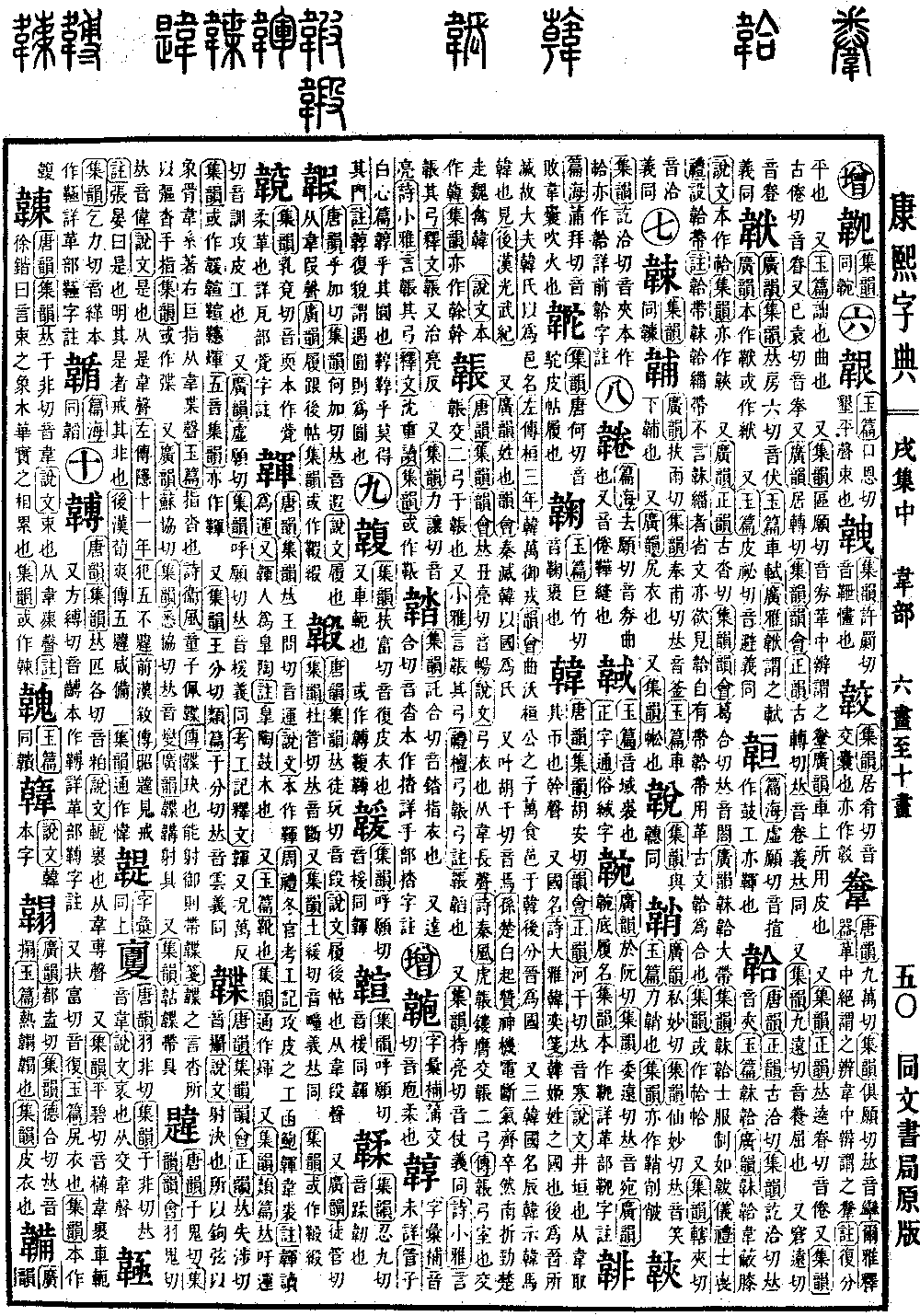
Xu Collection, Middle Volume
Radical: Leather (wéi)
Kangxi strokes: 17
Page 1394, Entry 20
Pronounced han.
Explaining the meaning based on the Explaining Graphs and Analyzing Characters (Shuowen Jiezi): The wall surrounding a well. The character form uses Leather as the radical, indicating the meaning of encircling; it uses Dry as the phonetic component.
Also refers to the name of a feudal state. In the Notes (Jian) to the Great Odes (Daya) of the Book of Odes (Shijing): Han was a feudal state with the surname Ji, which was later annexed by the state of Jin, and therefore the grandmasters of the Han clan took their former state name as their fief name. In the Zuo Tradition (Zuo Zhuan), under the third year of Duke Huan: Han Wan served in the position of chariot attendant. In the Collection of Rhymes (Yunhui): The son of Duke Huan of Quwo was named Wan, who was enfeoffed in Han; later, the Han family partitioned the state of Jin and established the state of Han.
Also refers to the Three Han, which were three tribal states on the ancient Korean peninsula: Chenhan, Bianhan, and Mahan. Recorded in the History of the Later Han (Hou Hanshu), Biography of the Eastern Barbarians (Dongyi Zhuan).
Also recorded in the Broad Rhymes (Guangyun) as a surname. According to the Collection of Rhymes (Yunhui): After the state of Qin destroyed the state of Han, its people took their former state name as their surname.
Also pronounced yan (level tone). In Sun Chu’s Eulogy for Bai Qi: His brilliant strategies and swift decisions were like lightning, his imposing spirit launched attacks abruptly, facing south he defeated the powerful state of Chu, crushed the state of Wei, and captured and destroyed the state of Han.
The original character in the Explaining Graphs and Analyzing Characters (Shuowen Jiezi) is written as the variant form. According to the Collection of Rhymes (Jiyun), it is also written as the variant forms gan or gan.
Textual research: Regarding the Three Han, the names of the states include Chenhan, Bianhan, and Mahan. This is seen in the History of the Later Han (Hou Hanshu), Biography of the Eastern Barbarians (Dongyi Zhuan). Note: Bianhan was previously listed incorrectly; it has been corrected to Bianhan based on the Biography of the Eastern Barbarians, and the reference has been updated from the Annals of Emperor Guangwu to the Biography of the Eastern Barbarians.