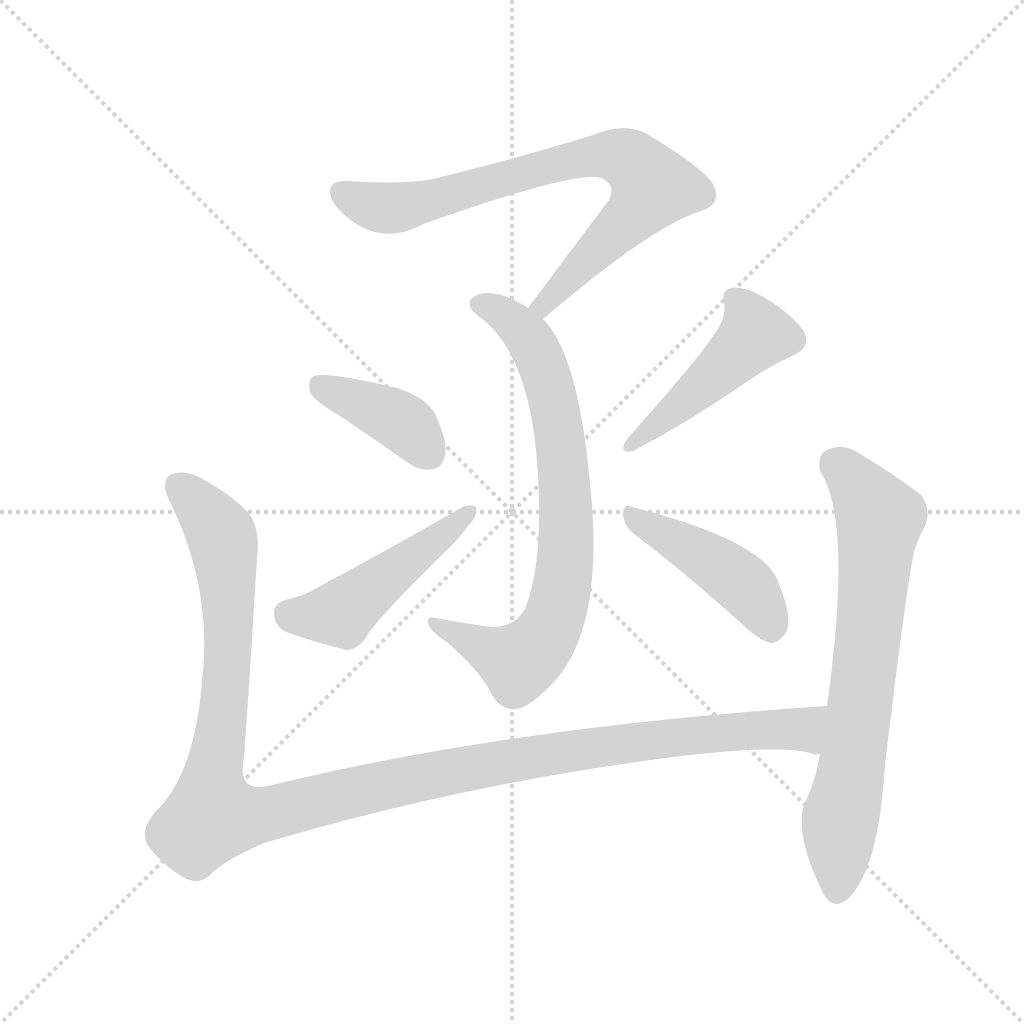
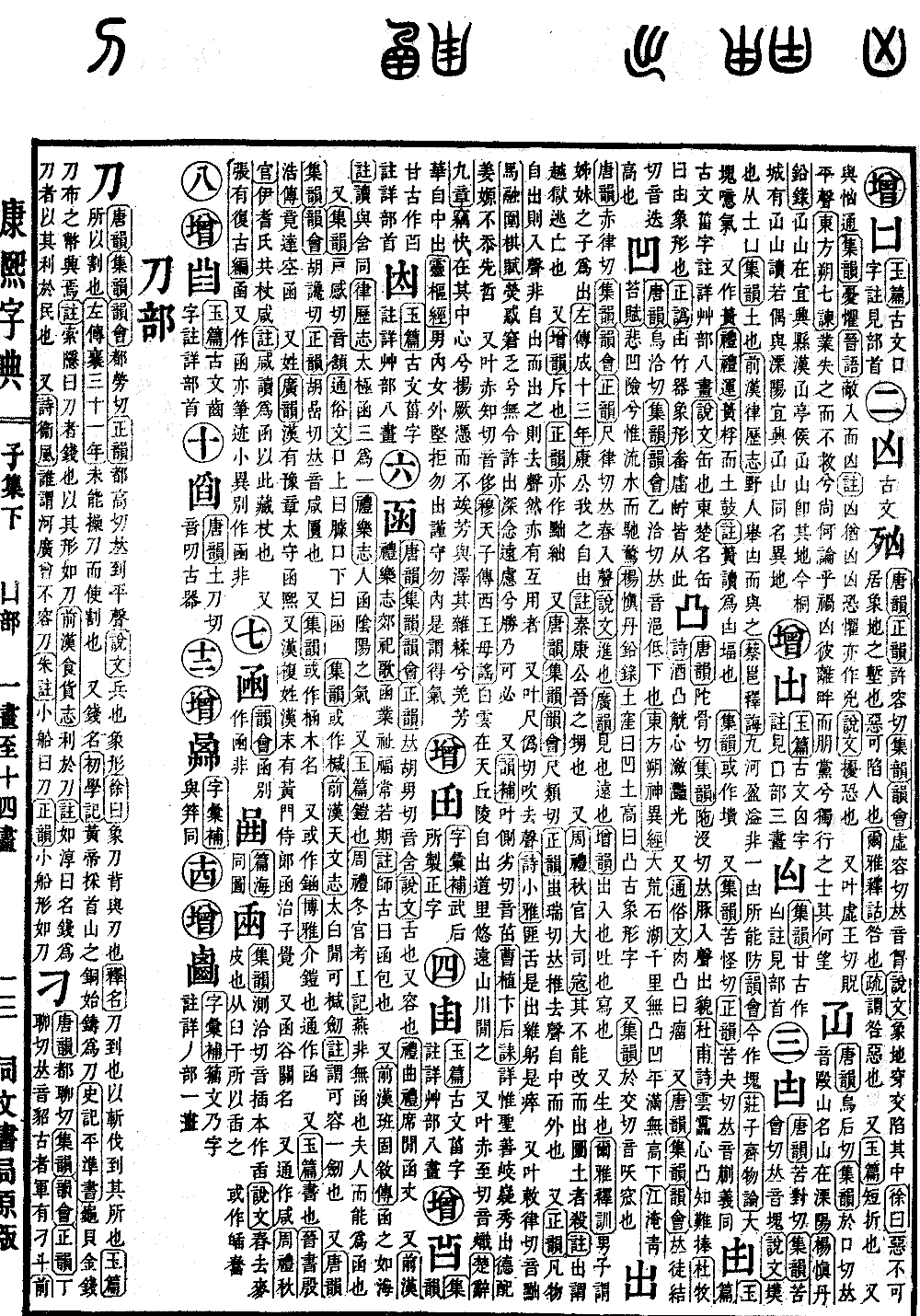
Zi Collection, Page Position: Lower. Radical: Open Container (kǎn). Kangxi stroke count: 8. Page number: 135, item 16.
Pronounced han.
As defined in the Analytical Dictionary of Characters (Shuowen Jiezi), it refers to the tongue, and also means to contain or encompass. In the Book of Rites (Liji), it says, "Between the mats, there is a space of one zhang (a unit of measure)."
Also, in the Book of Han (Hanshu), specifically the Treatises on Ritual and Music (Liyue Zhi) in the section on suburban sacrifices: "Encompassing and receiving blessings as if there were a fixed time." The commentary by Yan Shigu states: "Han means to contain or include."
Also, in the Book of Han, in the Preface by Ban Gu: "Contained within it like the sea." The commentary notes that the pronunciation is the same as han. In the Treatise on Harmonics and Calendars (Lüli Zhi), it states: "The Great Ultimate contains the three as one." In the Book of Rites, in the Record of Music (Yueji), it says: "Man contains the vital breath of yin and yang."
Also, in the Jade Chapters (Yupian), it refers to armor. In the Rites of Zhou (Zhouli), specifically the Winter Official, Records of Artificers (Kaogongji), it discusses that the land of Yan was not without armored men, but rather that everyone was capable of making armor.
Also, pronounced han. According to the Common Words (Tongsuxu), the part above the mouth is called the ju (palate), and the part below the mouth is called the han (jaw). According to the Jiyun, it is sometimes written as jian. In the Book of Han, in the Treatise on Astrology (Tianwen Zhi), it mentions: "Venus can contain a sword." The commentary notes that this refers to being able to hold one sword.
Also, pronounced xian. Refers to a box or chest.
Also, according to the Jiyun, it is sometimes written as a character denoting a type of tree.
Also, sometimes written as a variant form. According to the Guangya, it refers to armor, which is commonly written as han.
Also, according to the Jade Chapters, it means a letter or epistle. In the Book of Jin (Jinshu), the biography of Yin Hao states: "It finally arrived as an empty letter."
Also, a surname. According to the Guangyun, there was a Han Xi who served as the Grand Administrator of Yuzhang during the Han Dynasty.
Also, it exists as a compound surname. At the end of the Han Dynasty, there was a Palace Attendant named Han Zhizi Jue.
Also, Hangu, the name of a mountain pass.
Also, it is used interchangeably with the character xian. In the Rites of Zhou, in the Office of Autumn (Qiuguan), it states: "The Yiqi clan provided the staves and the xian." The commentary notes that xian is read as han, referring to a vessel used to store staves.
Also, according to Zhang You's Compilation of Restored Ancient Characters (Fugu Bian), the character han is also written as han, with only a slight difference in handwriting. The variant form written as han is incorrect.
Correction: In the reference to the Book of Han, Treatises on Ritual and Music, regarding the suburban sacrifice songs, the original text "han ye" has been corrected to "han meng" based on the standard text.