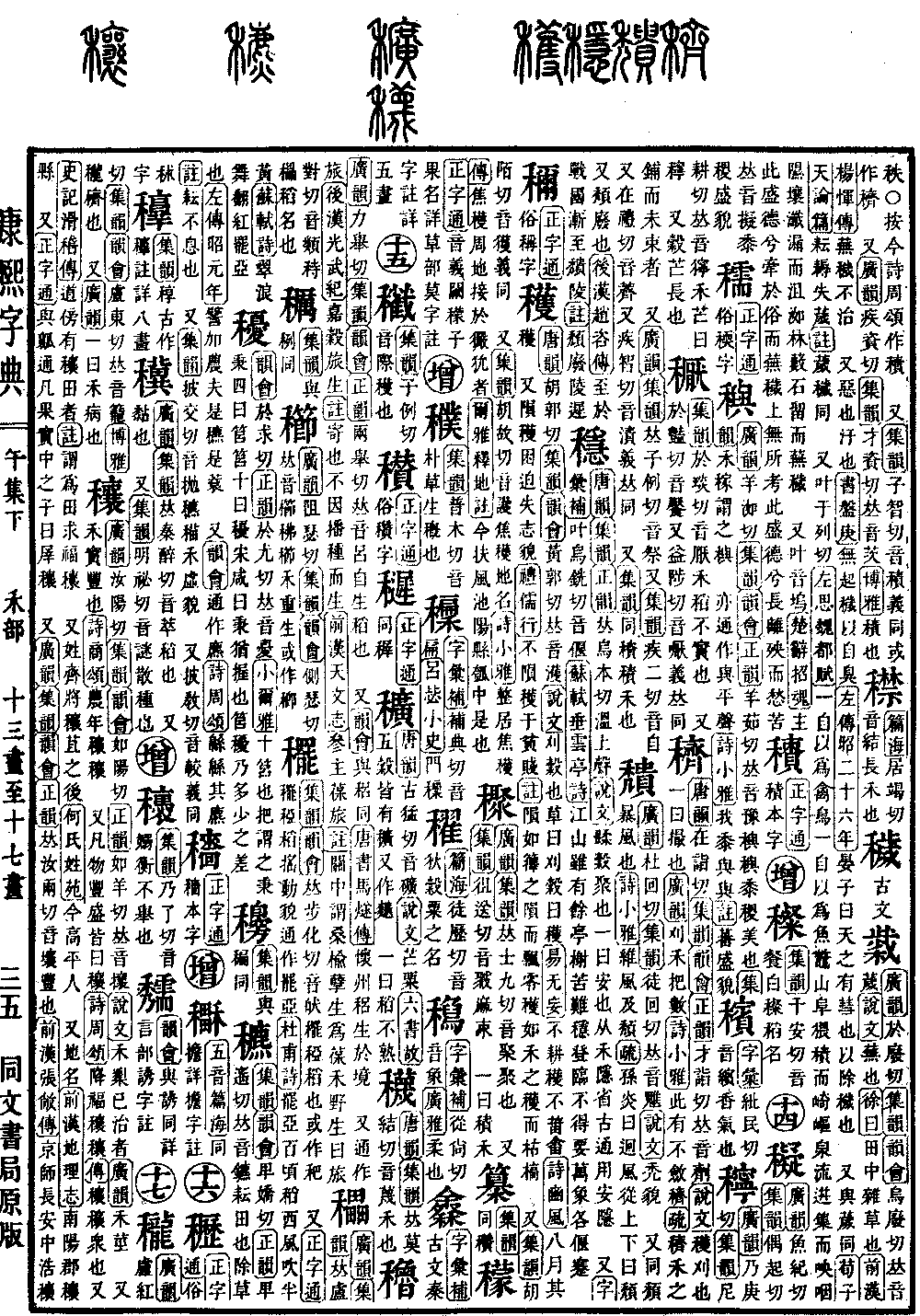
Wu Collection, Lower Volume
Radical: Grain (hé)
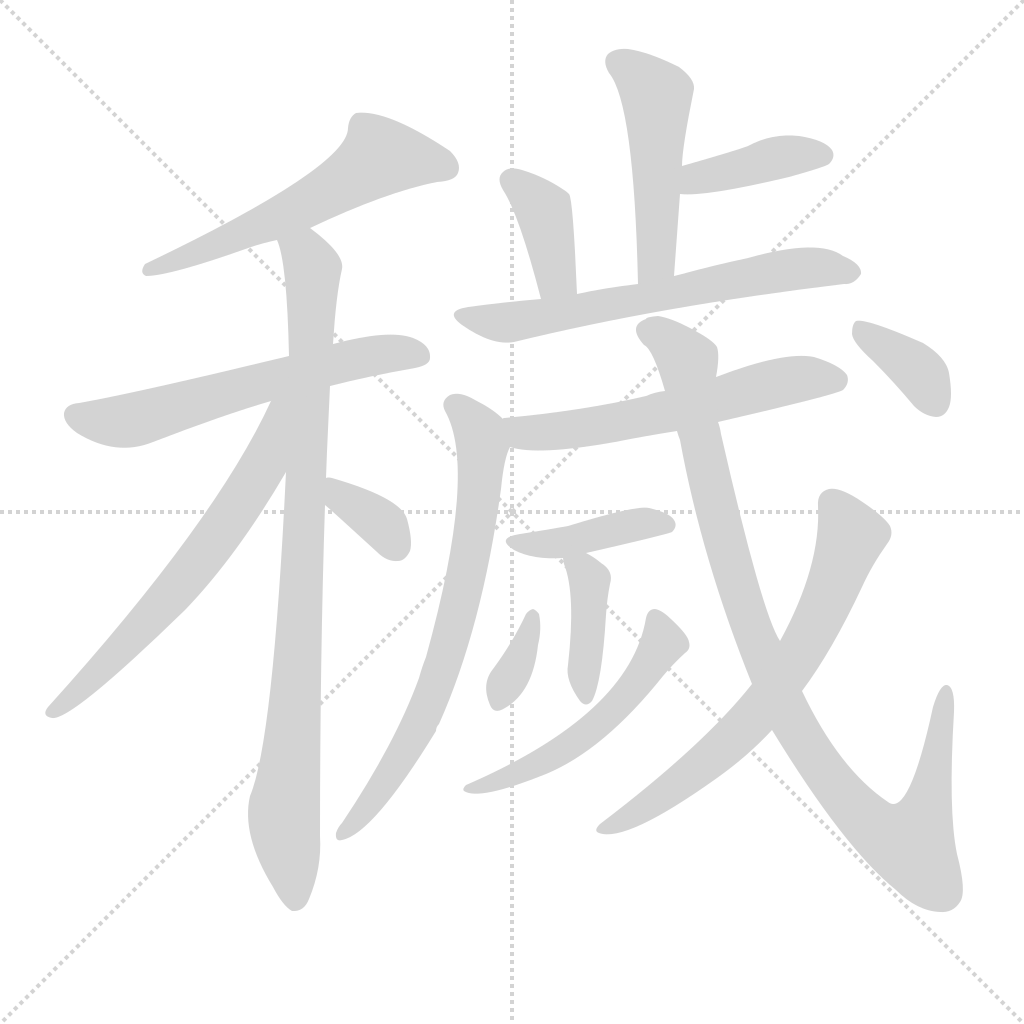
秽
Kangxi strokes: 18
Page 861, Entry 02
Ancient form.
Pronounced hui (falling tone).
According to the Explaining Graphs and Analyzing Characters (Shuowen Jiezi), it refers to weeds. According to Xu, it refers to miscellaneous grasses in a field. In the Biography of Yang Yun from the History of the Former Han (Qian Han Shu), it says: to have neglected the fields so they are overgrown with weeds. It also means evil or filthy. In the Book of Documents (Shujing), specifically the Pan Geng chapter, it says: do not stir up filth to make oneself smell foul. In the Zuo Tradition (Zuozhuan), during the twenty-sixth year of Duke Zhao, Yanzi said: the appearance of a comet in the sky is to clear away filth.
It is also used interchangeably with the character for weeds (hui). In the Xunzi, within the Heaven Discussion chapter, it says: if weeding and hoeing are neglected, weeds will grow. The commentary notes that both characters share the same meaning.
It also rhymes with lie (falling tone). In Zuo Si's Rhapsody on the Wei Capital (Wei Du Fu), it says: one thinks oneself a bird, another thinks oneself a fish or a turtle. Mountains and mounds are piled up in rugged terrain, springs flow and gather with a gurgling sound. Lowlands and soil are damp and leaking, forests and marshes are overgrown with weeds.
It also rhymes with the sound wu. In the Songs of Chu (Chuci), specifically the Summoning of the Soul (Zhao Hun) section, it says: in charge of this noble virtue, yet constrained by worldly customs and overgrown with weeds. With no one to investigate this noble virtue above, one remains long in misfortune and suffering.